
SEBA Class 10 Maths Chapter 3 Exercise 3.2 Solutions – Linear Equations in Two Variables
By Jamal Ali (M.Sc Physics, 5+ years teaching experience) · Reviewed by Editorial Board
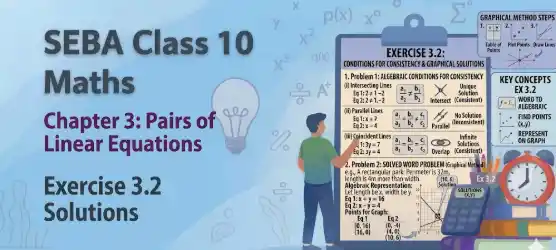
SEBA Class 10 Maths Chapter 3 Exercise 3.2 Solutions focuses mainly on solving pair of linear equations using the substituion method. As per the latest ASSEB Division 1 syllabus (March 2026), this exercise is important for understanding systematic algebraic techniques along with application-based word problems.
Students can strengthen their concepts by referring to complete chapter solutions and practicing regularly through chapterwise maths solutions. These help in building a clear step-by-step approach.
Practicing SEBA Class 10 Maths chapter 3 important questions exercise 3.2 along with SEBA HSLC Maths linear equations ex 3.2 solved questions improves accuracy in both MCQs and descriptive answers. Students can also revise using SEBA Class 10 Maths linear equations exercise 3.2 solutions pdf, based on the updated 2026 textbook.
SEBA Class 10 Maths Chapter 3 Exercise 3.2 Solutions with Step-by-Step Answers & Important Questions
Q1. Solve the following pair of linear equations by the substitution method.
(i) \(x + y = 14\) and \(x - y = 4\)
Answer:
Given:
\[
x + y = 14 \quad ...(1)
\]
\[
x - y = 4 \quad ...(2)
\]
From (2),
\[
x = y + 4 \quad ...(3)
\]
Substituting the value of x from (3) in (1), we get:
\[
(y + 4) + y = 14
\]
\[
2y + 4 = 14
\]
\[
2y = 10 \Rightarrow y = 5
\]
Now substituting the value of y in (3), we get:
\[
x = 5 + 4 = 9
\]
Therefore, \(x = 9,\; y = 5\)
(ii) \(5 - x = 3\) and \( \frac{5}{3} + \frac{x}{2} = 6\)
Answer:
Given:
\[
5 - x = 3 \quad ...(1)
\]
\[
\frac{5}{3} + \frac{x}{2} = 6 \quad ...(2)
\]
From (1),
\[
x = 2 \quad ...(3)
\]
Substituting the value of x in (2), we get:
\[
\frac{5}{3} + \frac{2}{2} = 6
\]
\[
\frac{5}{3} + 1 = \frac{8}{3} \ne 6
\]
Since both equations are not satisfied together,
Therefore, the system has no solution.
(iii) \(3x - y = 3\) and \(9x - 3y = 9\)
Answer:
Given:
\[
3x - y = 3 \quad ...(1)
\]
\[
9x - 3y = 9 \quad ...(2)
\]
From (1),
\[
y = 3x - 3 \quad ...(3)
\]
Substituting the value of y from (3) in (2), we get:
\[
9x - 3(3x - 3) = 9
\]
\[
9x - 9x + 9 = 9
\]
\[
9 = 9
\]
This is true for all values of x.
Therefore, the system has infinitely many solutions.
(iv) \(0.2x + 0.3y = 1.3\) and \(0.4x + 0.5y = 2.3\)
Answer:
Given:
\[
0.2x + 0.3y = 1.3 \quad ...(1)
\]
\[
0.4x + 0.5y = 2.3 \quad ...(2)
\]
Multiplying both equations by 10, we get:
\[
2x + 3y = 13 \quad ...(1)
\]
\[
4x + 5y = 23 \quad ...(2)
\]
From (1),
\[
2x = 13 - 3y
\Rightarrow x = \frac{13 - 3y}{2} \quad ...(3)
\]
Substituting the value of x from (3) in (2), we get:
\[
4\left(\frac{13 - 3y}{2}\right) + 5y = 23
\]
\[
2(13 - 3y) + 5y = 23
\]
\[
26 - 6y + 5y = 23
\]
\[
26 - y = 23
\Rightarrow y = 3
\]
Now substituting the value of y in (3), we get:
\[
x = \frac{13 - 9}{2} = 2
\]
Therefore, \(x = 2,\; y = 3\)
(v) \(\sqrt{2}x + \sqrt{3}y = 0\) and \(\sqrt{3}x - \sqrt{8}y = 0\)
Answer:
Given:
\[
\sqrt{2}x + \sqrt{3}y = 0 \quad ...(1)
\]
\[
\sqrt{3}x - \sqrt{8}y = 0 \quad ...(2)
\]
From (1),
\[
\sqrt{2}x = -\sqrt{3}y
\Rightarrow x = -\frac{\sqrt{3}}{\sqrt{2}}y \quad ...(3)
\]
Substituting the value of x from (3) in (2), we get:
\[
\sqrt{3}\left(-\frac{\sqrt{3}}{\sqrt{2}}y\right) - \sqrt{8}y = 0
\]
\[
-\frac{3}{\sqrt{2}}y - 2\sqrt{2}y = 0
\]
Taking LCM and simplifying, we get:
\[
y = 0
\]
Now substituting the value of y in (3), we get:
\[
x = 0
\]
Therefore, \(x = 0,\; y = 0\)
(vi) \( \frac{3x}{2} - \frac{5y}{3} = -2\) and \( \frac{x}{3} + \frac{y}{2} = \frac{13}{6}\)
Answer:
Given:
\[
\frac{3x}{2} - \frac{5y}{3} = -2 \quad ...(1)
\]
\[
\frac{x}{3} + \frac{y}{2} = \frac{13}{6} \quad ...(2)
\]
Multiplying both equations by 6, we get:
\[
9x - 10y = -12 \quad ...(1)
\]
\[
2x + 3y = 13 \quad ...(2)
\]
From (2),
\[
2x = 13 - 3y
\Rightarrow x = \frac{13 - 3y}{2} \quad ...(3)
\]
Substituting the value of x from (3) in (1), we get:
\[
9\left(\frac{13 - 3y}{2}\right) - 10y = -12
\]
\[
\frac{117 - 27y}{2} - 10y = -12
\]
\[
117 - 27y - 20y = -24
\]
\[
117 - 47y = -24
\Rightarrow y = 3
\]
Now substituting the value of y in (3), we get:
\[
x = \frac{13 - 9}{2} = 2
\]
Therefore, \(x = 2,\; y = 3\)
Q2. Solve \(2x + 3y = 11\) and \(2x - 4y = -24\) and hence find the value of ‘m’ for which \(y = mx + 3\).
Answer:
Given:
\[
2x + 3y = 11 \quad ...(1)
\]
\[
2x - 4y = -24 \quad ...(2)
\]
From (1),
\[
2x = 11 - 3y
\Rightarrow x = \frac{11 - 3y}{2} \quad ...(3)
\]
Substituting the value of x from (3) in (2), we get:
\[
2\left(\frac{11 - 3y}{2}\right) - 4y = -24
\]
\[
11 - 3y - 4y = -24
\]
\[
11 - 7y = -24
\Rightarrow -7y = -35
\Rightarrow y = 5
\]
Now substituting the value of y in (3), we get:
\[
x = \frac{11 - 15}{2} = -2
\]
Now given:
\[
y = mx + 3
\]
Substitute values:
\[
5 = m(-2) + 3
\]
\[
5 = -2m + 3
\Rightarrow -2m = 2
\Rightarrow m = -1
\]
Therefore, \(x = -2,\; y = 5\) and \(m = -1\)
Q3. Form the pair of linear equations for the following problems and find their solution by substitution method.
(i) The difference between two numbers is 26 and one number is three times the other. Find them.
Answer:
Let the two numbers be x and y.
Given:
\[
x - y = 26 \quad ...(1)
\]
One number is three times the other:
\[
x = 3y \quad ...(2)
\]
Substituting (2) in (1), we get:
\[
3y - y = 26
\]
\[
2y = 26
\Rightarrow y = 13
\]
Now from (2):
\[
x = 3 \times 13 = 39
\]
Therefore, the numbers are 39 and 13.
(ii) The larger of two supplementary angles exceeds the smaller by 18°. Find them.
Answer:
Let thee smaller angle be x and larger angle be y.
Since angles are supplementary:
\[
x + y = 180 \quad ...(1)
\]
Given:
\[
y = x + 18 \quad ...(2)
\]
Substituting (2) in (1), we get:
\[
x + (x + 18) = 180
\]
\[
2x + 18 = 180
\]
\[
2x = 162 \Rightarrow x = 81
\]
Now from (2):
\[
y = 81 + 18 = 99
\]
Therefore, the angles are 81° and 99°.
(iii) The coach of a cricket team buys 7 bats and 6 balls for Rs 3800. Later, he buys 3 bats and 5 balls for Rs 1750. Find the cost of each bat and ball.
Answer:
Let cost of one bat be x and cost of one ball be y.
\[
7x + 6y = 3800 \quad ...(1)
\]
\[
3x + 5y = 1750 \quad ...(2)
\]
From (2),
\[
3x = 1750 - 5y
\Rightarrow x = \frac{1750 - 5y}{3} \quad ...(3)
\]
Substituting (3) in (1), we get:
\[
7\left(\frac{1750 - 5y}{3}\right) + 6y = 3800
\]
\[
\frac{12250 - 35y}{3} + 6y = 3800
\]
\[
12250 - 35y + 18y = 11400
\]
\[
12250 - 17y = 11400
\Rightarrow 17y = 850
\Rightarrow y = 50
\]
Now from (3):
\[
x = \frac{1750 - 250}{3} = 500
\]
Therefore, cost of one bat = Rs 500 and one ball = Rs 50.
(iv) The taxi charges in a city consist of a fixed charge together with the charge for distance covered. For a journey of 10 km, the charge paid is Rs 105 and for 15 km, the charge paid is Rs 155. What are the fixed charges and the charge per km?
Answer:
Let fixed charge of the taxi be x and charge per km be y.
\[
x + 10y = 105 \quad ...(1)
\]
\[
x + 15y = 155 \quad ...(2)
\]
From (1),
\[
x = 105 - 10y \quad ...(3)
\]
Substituting (3) in (2), we get:
\[
105 - 10y + 15y = 155
\]
\[
105 + 5y = 155
\]
\[
5y = 50 \Rightarrow y = 10
\]
Now from (3):
\[
x = 105 - 100 = 5
\]
Therefore, fixed charge = Rs 5 and charge per km = Rs 10.
(v) A fraction becomes \( \frac{9}{11} \), if 2 is added to both the numerator and the denominator. If 3 is added to both the numerator and the denominator it becomes \( \frac{5}{6} \). Find the fraction.
Answer:
Let the numerator be x and denominator be y.
Given:
\[
\frac{x+2}{y+2} = \frac{9}{11} \quad ...(1)
\]
\[
\frac{x+3}{y+3} = \frac{5}{6} \quad ...(2)
\]
From (1):
\[
11(x+2) = 9(y+2)
\]
\[
11x + 22 = 9y + 18
\]
\[
11x - 9y = -4 \quad ...(3)
\]
From (2):
\[
6(x+3) = 5(y+3)
\]
\[
6x + 18 = 5y + 15
\]
\[
6x - 5y = -3 \quad ...(4)
\]
From (4):
\[
6x = 5y - 3
\Rightarrow x = \frac{5y - 3}{6} \quad ...(5)
\]
Substituting (5) in (3), we get:
\[
11\left(\frac{5y - 3}{6}\right) - 9y = -4
\]
\[
\frac{55y - 33}{6} - 9y = -4
\]
\[
55y - 33 - 54y = -24
\]
\[
y - 33 = -24 \Rightarrow y = 9
\]
Now from (5):
\[
x = \frac{45 - 3}{6} = 7
\]
Therefore, the fraction is \( \frac{7}{9} \).
(vi) Five years hence, the age of Jacob will be three times that of his son. Five years ago, Jacob’s age was seven times that of his son. Find their present ages.
Answer:
Let the present age of Jacob be x years and his son be y years.
Given:
\[
x + 5 = 3(y + 5) \quad ...(1)
\]
\[
x - 5 = 7(y - 5) \quad ...(2)
\]
From (1):
\[
x + 5 = 3y + 15
\]
\[
x = 3y + 10 \quad ...(3)
\]
Substituting (3) in (2), we get:
\[
3y + 10 - 5 = 7(y - 5)
\]
\[
3y + 5 = 7y - 35
\]
\[
40 = 4y \Rightarrow y = 10
\]
Now from (3):
\[
x = 3(10) + 10 = 40
\]
Therefore, Jacob’s present age is 40 years and his son’s age is 10 years.
Q4. If \(x + 3\) is a factor of \(x^3 + ax^2 - bx + 6\) and \(a + b = 7\), find the values of a and b.
Answer:
Since \(x + 3\) is a factor of the given polynomial,
by Factor Theorem, we have:
\[
(-3)^3 + a(-3)^2 - b(-3) + 6 = 0
\]
\[
-27 + 9a + 3b + 6 = 0
\]
\[
9a + 3b - 21 = 0
\Rightarrow 3a + b = 7 \quad ...(1)
\]
Given:
\[
a + b = 7 \quad ...(2)
\]
From (2),
\[
b = 7 - a \quad ...(3)
\]
Substituting the value of b from (3) in (1), we get:
\[
3a + (7 - a) = 7
\]
\[
2a + 7 = 7
\Rightarrow a = 0
\]
Now substituting the value of a in (3), we get:
\[
b = 7 - 0 = 7
\]
Therefore, \(a = 0\) and \(b = 7\).
Q5. Consider the following pair of linear equations of two variables, then choose the correct option from the given alternatives.
\[ 2x = y \quad \text{and} \quad -5x + 2y - 3 = 0 \]
(i) The graphs of the equations intersect at a point.
(ii) The graphs of the equations are parallel to each other.
(iii) The graphs of the equations coincide.
(iv) The equations have a unique solution.
(a) Both (i) and (ii) are true
(b) Both (i) and (iii) are true
(c) Both (ii) and (iii) are true
(d) Both (i) and (iv) are true
Answer: (d) Both (i) and (iv) are true
Given:
\[ 2x - y = 0 \quad ...(1) \] \[ -5x + 2y - 3 = 0 \quad ...(2) \]
\[ \frac{a_1}{a_2} = \frac{2}{-5}, \quad \frac{b_1}{b_2} = \frac{-1}{2} \] Since, \[ \frac{a_1}{a_2} \ne \frac{b_1}{b_2} \] Therefore, the lines are intersecting and have a unique solution.
Q6. Match the items of column I with column II and choose the correct option.
Column I
A. \(x - y = 0\)
B. \(2x - 3y = 5\) and \(x - y = 1\)
C. \(x + 2y = 6\) and \(4x + 8y = 24\)
D. \(2x + 3y = 6\) and \(4x + 6y = 10\)
Column II
(i) unique solution
(ii) linear equation in two variables
(iii) no solution
(iv) infinitely many solutions and lines coincide
(a) A → (ii), B → (i), C → (iv), D → (iii)
(b) A → (ii), B → (iv), C → (i), D → (iii)
(c) A → (i), B → (i), C → (ii), D → (iii)
(d) A → (iv), B → (ii), C → (i), D → (iii)
Answer: (a)
A: single equation → linear equation in two variables → (ii)
B: \[ \frac{2}{1} \ne \frac{-3}{-1} \] → intersecting → unique solution → (i)
C: \[ 4x + 8y = 24 \Rightarrow x + 2y = 6 \] → same equations → infinitely many solutions → (iv)
D: \[ \frac{2}{4} = \frac{3}{6} \ne \frac{6}{10} \] → parallel → no solution → (iii)
Q7. The value of x for which the pair (x, 4) satisfies the equation \(3x + y = 19\) is:
(a) 6
(b) 5
(c) 3
(d) 4
Answer: (b) 5
Given point: (x, 4)
Substitute in equation:
\[ 3x + 4 = 19 \] \[ 3x = 15 \Rightarrow x = 5 \]
Q8. Two equations are given as \(2x + 4y = 10\) and \(kx + 8y = 20\). For which value of k will the system have infinitely many solutions?
(a) 4
(b) 3
(c) 2
(d) 1
Answer: (a) 4
For infinitely many solutions,
\[ since\; \frac{a_1}{a_2} = \frac{b_1}{b_2} = \frac{c_1}{c_2} \] \[ \frac{2}{k} = \frac{4}{8} = \frac{10}{20} \] \[ \frac{4}{8} = \frac{1}{2} \] So, \[ \frac{2}{k} = \frac{1}{2} \Rightarrow k = 4 \]
📚 Explore More SEBA Class 10 Learning Resources
• Improve your preparation with SEBA Class 10 Assamese Medium chapterwise question answers for better understanding in your preferred language.
• Get subject-wise clarity through Class 10 Science chapter-wise solutions (SEBA) to strengthen core concepts and numerical problem-solving.
• Prepare theory subjects effectively with SEBA Class 10 Social Science chapter-wise solutions covering history, geography, and civics in detail.
• For elective subject preparation, explore Class 10 Elective Geography chapter-wise solutions aligned with the latest Assam Board syllabus.
• Access complete Assamese medium resources from Assam Board Assamese medium solutions hub for all subjects as per the updated 2026 curriculum.
SEBA Class 10 Maths Chapter 3 Exercise 3.2 Solutions – Mastering Substitution Method for HSLC | Assam Eduverse
To perform well in linear equations, students must develop a clear and practical understanding of the substitution method. SEBA Class 10 Maths Chapter 3 Exercise 3.2 Solutions is designed to help students build that clarity by guiding them through step-by-step problem-solving techniques. This exercise plays an important role in strengthening algebraic thinking and preparing students for real exam scenarios.
As per the latest ASSEB guidelines, questions from this exercise are framed in both MCQ and descriptive formats. Concept-based MCQs test quick understanding of substitution steps, while descriptive questions focus on proper presentation and logical flow. Word problems are also an important part of this exercise, requiring students to convert real-life situations into equations before solving them.
Regular practice of SEBA HSLC Maths linear equations ex 3.2 solved questions helps students improve their ability to substitute values correctly and avoid calculation mistakes. These questions also enhance problem interpretation skills, which are essential for solving application-based problems. For better conceptual flow, students can also refer to Exercise 3.1 solutions for graphical understanding.
Solving SEBA Class 10 Maths chapter 3 important questions exercise 3.2 ensures that students are well-prepared for exam-level questions. These questions are designed based on common patterns and help in improving both speed and accuracy. For a complete preparation strategy, referring to chapterwise maths solutions is highly recommended.
Students who prefer quick revision can use SEBA Class 10 Maths linear equations exercise 3.2 solutions pdf to revise all important questions efficiently. However, practicing problems manually is equally important to build confidence. You can also explore Class 9 and 10 solutions for strengthening fundamental concepts.
It is important to follow the updated Mathematics textbook introduced in March 2026, as the old book is no longer applicable. The new edition includes a mix of MCQs and application-based questions, making it essential for students to focus on both conceptual understanding and practice. Assam Eduverse provides updated, expert-reviewed solutions aligned with the latest syllabus.
To further improve performance, students can practice additional problems from chapterwise question answers and understand exam trends using SEBA blueprint 2026-27.
In summary, mastering the substitution method requires consistent practice, clear understanding of steps, and the ability to translate problems into equations. By thoroughly practicing SEBA Class 10 Maths Chapter 3 Exercise 3.2 Solutions, students can confidently solve both direct and application-based questions in the HSLC examination.
FAQs – Exercise 3.2 Linear Equations in Two Variable (Class 10 Maths)
1. How does the substitution method work in solving linear equations?
In this method, one equation is rearranged to express one variable in terms of the other. This value is then substituted into the second equation to find the solution step by step.
2. What are common mistakes students make in substitution method?
Common mistakes include incorrect rearrangement of equations, sign errors, and not substituting properly. Careful step-by-step solving helps avoid these errors.
3. How are word problems solved using linear equations in this exercise?
Word problems are solved by first forming two equations based on the given situation. Then, the substitution method is applied to find the required values.
4. Which type of questions are expected from Exercise 3.2 in exams?
Students can expect substitution-based problems, application-based word problems, and MCQs testing conceptual understanding of solving equations.
🎓 About Assam Eduverse
Assam Eduverse is an educational platform focused on providing study resources for students under SEBA, AHSEC (ASSEB), SCERT, and CBSE.
The platform offers chapter-wise notes, solutions, MCQs, important questions, and previous year papers for Class 9–12. All materials are prepared according to the latest Assam Board syllabus and follow current exam patterns.
Content is designed to help students understand concepts clearly, practice regularly, and improve performance in board examinations. Both Assamese and English medium resources are available to support different learning needs.
Explore MCQs, study materials, solutions, and exam preparation guides to strengthen preparation and revision. 📘 Visit Assam Eduverse for free Assam Board Solutions, notes, and Study Materials prepared by experts.