
Exercise 3.1 – Pair of Linear Equations in Two Variables
Q1. Form the pair of linear equations in the following problems, and find their solutions graphically.
(i) 10 students took part in a Mathematics quiz. If the number of girls is 4 more than the number of boys, find the number of boys and girls.
Answer:
Let number of boys be x and number of girls be y.
Total students = 10
\[
i.e x + y = 10 \quad ...(1)
\]
also,
Girls are 4 more than boys:
\[
so, y = x + 4 \quad ...(2)
\]
Table for equation (1):
| x | y |
|---|---|
| 2 | 8 |
| 6 | 4 |
Table for equation (2):
| x | y |
|---|---|
| 1 | 5 |
| 3 | 7 |
Graph of x + y = 10 and y = x + 4
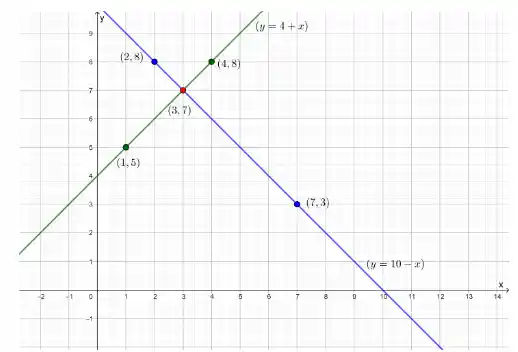
From the graph, the lines intersect at (3, 7).
Therefore,
Number of boys = 3
Number of girls = 7
(ii) 5 pens and 7 pencils together cost Rs 50, whereas 7 pens and 5 pencils together cost Rs 46. Find the cost of one pencil and one pen.
Answer:
Let the cost of one pencil be x and cost of one pen be y.
\[so, as per the question
7x + 5y = 50 \quad ...(1) and
\]
\[
5x + 7y = 46 \quad ...(2)
\]
Table for equation (1):
| x | y |
|---|---|
| 5 | 3 |
| 0 | 10 |
Table for equation (2):
| x | y |
|---|---|
| 5 | 3 |
| 2 | 4 |
Graph of 7x + 5y = 50 and 5x + 7y = 46:
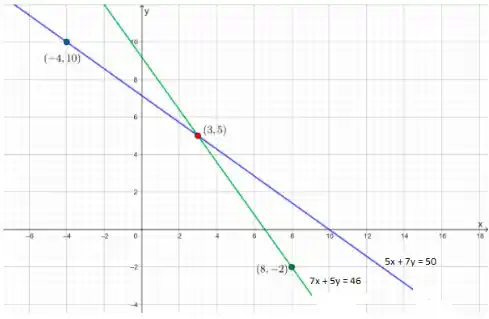
From the graph, the lines intersect at (5, 3).
Therefore,
Cost of pencil = Rs 5
Cost of pen = Rs 3
Q2. On comparing the ratios \( \frac{a_1}{a_2}, \frac{b_1}{b_2}, \frac{c_1}{c_2} \), find whether the lines intersect, are parallel or coincident.
(i) \(5x - 4y + 8 = 0\) and \(7x + 6y - 9 = 0\)
\[
\frac{a_1}{a_2} = \frac{5}{7}, \quad \frac{b_1}{b_2} = \frac{-4}{6} = -\frac{2}{3}
\]
Since,
\[
\frac{a_1}{a_2} \ne \frac{b_1}{b_2}
\]
Therefore, the lines are intersecting.
(ii) \(9x + 3y + 12 = 0\) and \(18x + 6y + 24 = 0\)
\[
\frac{a_1}{a_2} = \frac{9}{18} = \frac{1}{2}, \quad
\frac{b_1}{b_2} = \frac{3}{6} = \frac{1}{2}, \quad
\frac{c_1}{c_2} = \frac{12}{24} = \frac{1}{2}
\]
Since,
\[
\frac{a_1}{a_2} = \frac{b_1}{b_2} = \frac{c_1}{c_2}
\]
Therefore, the lines are coincident.
(iii) \(6x - 3y + 10 = 0\) and \(2x - y + 9 = 0\)
\[
\frac{a_1}{a_2} = \frac{6}{2} = 3, \quad
\frac{b_1}{b_2} = \frac{-3}{-1} = 3, \quad
\frac{c_1}{c_2} = \frac{10}{9}
\]
Since,
\[
\frac{a_1}{a_2} = \frac{b_1}{b_2} \ne \frac{c_1}{c_2}
\]
Therefore, the lines are parallel.
(iv) \(6x - y + 9 = 0\) and \(2x - 3y + 10 = 0\)
\[
\frac{a_1}{a_2} = \frac{6}{2} = 3, \quad
\frac{b_1}{b_2} = \frac{-1}{-3} = \frac{1}{3}
\]
Since,
\[
\frac{a_1}{a_2} \ne \frac{b_1}{b_2}
\]
Therefore, the lines are intersecting.
Q3. On comparing the ratios \( \frac{a_1}{a_2}, \frac{b_1}{b_2}, \frac{c_1}{c_2} \), find out whether the following pair of linear equations is consistent, or inconsistent.
(i) \(3x + 2y = 5\) and \(2x - 3y = 7\)
\[
\frac{a_1}{a_2} = \frac{3}{2}, \quad
\frac{b_1}{b_2} = \frac{2}{-3}
\]
Since,
\[
\frac{a_1}{a_2} \ne \frac{b_1}{b_2}
\]
Therefore, the lines are intersecting.
Hence, the system is consistent (unique solution).
(ii) \(2x - 3y = 8\) and \(4x - 6y = 9\)
\[
\frac{a_1}{a_2} = \frac{2}{4}, \quad
\frac{b_1}{b_2} = \frac{-3}{-6}, \quad
\frac{c_1}{c_2} = \frac{8}{9}
\]
Since,
\[
\frac{a_1}{a_2} = \frac{b_1}{b_2} \ne \frac{c_1}{c_2}
\]
Therefore, the lines are parallel.
Hence, the system is inconsistent (no solution).
(iii) \( \frac{2}{3}x + \frac{3}{7}y = 7\) and \(9x - 10y = 14\)
Convert:
\[
14x + 9y = 147,\quad 9x - 10y = 14
\]
\[
\frac{a_1}{a_2} = \frac{14}{9}, \quad
\frac{b_1}{b_2} = \frac{9}{-10}
\]
Since,
\[
\frac{a_1}{a_2} \ne \frac{b_1}{b_2}
\]
Therefore, the lines are intersecting.
Hence, the system is consistent (unique solution).
(iv) \(5x - 3y = 11\) and \(-10x + 6y = -22\)
\[
\frac{a_1}{a_2} = \frac{5}{-10}, \quad
\frac{b_1}{b_2} = \frac{-3}{6}, \quad
\frac{c_1}{c_2} = \frac{11}{-22}
\]
Since,
\[
\frac{a_1}{a_2} = \frac{b_1}{b_2} = \frac{c_1}{c_2}
\]
Therefore, the lines are coincident.
Hence, the system is consistent (infinitely many solutions).
(v) \( \frac{3}{4}x + 2y = 8\) and \(2x + 3y = 12\)
Convert:
\[
3x + 8y = 32,\quad 2x + 3y = 12
\]
\[
\frac{a_1}{a_2} = \frac{3}{2}, \quad
\frac{b_1}{b_2} = \frac{8}{3}
\]
Since,
\[
\frac{a_1}{a_2} \ne \frac{b_1}{b_2}
\]
Therefore, the lines are intersecting.
Hence, the system is consistent (unique solution).
Q4. Which of the following pairs of linear equations are consistent/inconsistent? If consistent, obtain the solution graphically.
(i) \(x + y = 5\) and \(2x + 2y = 10\)
\[
\frac{a_1}{a_2} = \frac{1}{2}, \quad
\frac{b_1}{b_2} = \frac{1}{2}, \quad
\frac{c_1}{c_2} = \frac{5}{10} = \frac{1}{2}
\]
Since,
\[
\frac{a_1}{a_2} = \frac{b_1}{b_2} = \frac{c_1}{c_2}
\]
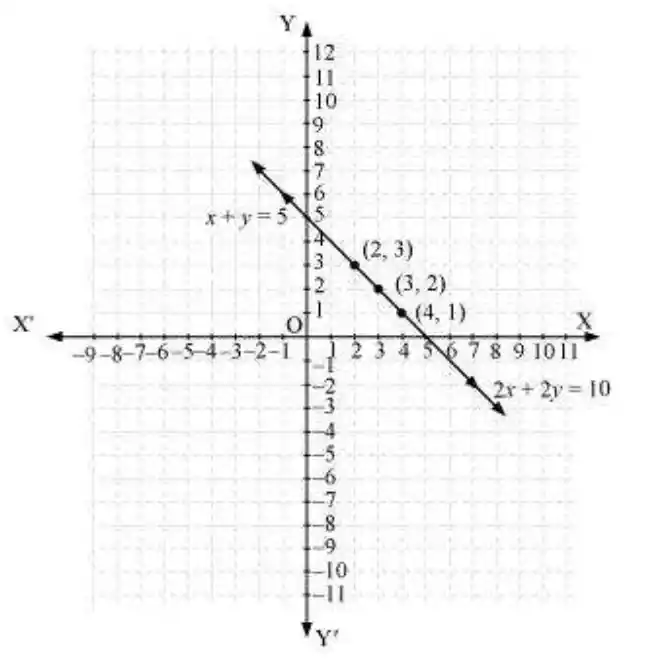
Therefore, the lines are coincident.
Hence, the system is consistent (infinitely many solutions).
Table for \(x + y = 5\)
| x | y |
|---|---|
| 1 | 4 |
| 3 | 2 |
Graph of \(x + y = 5\) and \(2x + 2y = 10\)
(ii) \(x - 2y = 4\) and \(2x - 4y = 9\)
\[
\frac{a_1}{a_2} = \frac{1}{2}, \quad
\frac{b_1}{b_2} = \frac{-2}{-4} = \frac{1}{2}, \quad
\frac{c_1}{c_2} = \frac{4}{9}
\]
Since,
\[
\frac{a_1}{a_2} = \frac{b_1}{b_2} \ne \frac{c_1}{c_2}
\]
Therefore, the lines are parallel.
Hence, the system is inconsistent (no solution).
(iii) \(2x - y - 6 = 0\) and \(4x - 2y - 5 = 0\)
Convert:
\[
2x - y = 6,\quad 4x - 2y = 5
\]
\[
\frac{a_1}{a_2} = \frac{2}{4}, \quad
\frac{b_1}{b_2} = \frac{-1}{-2} = \frac{1}{2}, \quad
\frac{c_1}{c_2} = \frac{6}{5}
\]
Since,
\[
\frac{a_1}{a_2} = \frac{b_1}{b_2} \ne \frac{c_1}{c_2}
\]
Therefore, the lines are parallel.
Hence, the system is inconsistent (no solution).
(iv) \(2x - y + 2 = 0\) and \(4x - y - 5 = 0\)
Convert:
\[
2x - y = -2,\quad 4x - y = 5
\]
\[
\frac{a_1}{a_2} = \frac{2}{4}, \quad
\frac{b_1}{b_2} = \frac{-1}{-1} = 1
\]
Since,
\[
\frac{a_1}{a_2} \ne \frac{b_1}{b_2}
\]
Therefore, the lines are intersecting.
Hence, the system is consistent (unique solution).
Table for \(2x - y = -2\)
| x | y |
|---|---|
| 0 | 2 |
| 1 | 4 |
Table for \(4x - y = 5\)
| x | y |
|---|---|
| 1 | -1 |
| 2 | 3 |
Graph of \(2x - y + 2 = 0\) and \(4x - y - 5 = 0\)
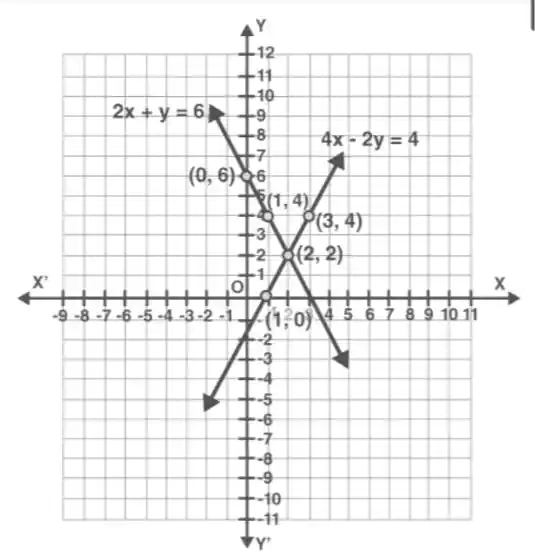
Solution point: \( \left(\frac{7}{2}, 9\right) \)
Q5. Half the perimeter of a rectangular garden, whose length is 4 m more than its width, is 36 m. Find the dimensions of the garden.
Answer:
Let width of the garden be x m and length be y m.
Given, half of the perimeter = 36 m
\[
i.e\; x + y = 36 \quad ...(1)
\]
also,
Length is 4 m more than width:
\[
so,\; y = x + 4 \quad ...(2)
\]
Substituting (2) in (1):
\[
x + (x + 4) = 36
\]
\[
2x + 4 = 36
\]
\[
2x = 32
\Rightarrow x = 16
\]
Now, from (2):
\[
y = 16 + 4 = 20
\]
Therefore,
Width of the garden = 16 m
Length of the garden = 20 m
Q6. Given the linear equation \(2x + 3y - 8 = 0\), write another linear equation such that the pair of equations formed is:
(i) Intersecting lines
Answer:
Given equation:
\[
2x + 3y - 8 = 0
\]
For intersecting lines,
\[
since\; \frac{a_1}{a_2} \ne \frac{b_1}{b_2}
\]
Choose another equation such that ratios are not equal.
\[
so,\; x - y + 1 = 0
\]
Therefore, the given pair represents intersecting lines.
(ii) Parallel lines
Answer:
Given equation:
\[
2x + 3y - 8 = 0
\]
For parallel lines,
\[
since\; \frac{a_1}{a_2} = \frac{b_1}{b_2} \ne \frac{c_1}{c_2}
\]
Multiply first equation by 2:
\[
4x + 6y - 16 = 0
\]
Change constant term:
\[
so,\; 4x + 6y + 5 = 0
\]
Therefore, the lines are parallel.
(iii) Coincident lines
Answer:
Given equation:
\[
2x + 3y - 8 = 0
\]
For coincident lines,
\[
since\; \frac{a_1}{a_2} = \frac{b_1}{b_2} = \frac{c_1}{c_2}
\]
Multiply by 2:
\[
so,\; 4x + 6y - 16 = 0
\]
Therefore, both equations represent the same line (coincident lines).
Q7. Draw the graphs of the equations \(x - y + 1 = 0\) and \(3x + 2y - 12 = 0\). Determine the coordinates of the vertices of the triangle formed by these lines and the x-axis, and shade the triangular region.
Answer:
Given equations:
\[
x - y + 1 = 0 \quad ...(1)
\]
\[
3x + 2y - 12 = 0 \quad ...(2)
\]
From (1):
\[
x = y - 1 \; \text{or} \; y = x + 1
\]
From (2):
\[
x = \frac{12 - 2y}{3}
\]
Table for equation (1):
| x | 0 | 1 | 2 |
|---|---|---|---|
| y | 1 | 2 | 3 |
Table for equation (2):
| x | 4 | 2 | 0 |
|---|---|---|---|
| y | 0 | 3 | 6 |
Graph of \(x - y + 1 = 0\) and \(3x + 2y - 12 = 0\)
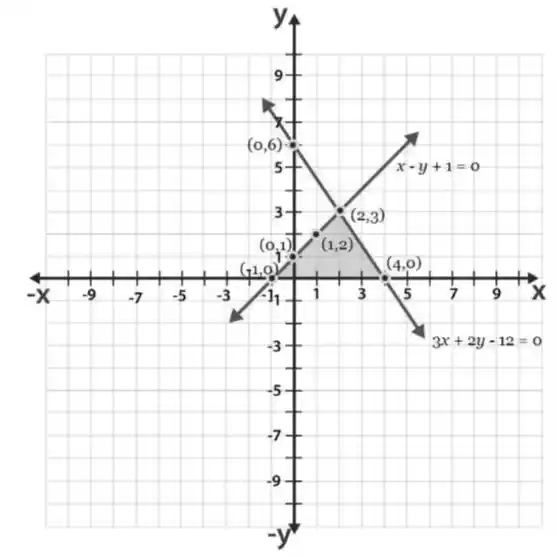
Now, find intersection points with x-axis:
For (1):
\[
y = 0 \Rightarrow x = -1
\Rightarrow (-1,0)
\]
For (2):
\[
y = 0 \Rightarrow 3x = 12 \Rightarrow x = 4
\Rightarrow (4,0)
\]
Now, intersection of both lines:
\[
y = x + 1
\]
Put in (2):
\[
3x + 2(x+1) = 12
\]
\[
5x + 2 = 12
\Rightarrow x = 2,\; y = 3
\]
Therefore, vertices of triangle are:
\[
(-1,0),\; (4,0),\; (2,3)
\]
Q8. For what value of p does the pair of equations have a unique solution?
\[ 4x + py + 8 = 0 \] \[ 2x + 2y + 2 = 0 \]
(a) \(p = 4\)
(b) \(p \ne 4\)
(c) \(p = -4\)
(d) \(p \ne -4\)
Answer: (b) \(p \ne 4\)
For unique solution,
\[ since\; \frac{a_1}{a_2} \ne \frac{b_1}{b_2} \] \[ \frac{4}{2} = \frac{p}{2} \] \[ 2 = \frac{p}{2} \Rightarrow p = 4 \] So, for unique solution:
\[ p \ne 4 \]
Q9. Which of the following has infinitely many solutions?
(a) \(2x + 3y = 6\) and \(4x + 6y - 12 = 0\)
(b) \(x + y = 4\) and \(x - y - 2 = 0\)
(c) \(x - y = 3\) and \(x + y = 7\)
(d) \(x + y = 5\) and \(2x - y = 3\)
Answer: (a)
(a): \[ 4x + 6y - 12 = 0 \Rightarrow 4x + 6y = 12 \] Multiply first equation by 2: \[ 4x + 6y = 12 \] Since, \[ \frac{a_1}{a_2} = \frac{b_1}{b_2} = \frac{c_1}{c_2} \] Therefore, lines are coincident → infinitely many solutions.
Q10. In the following question a statement of assertion (A) is followed by a statement of reason (R).
Assertion (A): The equation \(2x - 3y = 0\) has an infinite number of solutions.
Reason (R): A linear equation in two variables represents a straight line on the coordinate plane.
(a) Both A and R are true and R is correct explanation
(b) Both A and R are true but R is not correct explanation
(c) A is true but R is false
(d) A is false but R is true
Answer: (a)
Assertion is true because a linear equation has infinitely many solutions.
Reason is also true because such equations represent a straight line.
Since all points on the line satisfy the equation,
therefore it has infinitely many solutions.
Hence, both are true and R explains A.