
cl 10 adv geo ch 6 extra questions

SEBA Elective Geography Chapter 6 Important Extra Questions | Assam Eduverse

SEBA Elective Geography Chapter 6 Important Extra Questions are prepared to help students understand the major concepts of Regional Geography of India in a clear and exam-oriented manner. SEBA Elective Geography Chapter 6 Important Extra Questions focus on important topics such as physical divisions of India, climate regions, natural vegetation, agriculture, mineral resources, industries, transport, and population distribution.

SEBA Elective Geography Chapter 6 Important Extra Questions strictly follow the latest SEBA (ASSEB) syllabus and are updated for the academic session 2026–27. Each of the SEBA Elective Geography Chapter 6 Important Extra Questions is selected after analysing previous year examination trends to ensure relevance and scoring value.

Students searching for SEBA Advanced Geography Important Questions or ASSEB Class 10 Advanced Geography Extra Questions will find SEBA Elective Geography Chapter 6 Important Extra Questions extremely useful for developing regional understanding and effective revision.

SEBA Elective Geography Chapter 6 Regional Geography of India Important Questions | Previous Year Questions

Table of Contents

A. Previous Year Very Short Type Questions (MCQs – 1 Mark)

Q1. Among the countries of the world India’s position in terms of area is – (HSLC 2010, 2011, 2013)
(i) Seventh
(ii) Second
(iii) Fourth
(iv) Fifth
Answer: Seventh


Q2. Mangrove vegetation is found mainly in – (HSLC 2012)
(i) Coastal region
(ii) Desert region
(iii) Mountainous region
(iv) Plateau region
Answer: Coastal region


Q3. The Mumbai–Pune industrial region of India is famous for which of the following? (HSLC 2012)
(i) Cotton textile industry
(ii) Fertilizer industry
(iii) Ship-building industry
(iv) Iron and steel industry
Answer: Cotton textile industry


Q4. Which of the following states has the lowest population density in India? (HSLC 2012)
(i) Mizoram
(ii) Sikkim
(iii) Jammu and Kashmir
(iv) Arunachal Pradesh
Answer: Arunachal Pradesh


Q5. The total number of states in India is – (HSLC 2014)
(i) 27
(ii) 28
(iii) 25
(iv) 29
Answer: 28


Q6. The country located to the east of India is – (HSLC 2015)
(i) China
(ii) Pakistan
(iii) Myanmar
(iv) Thailand
Answer: Myanmar


Q7. India covers the geographical area of the world in percentage – (HSLC 2016)
(i) 3.2%
(ii) 4.3%
(iii) 5.4%
(iv) 2.2%
Answer: 2.2%


Q8. The country located to the west of India is – (HSLC 2017)
(i) China
(ii) Pakistan
(iii) Myanmar
(iv) Thailand
Answer: Pakistan


Q9. Which one of the following lakes of India is located in Rajasthan? (HSLC 2018)
(i) Loktak
(ii) Pushkar
(iii) Chilka
(iv) Pulicat
Answer: Pushkar


Q10. The total length of land boundary of India is – (HSLC 2019)
(i) 18,400 km
(ii) 16,800 km
(iii) 15,200 km
(iv) 13,200 km
Answer: 15,200 km


Q11. Which of the following crops grown in India is not included under rabi crops? (HSLC 2020)
(i) Wheat
(ii) Mustard
(iii) Gram
(iv) Groundnut
Answer: Groundnut


Q12. In which of the following areas is the Coromandel Coast of India located? (HSLC 2022)
(i) Between the mouth of Godavari and Cape Comorin
(ii) Between the mouth of Ganga and Cape Comorin
(iii) Between Mangalore and Cape Comorin
(iv) Between the mouths of Godavari and Kaveri
Answer: Between the mouths of Godavari and Kaveri

Extra Short Type Questions (MCQs – 1 Mark)

Q1. India is located in which hemisphere of the world?
(i) Southern hemisphere
(ii) Northern hemisphere
(iii) Eastern hemisphere only
(iv) Western hemisphere
Answer: Northern hemisphere


Q2. India is situated in which continent?
(i) Europe
(ii) Africa
(iii) Asia
(iv) Australia
Answer: Asia


Q3. India is described as a country full of diversities mainly due to variation in –
(i) Climate and physical environment
(ii) Longitude only
(iii) Latitude only
(iv) Ocean currents
Answer: Climate and physical environment


Q4. Which mountain range lies in the northern part of India?
(i) Aravalli
(ii) Vindhya
(iii) Himalayas
(iv) Satpura
Answer: Himalayas


Q5. The dry sandy desert region of India is located in –
(i) Punjab
(ii) Rajasthan
(iii) Gujarat
(iv) Haryana
Answer: Rajasthan


Q6. Floods in India mainly occur due to –
(i) Scanty rainfall
(ii) Heavy rainfall
(iii) Snowfall
(iv) Cyclones only
Answer: Heavy rainfall


Q7. Drought occurs in India due to –
(i) Excess rainfall
(ii) Heavy snowfall
(iii) Scanty rainfall
(iv) River floods
Answer: Scanty rainfall


Q8. Which type of vegetation is found in dry regions of India?
(i) Broad-leaf trees
(ii) Thorny bushes
(iii) Mangroves
(iv) Coniferous forests
Answer: Thorny bushes


Q9. The Indian subcontinent has which type of landforms?
(i) Only plains
(ii) Only plateaus
(iii) Mountains, plains and plateaus
(iv) Only hills
Answer: Mountains, plains and plateaus


Q10. Social and economic diversities in India are mainly due to –
(i) Physical diversities
(ii) Longitude
(iii) Ocean currents
(iv) Earth’s rotation
Answer: Physical diversities


Q11. India is a –
(i) Monarchy
(ii) Dictatorship
(iii) Democratic country
(iv) Military state
Answer: Democratic country


Q12. Unity and integration are considered as –
(i) Weakness of India
(ii) Temporary feature
(iii) Tradition of India
(iv) Modern concept
Answer: Tradition of India


Q13. India is divided into how many states according to the textbook?
(i) 27
(ii) 28
(iii) 29
(iv) 30
Answer: 28


Q14. India has how many Union Territories (as per the book)?
(i) 5
(ii) 6
(iii) 7
(iv) 8
Answer: 7


Q15. Which ocean lies to the south of India?
(i) Pacific Ocean
(ii) Atlantic Ocean
(iii) Indian Ocean
(iv) Arctic Ocean
Answer: Indian Ocean


Q16. Which sea lies to the west of India?
(i) Red Sea
(ii) Arabian Sea
(iii) Caspian Sea
(iv) Mediterranean Sea
Answer: Arabian Sea


Q17. Which bay lies to the east of India?
(i) Bay of Bengal
(ii) Persian Gulf
(iii) Gulf of Oman
(iv) South China Sea
Answer: Bay of Bengal


Q18. The eastern coastal plain of India is broader than the western coastal plain because of –
(i) Tectonic activity
(ii) River deposition
(iii) Volcanic activity
(iv) Glacial erosion
Answer: River deposition


Q19. Which plateau is rich in mineral resources?
(i) Deccan Plateau
(ii) Chotanagpur Plateau
(iii) Malwa Plateau
(iv) Meghalaya Plateau
Answer: Chotanagpur Plateau


Q20. Which soil is most suitable for cotton cultivation?
(i) Alluvial soil
(ii) Red soil
(iii) Black soil
(iv) Laterite soil
Answer: Black soil


Q21. Alluvial soil is mainly found in –
(i) Peninsular plateau
(ii) Himalayan region
(iii) Northern plains
(iv) Coastal plateau
Answer: Northern plains


Q22. Which crop is mainly grown in the monsoon season?
(i) Wheat
(ii) Barley
(iii) Rice
(iv) Gram
Answer: Rice


Q23. Wheat is mainly a –
(i) Kharif crop
(ii) Rabi crop
(iii) Zaid crop
(iv) Plantation crop
Answer: Rabi crop


Q24. Which of the following is a plantation crop?
(i) Rice
(ii) Wheat
(iii) Tea
(iv) Pulses
Answer: Tea


Q25. Which factor mainly controls the climate of India?
(i) Westerlies
(ii) Trade winds
(iii) Monsoon winds
(iv) Jet streams only
Answer: Monsoon winds


Q26. The summer monsoon winds bring –
(i) Cold dry air
(ii) Heavy rainfall
(iii) Snowfall
(iv) Cyclones only
Answer: Heavy rainfall


Q27. Population density is highest in –
(i) Desert regions
(ii) Mountain regions
(iii) River valleys and plains
(iv) Plateau regions
Answer: River valleys and plains


Q28. Which factor does NOT affect population distribution in India?
(i) Climate
(ii) Soil
(iii) Relief
(iv) Latitude lines
Answer: Latitude lines


Q29. Which industrial region is famous for cotton textile industry?
(i) Chotanagpur region
(ii) Mumbai–Pune region
(iii) Hooghly region
(iv) North-East region
Answer: Mumbai–Pune region


Q30. The Hooghly industrial region is located in –
(i) Maharashtra
(ii) Gujarat
(iii) West Bengal
(iv) Odisha
Answer: West Bengal


Q31. Which industry mainly developed in the Chotanagpur region?
(i) IT industry
(ii) Mining and metal industry
(iii) Cotton industry
(iv) Fertilizer industry
Answer: Mining and metal industry


Q32. India shares its longest land boundary with –
(i) Pakistan
(ii) Bangladesh
(iii) China
(iv) Nepal
Answer: Bangladesh


Q33. The eastern coastal plain is also known as –
(i) Malabar Coast
(ii) Konkan Coast
(iii) Coromandel Coast
(iv) Canara Coast
Answer: Coromandel Coast


Q34. The western coastal plain is narrower because –
(i) Rivers are long
(ii) Rivers are short and swift
(iii) Heavy snowfall occurs
(iv) Less rainfall occurs
Answer: Rivers are short and swift


Q35. Which language diversity reflects the cultural diversity of India?
(i) Single language
(ii) Regional languages
(iii) Foreign languages
(iv) Classical languages only
Answer: Regional languages


Q36. Which region of India is sparsely populated?
(i) Northern plains
(ii) Coastal plains
(iii) Himalayan region
(iv) Delta regions
Answer: Himalayan region


Q37. Which crop is mainly grown in dry regions?
(i) Rice
(ii) Jute
(iii) Bajra
(iv) Tea
Answer: Bajra


Q38. Which type of forest is found in areas of heavy rainfall?
(i) Thorn forests
(ii) Tropical evergreen forests
(iii) Desert vegetation
(iv) Coniferous forests
Answer: Tropical evergreen forests


Q39. India’s unity in diversity means –
(i) No diversity exists
(ii) Only cultural unity
(iii) Diverse features but national unity
(iv) Political separation
Answer: Diverse features but national unity


Q40. Regional Geography of India mainly studies –
(i) Only physical features
(ii) Only economic features
(iii) Physical, social and economic features together
(iv) Only climate
Answer: Physical, social and economic features together

B. Previous Year Very Short Type Questions (1 Mark)

Q1. Name a famous lake of North-East India. (HSLC 2010)
A
nswer: Loktak Lake is a well-known and important lake of North-East India.


Q2. In which part of India is the Thar Desert located? (HSLC 2012)
A
nswer: The Thar Desert is located in the north-western part of India, mainly in Rajasthan.


Q3. In which state of India is the Loktak Lake located? (HSLC 2012)
A
nswer: Loktak Lake is situated in the state of Manipur.


Q4. In which state of India is the Chilika Lake located? (HSLC 2013)
A
nswer: Chilika Lake is found in the coastal region of Odisha.


Q5. Name one south-bank tributary of the river Ganga. (HSLC 2014)
A
nswer: The Son River is an important south-bank tributary of the Ganga.


Q6. What is the Chotanagpur Plateau region of India famous for? (HSLC 2015)
A
nswer: The Chotanagpur Plateau region is famous for its rich mineral resources.


Q7. How many districts are there in Assam now? (HSLC 2016)
A
nswer: At present, Assam has 31 districts.


Q8. Which line of latitude divides India into the Northern and Southern parts? (HSLC 2017)
A
nswer: The Tropic of Cancer divides India almost equally into northern and southern parts.


Q9. What is the length of India’s land boundary? (HSLC 2018)
A
nswer: The total length of India’s land boundary is about 15,200 kilometres.


Q10. In which region of India is mangrove vegetation found? (HSLC 2019)
A
nswer: Mangrove vegetation is mainly found in the coastal and delta regions of India.


Q11. What is the name of the Indian desert? (HSLC 2020)
A
nswer: The Indian desert is known as the Thar Desert.


Q12. Mention the largest city of India. (HSLC 2022)
A
nswer: Mumbai is the largest city of India.

Extra Very Short Type Questions (1 Mark)

Q1. In which continent is India located?
Answer: India is located in the continent of Asia.


Q2. In which hemisphere is India situated?
Answer: India is situated in the Northern Hemisphere.


Q3. Name the ocean lying to the south of India.
Answer: The Indian Ocean lies to the south of India.


Q4. Which sea lies to the west of India?
Answer: The Arabian Sea lies to the west of India.


Q5. Which bay lies to the east of India?
Answer: The Bay of Bengal lies to the east of India.


Q6. Name the mountain range lying in the northern boundary of India.
Answer: The Himalayas form the northern boundary of India.


Q7. Which desert is located in north-western India?
Answer: The Thar Desert is located in north-western India.


Q8. Name one major physical division of India.
Answer: The Northern Plains are one of the major physical divisions of India.


Q9. Which plateau is rich in mineral resources?
Answer: The Chotanagpur Plateau is rich in mineral resources.


Q10. Which type of soil is suitable for cotton cultivation?
Answer: Black soil is considered suitable for cotton cultivation.


Q11. Which soil is widely found in the Northern Plains of India?
Answer: Alluvial soil is widely found in the Northern Plains.


Q12. Name one important rabi crop of India.
Answer: Wheat is an important rabi crop of India.


Q13. Name one important kharif crop of India.
Answer: Rice is an important kharif crop of India.


Q14. Which wind system mainly controls the climate of India?
Answer: The monsoon wind system mainly controls India’s climate.


Q15. Which season brings maximum rainfall to India?
Answer: The summer monsoon season brings maximum rainfall to India.


Q16. Why do floods occur frequently in some parts of India?
Answer: Floods occur mainly due to heavy and continuous rainfall.


Q17. Why do droughts occur in some regions of India?
Answer: Droughts occur due to scanty or irregular rainfall.


Q18. Which type of vegetation is found in areas of heavy rainfall?
Answer: Tropical evergreen forests are found in areas of heavy rainfall.


Q19. Which vegetation is common in dry regions of India?
Answer: Thorny vegetation is common in dry regions.


Q20. In which regions of India is population density very high?
Answer: Population density is high in river valleys and fertile plains.


Q21. In which regions of India is population density low?
Answer: Population density is low in desert and mountainous regions.


Q22. Name one factor affecting population distribution in India.
Answer: Climate is an important factor affecting population distribution.


Q23. Which industrial region is famous for cotton textile industry?
Answer: The Mumbai–Pune industrial region is famous for cotton textiles.


Q24. Which industrial region is based on mineral resources?
Answer: The Chotanagpur industrial region is based on mineral resources.


Q25. Name one major industrial region of India.
Answer: The Hooghly industrial region is a major industrial region of India.


Q26. Which coast of India is known as the Coromandel Coast?
Answer: The eastern coast of India is known as the Coromandel Coast.


Q27. Why is the western coastal plain narrow?
Answer: It is narrow because the rivers are short and flow swiftly.


Q28. Name one south-flowing river of Peninsular India.
Answer: The Godavari is an important south-flowing river.


Q29. Which river is known as the “Dakshin Ganga”?
Answer: The Godavari River is known as the Dakshin Ganga.


Q30. Name one important plantation crop of India.
Answer: Tea is an important plantation crop of India.


Q31. In which regions of India is tea cultivation common?
Answer: Tea is commonly cultivated in Assam and hilly regions.


Q32. Which physical feature brings unity despite diversity in India?
Answer: A common administrative and political system brings unity.


Q33. Why is India called a land of diversity?
Answer: India has diverse landforms, climates, languages and cultures.


Q34. What type of country is India politically?
Answer: India is a democratic country.


Q35. Name one feature of Indian society.
Answer: Unity in diversity is a major feature of Indian society.


Q36. Which part of India experiences very cold climate?
Answer: The Himalayan region experiences very cold climate.


Q37. Which region of India experiences very hot climate?
Answer: The desert region of Rajasthan experiences very hot climate.


Q38. Name one important river of the Northern Plains.
Answer: The Ganga is an important river of the Northern Plains.


Q39. Which region of India is suitable for agriculture?
Answer: The fertile plains of northern India are suitable for agriculture.


Q40. What does Regional Geography of India mainly study?
Answer: It studies the physical, social and economic features of India together.
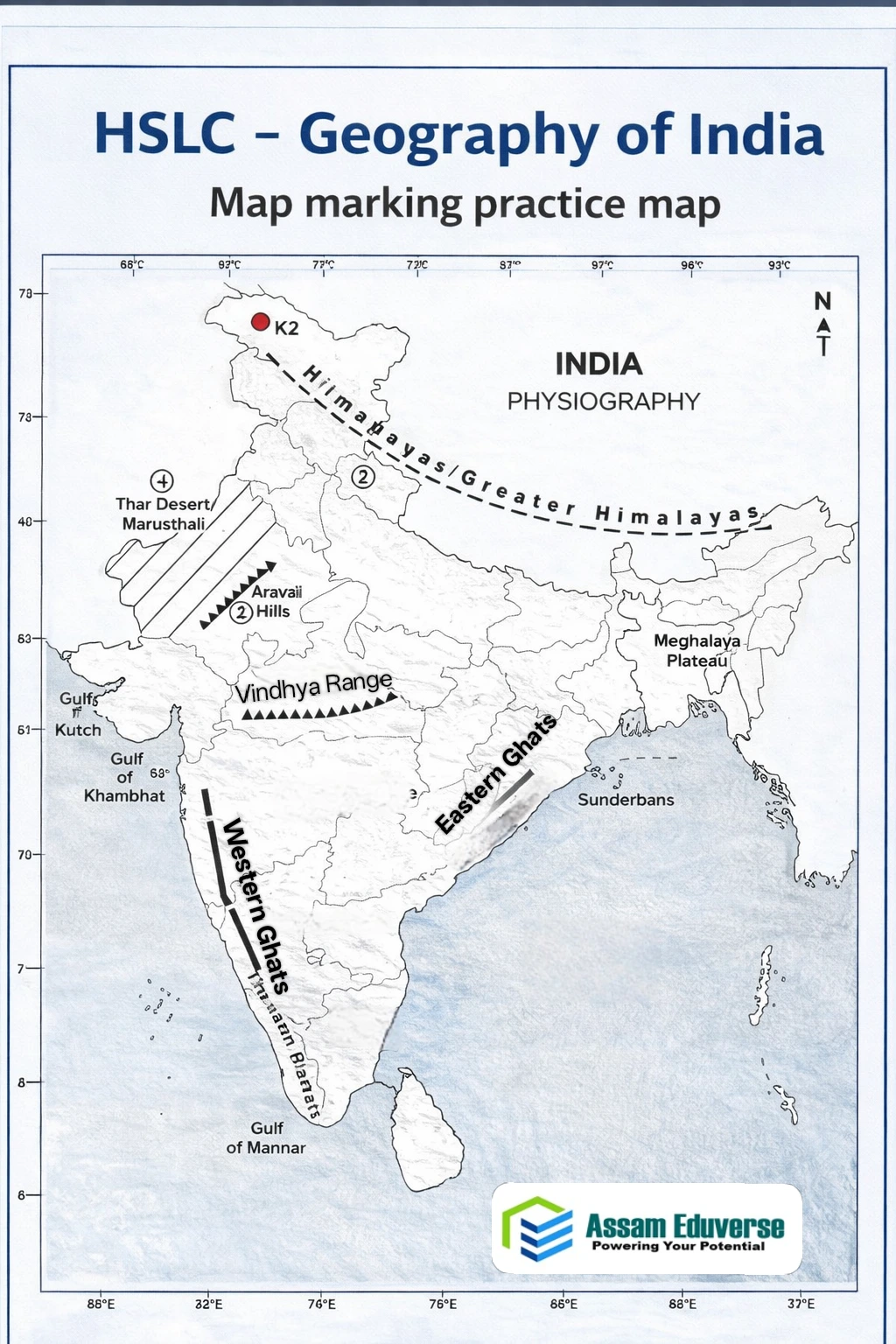
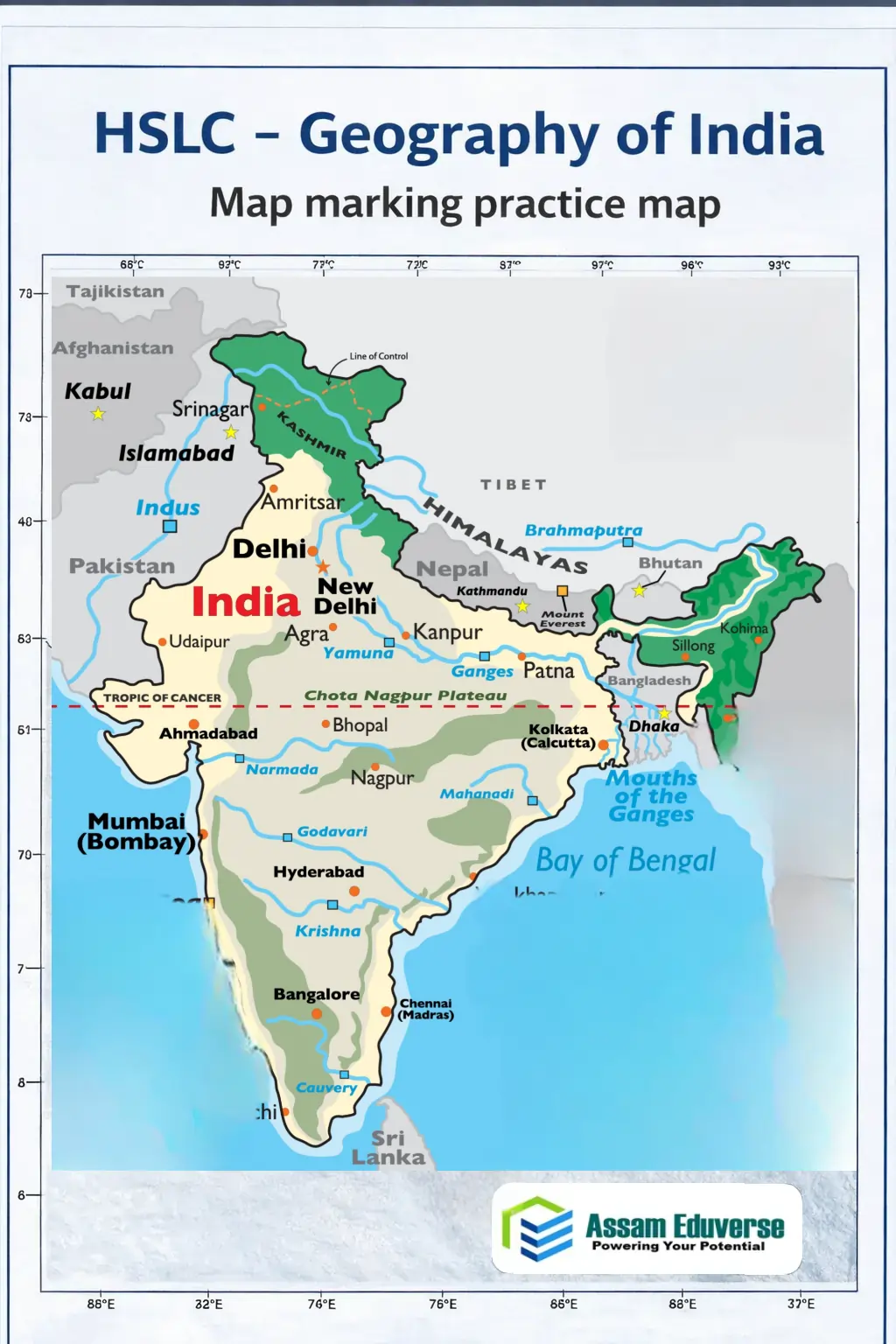
C. Previous Year Short Answer Type Questions (2–3 Marks)

Q1. Mention two major characteristics of the rivers of North India. (HSLC 2010)
Answer: The rivers of North India are generally long and perennial in nature. They are mainly snow-fed and form extensive river valleys with fertile plains.


Q2. Mention two important types of vegetation of India. (HSLC 2011)
Answer: Two important types of vegetation found in India are tropical evergreen vegetation and tropical deciduous vegetation.


Q3. Name two cities of India with population more than one crore as per 1991 census. (HSLC 2011)
Answer: According to the 1991 census, Mumbai and Kolkata had a population of more than one crore.


Q4. Name two west-flowing rivers of India. (HSLC 2012)
Answer: The Narmada and the Tapi are two important west-flowing rivers of India.


Q5. Name two coasts of the eastern part of India. (HSLC 2012)
Answer: The eastern coast of India includes the Coromandel Coast and the Northern Circars Coast.


Q6. Name two east-flowing rivers of India. (HSLC 2013)
Answer: The Godavari and the Krishna are two major east-flowing rivers of India.


Q7. Name two million population cities of India. (HSLC 2013)
Answer: Delhi and Chennai are two cities of India having a population of more than one million.


Q8. Name three major crops cultivated in the monsoon region. (HSLC 2013)
Answer: Rice, jute and sugarcane are the major crops cultivated in the monsoon region.


Q9. Name two lakes of Rajasthan. (HSLC 2014)
Answer: Sambhar Lake and Pushkar Lake are two important lakes of Rajasthan.


Q10. Name two industrial regions of Western India. (HSLC 2014)
Answer: The Mumbai–Pune industrial region and the Ahmedabad–Vadodara industrial region are two important industrial regions of Western India.


Q11. Mention the name of two areas in India where mangrove vegetation is found. (HSLC 2015)
Answer: Mangrove vegetation is mainly found in the Sundarbans region of West Bengal and the delta region of the Godavari river.


Q12. Name two rivers of the Deccan Plateau region of India. (HSLC 2015, 2017)
Answer: The Godavari and the Krishna are two important rivers of the Deccan Plateau region.


Q13. How many types of monsoon prevail in India? Give their names. (HSLC 2016)
Answer: Two types of monsoon prevail in India. They are the South-West Monsoon and the North-East Monsoon.


Q14. Where is the cotton region located in India? (HSLC 2016)
Answer: The cotton region of India is mainly located in the Deccan Plateau region, especially in Maharashtra and Gujarat.


Q15. Write the name of two areas in India where evergreen vegetation is found. (HSLC 2017)
Answer: Evergreen vegetation is found in the Western Ghats and the Andaman and Nicobar Islands.


Q16. Write the name of two important mountains located in the Deccan Plateau region of India. (HSLC 2018)
Answer: The Western Ghats and the Eastern Ghats are two important mountain ranges of the Deccan Plateau.


Q17. Write the name of two areas of India with very high amount of rainfall. (HSLC 2018)
Answer: Cherrapunji region and the Western Ghats receive a very high amount of rainfall in India.


Q18. Write the names of two major rivers of Southern India. (HSLC 2019)
Answer: The Godavari and the Kaveri are two major rivers of Southern India.


Q19. Mention two important factors behind the growth of the Chotanagpur industrial region of India. (HSLC 2019)
Answer: The availability of rich mineral resources and the presence of power resources have helped in the growth of the Chotanagpur industrial region.


Q20. Mention the names of three rivers flowing through the state of Punjab in India. (HSLC 2019)
Answer: The Sutlej, Beas and Ravi rivers flow through the state of Punjab.


Q21. Write three causes behind rapid population growth in India. (HSLC 2019)
Answer: High birth rate, decline in death rate and improvement in medical facilities are the main causes of rapid population growth in India.


Q22. Why is the southern part of India relatively warmer than the northern part? (HSLC 2020)
Answer: The southern part of India lies closer to the equator, so it receives more direct sunlight throughout the year and remains warmer.


Q23. Mention the seasons as observed in India in a year. (HSLC 2020)
Answer: The main seasons observed in India are the cold season, hot season, south-west monsoon season and retreating monsoon season.


Q24. Write down the names of any three industrial regions of India. (HSLC 2020, 2022)
Answer: The Mumbai–Pune region, Hooghly industrial region and Chotanagpur industrial region are important industrial regions of India.


Q25. Explain briefly why the East Coastal Region of India is comparatively wider and more fertile than the West Coastal Region. (HSLC 2020)
Answer: The east coastal region is wider and more fertile because many large rivers form extensive deltas by depositing fertile alluvial soil.


Q26. Mention two agricultural regions of India. (HSLC 2022)
Answer: The wheat growing region and the rice growing region are two important agricultural regions of India.


Q27. What do you mean by cotton soil? (HSLC 2022)
Answer: Cotton soil is a type of black soil which is very suitable for cotton cultivation and retains moisture for a long time.


Q28. Mention three climatic characteristics of India. (HSLC 2022)
Answer: India has a monsoon type of climate, seasonal rainfall and wide variations in temperature from region to region.


Q29. Name three tributaries of the River Ganga. (HSLC 2022)
Answer: The Yamuna, Son and Gomti are important tributaries of the River Ganga.


Q30. Mention the causes of uneven distribution of rainfall in India. (HSLC 2022)
Answer: Relief features, direction of monsoon winds and distance from the sea cause uneven distribution of rainfall in India.


Q31. State the importance of agriculture in the Indian economy. (HSLC 2022)
Answer: Agriculture provides employment to a large section of the population and supplies raw materials to many industries in India.

Extra Short Answer Type Questions (2–3 Marks)

Q1. Mention two characteristics of the Himalayan rivers.
Answer: The Himalayan rivers are perennial in nature and carry water throughout the year as they are fed by snow and rainfall.


Q2. Name two major physical divisions of India.
Answer: The Northern Plains and the Peninsular Plateau are two major physical divisions of India.


Q3. Name two west-flowing rivers of Peninsular India.
Answer: The Narmada and the Tapi are important west-flowing rivers of Peninsular India.


Q4. Name two east-flowing rivers of India.
Answer: The Godavari and the Krishna are two major east-flowing rivers of India.


Q5. Mention two important features of the Northern Plains of India.
Answer: The Northern Plains are very fertile and densely populated due to the presence of alluvial soil and rivers.


Q6. Name two types of soils found in India.
Answer: Alluvial soil and black soil are two important types of soil found in India.


Q7. Mention two important rabi crops of India.
Answer: Wheat and gram are two important rabi crops grown in India.


Q8. Mention two important kharif crops of India.
Answer: Rice and maize are important kharif crops cultivated in India.


Q9. Name two plantation crops of India.
Answer: Tea and coffee are important plantation crops of India.


Q10. Mention two factors affecting the climate of India.
Answer: Latitude and monsoon winds are two important factors affecting the climate of India.


Q11. Mention two causes of floods in India.
Answer: Heavy rainfall and overflowing of rivers are the main causes of floods in India.


Q12. Mention two causes of drought in India.
Answer: Scanty rainfall and irregular monsoon are major causes of drought in India.


Q13. Name two areas of India receiving very heavy rainfall.
Answer: Cherrapunji and the Western Ghats receive very heavy rainfall in India.


Q14. Name two areas of India where thorny vegetation is found.
Answer: Thorny vegetation is found in Rajasthan and parts of Gujarat.


Q15. Name two areas where mangrove vegetation is found in India.
Answer: Mangrove vegetation is found in the Sundarbans and the Godavari delta region.


Q16. Mention two features of tropical evergreen forests.
Answer: These forests are dense and remain green throughout the year due to heavy rainfall.


Q17. Name two industrial regions of India.
Answer: The Mumbai–Pune industrial region and the Hooghly industrial region are important industrial regions of India.


Q18. Mention two reasons for the development of industries in the Mumbai–Pune region.
Answer: Availability of capital and good transport facilities have helped the growth of industries in this region.


Q19. Name two mineral resources found in the Chotanagpur Plateau.
Answer: Coal and iron ore are major mineral resources found in the Chotanagpur Plateau.


Q20. Name two rivers flowing through the Deccan Plateau.
Answer: The Godavari and the Kaveri flow through the Deccan Plateau.


Q21. Mention two factors affecting population distribution in India.
Answer: Climate and relief play an important role in the distribution of population in India.


Q22. Name two densely populated regions of India.
Answer: The Northern Plains and the coastal plains are densely populated regions of India.


Q23. Name two sparsely populated regions of India.
Answer: The Himalayan region and the Thar Desert are sparsely populated regions.


Q24. Mention two causes of rapid population growth in India.
Answer: High birth rate and improvement in medical facilities are important causes of population growth.


Q25. Name two important crops grown in the monsoon region.
Answer: Rice and jute are important crops grown in the monsoon region.


Q26. Mention two characteristics of Indian agriculture.
Answer: Indian agriculture is largely dependent on monsoon rainfall and employs a large section of the population.


Q27. Name two important coastal plains of India.
Answer: The Western Coastal Plain and the Eastern Coastal Plain are important coastal plains of India.


Q28. Mention two reasons why the eastern coastal plain is fertile.
Answer: Deposition of alluvial soil by rivers and adequate rainfall make it fertile.


Q29. Name two major rivers of Northern India.
Answer: The Ganga and the Yamuna are major rivers of Northern India.


Q30. Mention two important features of Indian climate.
Answer: India has a monsoon type of climate and shows wide seasonal variations.


SEBA Elective Geography Chapter 6 Important Extra Questions play a vital role in strengthening exam preparation when SEBA Elective Geography Chapter 6 Important Extra Questions are practised regularly. SEBA Elective Geography Chapter 6 Important Extra Questions help students revise answers efficiently and improve understanding of the Regional Geography of India through SEBA Elective Geography Chapter 6 Important Extra Questions. Continuous practice of SEBA Elective Geography Chapter 6 Important Extra Questions boosts confidence among learners. SEBA Elective Geography Chapter 6 Important Extra Questions are essential.

By focusing on SEBA Elective Geography Chapter 6 Important Extra Questions, students using SEBA Elective Geography Chapter 6 Important Extra Questions can identify high-scoring areas and avoid unnecessary topics. SEBA Elective Geography Chapter 6 Important Extra Questions also support preparation alongside HSLC Advanced Geography Chapter-wise Important Questions, with SEBA Elective Geography Chapter 6 Important Extra Questions ensuring balanced syllabus coverage.

Students preparing with SEBA Elective Geography Chapter 6 Important Extra Questions gain accuracy in answering regional geography questions through SEBA Elective Geography Chapter 6 Important Extra Questions. In conclusion, SEBA Elective Geography Chapter 6 Important Extra Questions act as a reliable study tool that helps students enter the examination hall confident, well-prepared, and ready to score high marks using SEBA Elective Geography Chapter 6 Important Extra Questions.

Frequently Asked Questions (FAQ)

1. Why is Chapter 6 Regional Geography of India important?

This chapter is very important as it explains the physical and economic regions of India and carries high weightage in Elective Geography.

2. Are these important extra questions based on the SEBA syllabus?

Yes, all SEBA Elective Geography Chapter 6 Important Extra Questions are prepared as per the latest SEBA (ASSEB) syllabus for 2026–27.

3. Do these questions include previous year examination questions?

Yes, many questions from Regional Geography of India are framed based on previous year examination trends.

4. Are these questions exam-oriented?

Yes, these questions are fully exam-oriented and suitable for Elective Geography preparation.

5. Are these questions useful for last-minute revision?

Yes, these Regional Geography of India extra questions are ideal for quick revision before the examination.

6. Is this content suitable for ASSEB students?

Yes, SEBA and ASSEB are the same board, so the content applies to all students.

7. Why should I study Elective Geography from Assam EduVerse?

Assam EduVerse provides syllabus-based, exam-focused, and reliable SEBA Elective Geography study resources.

🎓 About Assam Eduverse

Assam Eduverse is the best educational platform in Assam, offering SEBA, AHSEC (ASSEB), SCERT, CBSE, and Assam Board Solutions along with study materials, notes, and exam preparation guides to help students learn smarter and score higher.

Our expert-prepared answers and MCQs follow the latest Assam Board Syllabus and NCERT Syllabus. We make learning simple, accessible, and effective for all students preparing for board or competitive exams.📘 Visit Assam Eduverse for free Assam Board Solutions, notes, and Study Materials prepared by experts.

1 thought on “cl 10 adv geo ch 6 extra questions”

Leave a Comment