📝 Page 3
Q1. Which of the following are matter? Chair, air, love, smell, hate, almonds, thought, cold, lemon water, smell of perfume.
Answer: Chair, air, almonds, lemon water, and smell of perfume are considered matter because they have mass and occupy space.
Q2. Give reasons for the following observation: The smell of hot sizzling food reaches you several metres away, but to get the smell from cold food you have to go close.
Answer: The smell of hot sizzling food reaches you faster because the heat increases the kinetic energy of the particles, which allows the smell to diffuse more rapidly. Cold food does not release smell particles as quickly due to lower kinetic energy, so you have to be closer to detect it.
Q3. A diver is able to cut through water in a swimming pool. Which property of matter does this observation show?
Answer: This shows that particles of matter have spaces between them, allowing a diver to move through the water.
Q4. What are the characteristics of the particles of matter?
Answer: Particles of matter are very small, have spaces between them, are in constant motion, and attract each other.
📝 Page 5
Q1. The mass per unit volume of a substance is called density. (density = mass/volume). Arrange the following in order of increasing density – air, exhaust from chimneys, honey, water, chalk, cotton and iron.
Answer: The order of increasing density is: air < exhaust from chimneys < cotton < water < honey < chalk < iron.
Q2(a). Tabulate the differences in the characteristics of states of matter.
Answer:
| Property | Solid | Liquid | Gas |
|---|
| Shape | Fixed | Takes container shape | Takes container shape |
| Volume | Fixed | Fixed | Not fixed |
| Compressibility | Negligible | Slight | High |
| Fluidity | Absent | Present | Present |
| Rigidity | Rigid | Not rigid | Not rigid |
| Kinetic energy | Least | Moderate | Highest |
| Inter-particle attraction | Strongest | Moderate | Weakest |
Q2(b). Comment upon the following: rigidity, compressibility, fluidity, filling a gas container, shape, kinetic energy and density.
Answer: Rigidity is the tendency of a substance to maintain its shape; solids are rigid, liquids and gases are not. Compressibility is the ability to reduce in volume when pressure is applied; it is highest in gases. Fluidity is the ability to flow; liquids and gases are fluids. Gases fill the entire container because their particles move freely. Solids have a definite shape, liquids take the shape of the container, and gases do not have any fixed shape. The kinetic energy of particles increases from solids to liquids to gases. Density, which is mass per unit volume, is usually highest in solids.
Q3. Give reasons:
(a) A gas fills completely the vessel in which it is kept.
Answer: Gas particles move freely in all directions and spread out to fill the entire space available to them.
(b) A gas exerts pressure on the walls of the container.
Answer: The fast-moving gas particles collide with the container walls, exerting pressure on them.
(c) A wooden table should be called a solid.
Answer:
It has a definite shape and volume, is rigid, and cannot be compressed, which are all properties of solids.
Q4. Liquids generally have lower density as compared to solids. But you must have observed that ice floats on water. Find out why.
Answer: Ice floats on water because it has a lower density than liquid water. In ice, water molecules are arranged in a structure that occupies more space, making it less dense than water.
📝 Page 7
Q1. Convert the following temperatures to the Celsius scale:
(a) 300 K
Formula: °C = K – 273
Calculation: 300 – 273 = 27°C
(b) 573 K
Formula: °C = K – 273
Calculation: 573 – 273 = 300°C
Q2. What is the physical state of water at:
(a) 250°C
Answer: Gaseous (Steam)
(b) 100°C
Answer: Both liquid and gas may coexist at this temperature, as it is the boiling point of water.
Q3. For any substance, why does the temperature remain constant during the change of state?
Answer: During a change of state, the heat energy supplied is used to overcome the forces of attraction between particles, not to increase their kinetic energy. Therefore, the temperature remains constant until the entire substance has changed state.
Q4. Suggest a method to liquefy atmospheric gases.
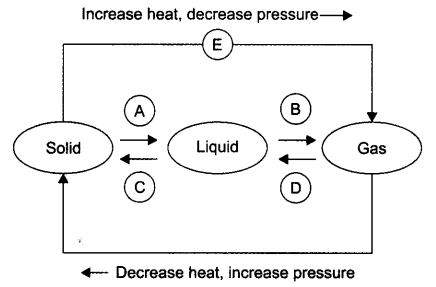
Answer: Atmospheric gases can be liquefied by cooling them and applying high pressure.
📝 Page 9
Q1. Why does a desert cooler cool better on a hot dry day?
Answer: On a hot dry day, the rate of evaporation is faster because the air is dry. Evaporation requires heat, which it takes from the surrounding air, thus cooling it more efficiently.
Q2. How does the water kept in an earthen pot (matka) become cool during summer?
Answer: Water slowly seeps through the pores of the pot and evaporates from the outer surface. The evaporation process absorbs heat from the water inside the pot, thereby cooling it.
Q3. Why does our palm feel cold when we put some acetone or petrol or perfume on it?
Answer: These liquids evaporate quickly, absorbing heat from the skin during evaporation, which makes the palm feel cold.
Q4. Why are we able to sip hot tea or milk faster from a saucer rather than a cup?
Answer: A saucer has a larger surface area than a cup, so the tea spreads out and cools faster due to faster evaporation.
Q5. What type of clothes should we wear in summer?
Answer: We should wear cotton clothes in summer. Cotton absorbs sweat and exposes it to air for easy evaporation, which cools the body.