
📝 Page 143
Q1: If a trait A exists in 10% of a population of an asexually reproducing species and a trait B exists in 60% of the same population, which trait is likely to have arisen earlier?
Answer:
Trait B is more common (60%) than trait A (10%), so it is likely to have arisen earlier in the population. In asexual reproduction, traits are passed unchanged, so older traits are more widespread.
Q2: How does the creation of variations in a species promote survival?
Answer:
Variations help species adapt to changing environments. If a change occurs, some individuals with beneficial variations can survive and reproduce, ensuring the species’ survival.
📝 Page 147
Q1: How do Mendel’s experiments show that traits may be dominant or recessive?
Answer:
Mendel found that when he crossed tall and short plants, all first-generation (F1) plants were tall. The short trait reappeared in the second generation (F2). This showed that the short trait was recessive, and tall was dominant.
Q2: How do Mendel’s experiments show that traits are inherited independently?
Answer:
Mendel crossed plants with two different traits (like tall plants with violet flowers and short plants with white flowers). The offspring showed new combinations, proving that traits are inherited independently, not linked.
Q3: A man with blood group A marries a woman with blood group O and their daughter has blood group O. Is this enough to say which trait is dominant?
Answer:
No, this information alone is not enough. Blood group A can be AA or AO. Since the child is O, the father must be AO and the mother OO. This suggests A is dominant over O, but we cannot confirm just from one example.
Q4: How is the sex of the child determined in human beings?
Answer:
Humans have XX (female) and XY (male) chromosomes. The mother always gives X, while the father can give X or Y. If the child gets X from father → girl (XX), if Y → boy (XY). So, the father decides the child’s sex.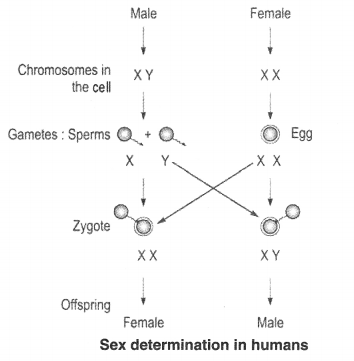
📝 Page 150
Q1: What are the different ways in which individuals with a particular trait may increase in a population?
Answer:
- If the trait provides a survival advantage
Natural selection favors it
The individuals with this trait reproduce more
Trait is passed on to the next generations
Q2: Why are traits acquired during the life-time of an individual not inherited?
Answer:
Acquired traits (like muscle build or scars) do not change the genes in reproductive cells, so they are not passed to the next generation.
Q3: Why are the small numbers of surviving tigers a cause of worry from the point of view of genetics?
Answer: Fewer tigers means less genetic variation. Low variation makes the population weaker against diseases or environmental changes and reduces chances of long-term survival.
📝 Page 151
Q1: What factors could lead to the rise of a new species?
Answer: The factors that would lead to the rise of a new species are the following :
- Geographical isolation of a population caused by various types of barriers (such as mountain ranges, rivers and sea). The geographical isolation leads to reproductive isolation due to which there is no flow of genes between separated groups of pupulation.
- Genetic drift caused by drastic changes in the frequencies of particular genes by chance alone.
- Variations caused in individuals due to a natural selection
Q2: Will geographical isolation be a major factor in the speciation of a self-pollinating plant species? Why or why not?
Answer:
No, because self-pollinating plants do not depend on other individuals for reproduction, so isolation doesn’t cause much genetic change.
Q3: Will geographical isolation be a major factor in the speciation of an organism that reproduces asexually? Why or why not?
Answer:
No, because asexual organisms produce genetically identical offspring, so isolation has little effect on genetic variation or speciation.
📝 Page 156
Q1: Give an example of characteristics being used to determine how close two species are in evolutionary terms.
Answer:
The forelimbs of humans and whales have similar bone structures, showing they came from a common ancestor, even if their functions are different.
Q2: Can the wing of a butterfly and the wing of a bat be considered homologous organs? Why or why not?
Answer:
No, they are analogous organs. Both are used for flying, but have different structures and different evolutionary origins.
Q3: What are fossils? What do they tell us about the process of evolution?
Answer:
Fossils are remains or imprints of ancient organisms.
They provide following information on the process of evolution.
- They tell about the changes that occured on the earth’s surface and the corresponding organisms.
- They tell about the gradual development of complex structured organisms from simple structured organisms.
- It is known through them that birds are evolved from reptiles.
- They exhibit the process of humana evolution.
📝 Page 158
Q1: Why are human beings who look so different from each other in terms of size, colour and looks said to belong to the same species?
Answer:
Despite physical differences, humans can reproduce with each other and have fertile offspring, so all humans belong to the same species.
Q2: In evolutionary terms, can we say which among bacteria, spiders, fish and chimpanzees have a ‘better’ body design? Why or why not?
Answer:
No, all body designs are suited to their environment. Evolution doesn’t mean “better”, it means better adapted to survive in their conditions.
Q1: A Mendelian experiment consisted of breeding tall pea plants bearing violet flowers with short pea plants bearing white flowers. The progeny all bore violet flowers, but almost half of them were short. This suggests that the genetic make-up of the tall parent can be depicted as:(a) TTWW
(b) TTww
(c) TtWW
(d) TtWw
Answer: (c) TtWW
Explanation:
- All progeny have violet flowers → violet is dominant. So, the parent must have WW or Ww (at least one dominant allele).
- Half the offspring are short → height trait is segregating. So, the tall parent must be heterozygous (Tt).
- So, the correct genotype is TtWW.
Q2: An example of homologous organs is:
(a) Our arm and a dog’s fore-leg
(b) Our teeth and an elephant’s tusks
(c) Potato and runners of grass
(d) All of the above
Answer: (d) All of the above
Explanation:
Homologous organs have the same basic structure, but may have different functions, and come from a common ancestor.
All given examples show structural similarity and hence are homologous.
Q3: In evolutionary terms, we have more in common with:
(a) A Chinese school-boy
(b) A chimpanzee
(c) A spider
(d) A bacterium
Answer: (a) A Chinese school-boy
Explanation:
All human beings belong to the same species (Homo sapiens). So, despite differences in appearance or geography, we are genetically closest to other humans.
Q4: A study found that children with light-coloured eyes are likely to have parents with light-coloured eyes. On this basis, can we say anything about whether the light eye colour trait is dominant or recessive? Why or why not?
Answer:
No, we cannot say whether the light eye colour trait is dominant or recessive based on this single observation.
To determine dominance, we need to observe several generations and track how the trait is passed on. One example is not enough for a conclusion.
Q5: How are the areas of study – evolution and classification – interlinked?
Answer:
Evolution and classification are closely related. Classification is based on similar traits, which are the result of evolutionary relationships.
Organisms with common ancestors are grouped together. So, classification reflects evolutionary history.
Q6: Explain the terms analogous and homologous organs with examples.
Answer:
- Homologous organs: Same basic structure but different function.
- Example: Forelimbs of humans and whales – same structure, but used for different purposes (grasping vs swimming).
- Analogous organs: Different structure but same function.
- Example: Wings of a bat and wings of a butterfly – both used for flying but built differently.
Q7: Outline a project which aims to find the dominant coat colour in dogs.
Answer: To find the dominant coat colour in dogs, mate two dogs with different coat colours and observe the offspring. If one colour consistently appears in all or most puppies, it is likely the dominant trait. Repeating the experiment with other dogs helps confirm the result.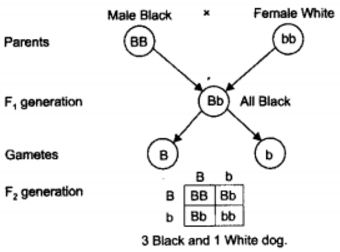
Q8: Explain the importance of fossils in deciding evolutionary relationships.
Answer:
Fossils are the preserved remains or imprints of ancient organisms. They provide clues about:
- What organisms lived in the past
- How species have changed over time
- Intermediate forms between groups (e.g., birds and reptiles)
Thus, fossils help trace the evolutionary history of life.
Q9: What evidence do we have for the origin of life from inanimate matter?
Answer:
The Miller-Urey experiment (1953) simulated early Earth conditions.
Simple gases like methane, ammonia, and hydrogen were mixed.
Electric sparks mimicked lightning.
After a week, amino acids (building blocks of life) were formed.
This showed that life could have originated from non-living matter under certain conditions.
Q10: Explain how sexual reproduction gives rise to more viable variations than asexual reproduction. How does this affect the evolution of those organisms that reproduce sexually?
Answer:
In sexual reproduction, genes come from two parents, leading to new gene combinations and more variation.
In asexual reproduction, offspring are clones, so variation is minimal.
More variation means better adaptability and faster evolution, which increases the chances of survival.
Q11: How is the equal genetic contribution of male and female parents ensured in the progeny?
Answer:
In human beings, equal genetic contribution from both male and female parents is ensured through the process of sexual reproduction. Each parent has 23 pairs of chromosomes, and during the formation of gametes (sperm and egg), each contributes only half — that is, 23 chromosomes. When the sperm from the father and the egg from the mother fuse during fertilization, the resulting zygote receives 23 chromosomes from each parent, making a total of 46 chromosomes. This way, the child inherits half of its genetic material from the father and half from the mother, ensuring equal genetic contribution from both parents.
Q12: Only variations that confer an advantage to an individual organism will survive in a population. Do you agree with this statement? Why or why not?
Answer:
No, not all variations give a survival advantage, but they can still be found in a population. For example, free earlobes and attached earlobes are just variations with no impact on survival. However, many other variations do help an organism adapt better to its environment. These useful variations may help the organism survive, reproduce, and pass on the trait to the next generation. So, most variations are helpful for better adaptation and increase the chances of survival in a changing environment.