
SEBA Class 10 Maths Chapter 1 Exercise 1.1 Solutions – Real Numbers
By Jamal Ali (M.Sc Physics, 5+ years teaching experience) · Reviewed by Editorial Board
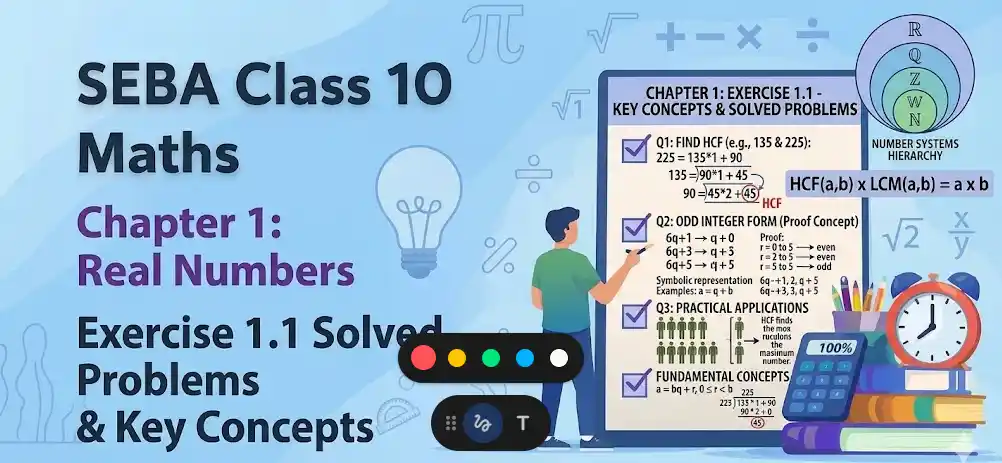
SEBA Class 10 Maths Chapter 1 Exercise 1.1 Solutions is the perfect starting point for students preparing for the 2026-27 HSLC examination under the updated SEBA curriculum. The chapter on Real Numbers introduces fundamental concepts like Euclid’s Division Lemma and number properties, which are essential for building a strong mathematical foundation.
Prepared according to the latest SEBA syllabus under ASSEB Division 1, introduced after the March 2026 update, these solutions help students understand concepts clearly and solve problems step by step. For a complete overview, students should also refer to the full Real Numbers chapter solutions. You can further strengthen your preparation using complete maths chapterwise solutions and practice important problems through structured question answers based on the latest SEBA syllabus.
SEBA Class 10 Maths Chapter 1 Exercise 1.1 Solutions with Step-by-Step Answers & Important Questions
Q1. Express each number as a product of its prime factors:
(i) 140
Answer: Given: 140
\(140 = 2 \times 2 \times 5 \times 7 = 2^2 \times 5 \times 7\)
(ii) 156
Answer: Given: 156
\(156 = 2 \times 2 \times 3 \times 13 = 2^2 \times 3 \times 13\)
(iii) 3825
Answer: Given: 3825
\(3825 = 3 \times 3 \times 5 \times 5 \times 17 = 3^2 \times 5^2 \times 17\)
(iv) 5005
Answer: Given: 5005
\(5005 = 5 \times 7 \times 11 \times 13\)
(v) 7429
Answer: Given: 7429
\(7429 = 17 \times 19 \times 23\)
Q2. Find the LCM and HCF of the following pairs of integers and verify that LCM × HCF = product of the two numbers:
(i) 26 and 91
Solution:
We have:
\[
26 = 2 \times 13,\quad 91 = 7 \times 13
\]
Here, 13 is the common prime factor.
So,
\[
\text{HCF}(26, 91) = 13
\]
Taking highest powers of all prime factors:
\[
\text{LCM}(26, 91) = 2 \times 7 \times 13 = 182
\]
Verification:
\[
LCM \times HCF = 182 \times 13 = 2366
\]
\[
26 \times 91 = 2366
\]
Hence verified.
(ii) 510 and 92
Solution:
We have:
\[
510 = 2 \times 3 \times 5 \times 17,\quad 92 = 2^2 \times 23
\]
Common factor = 2
\[
\text{HCF}(510, 92) = 2
\]
Taking greatest powers:
\[
\text{LCM}(510, 92) = 2^2 \times 3 \times 5 \times 17 \times 23 = 23460
\]
Verification:
\[
23460 \times 2 = 510 \times 92
\]
Hence verified.
(iii) 336 and 54
Solution:
We have:
\[
336 = 2^4 \times 3 \times 7,\quad 54 = 2 \times 3^3
\]
Common factors with smallest powers:
\[
\text{HCF}(336, 54) = 2 \times 3 = 6
\]
Taking greatest powers:
\[
\text{LCM}(336, 54) = 2^4 \times 3^3 \times 7 = 3024
\]
Verification:
\[
3024 \times 6 = 336 \times 54
\]
Hence verified.
Q3. Find the LCM and HCF of the following integers by applying the prime factorisation method:
(i) 12, 15 and 21
Solution:
We have:
\[
12 = 2^2 \times 3,\quad 15 = 3 \times 5,\quad 21 = 3 \times 7
\]
Common factor:
\[
\text{HCF} = 3
\]
Taking greatest powers:
\[
\text{LCM} = 2^2 \times 3 \times 5 \times 7 = 420
\]
(ii) 17, 23 and 29
Solution:
We have:
\[
17, 23, 29 \text{ are prime numbers}
\]
So,
\[
\text{HCF} = 1
\]
\[
\text{LCM} = 17 \times 23 \times 29 = 11339
\]
(iii) 8, 9 and 25
Solution:
We have:
\[
8 = 2^3,\quad 9 = 3^2,\quad 25 = 5^2
\]
No common factor:
\[
\text{HCF} = 1
\]
Taking greatest powers:
\[
\text{LCM} = 2^3 \times 3^2 \times 5^2 = 1800
\]
Q4. Given that HCF (306, 657) = 9, find LCM (306, 657).
Answer: Given: HCF = 9, numbers = 306, 657
We know,
\[
LCM \times HCF = \text{Product of numbers}
\]
\[
LCM = \frac{306 \times 657}{9}
\]
First find the product:
\[
306 \times 657 = 201042
\]
Now divide:
\[
LCM = \frac{201042}{9} = 22338
\]
Q5. Check whether \(6^n\) can end with the digit 0 for any natural number n.
Solution:
We know that a number ending with 0 must be divisible by 10.
That means it must contain factors 2 and 5.
Now,
\[
6^n = (2 \times 3)^n = 2^n \times 3^n
\]
It contains factors 2 and 3 only, but no factor 5.
So, it cannot be divisible by 10.
Final Answer: \(6^n\) cannot end with digit 0 for any natural number \(n\).
Q6. Explain why 7 × 11 × 13 + 13 and 7 × 6 × 5 × 4 × 3 × 2 × 1 + 5 are composite numbers.
Answer:
(i) \(7 \times 11 \times 13 + 13 = 13(7 \times 11 + 1)\)
So, it is divisible by 13 → composite
(ii) \(7! + 5 = 7 \times 6 \times 5 \times 4 \times 3 \times 2 \times 1 + 5\)
\(= 5(remaining terms + 1)\)
So divisible by 5 → composite
Q7. There is a circular path around a sports field. Sonu takes 18 minutes, Ravi takes 12 minutes, and Sona takes 18 minutes to complete one round. If they start together, after how many minutes will they meet again?
Answer:
Time = LCM of 18, 12, 18
\[
LCM = 36
\]
Final Answer: They will meet again after 36 minutes.
Q8. Solve the following:
(i) The soldiers in a regiment can be stood in some rows consisting of 15, 20 or 25 soldiers in each row. Find the least number of soldiers in the regiment.
Answer:
Given: Number of soldiers per row = 15, 20, 25
We need to find the smallest number which is divisible by all three numbers.
So, we find LCM of 15, 20 and 25.
Prime factorisation:
\[
15 = 3 \times 5,\quad 20 = 2^2 \times 5,\quad 25 = 5^2
\]
Taking highest powers:
\[
LCM = 2^2 \times 3 \times 5^2 = 300
\]
Final Answer: The least number of soldiers = 300
(ii) All bells ring at every 18 seconds, another bell rings at every 60 seconds. If these two bells ring simultaneously at an instant, then find after how many seconds they will ring simultaneously again.
Answer:
Given: Time intervals = 18 seconds and 60 seconds
To find when they ring together again, we calculate LCM of 18 and 60.
Prime factorisation:
\[
18 = 2 \times 3^2,\quad 60 = 2^2 \times 3 \times 5
\]
Taking highest powers:
\[
LCM = 2^2 \times 3^2 \times 5 = 180
\]
Final Answer: They will ring together again after 180 seconds.
(iii) A radio station plays ‘Assam Sangeet’ once every two days. Another radio station plays the same song once every three days. How many times in 30 days will both the stations play the same song on the same day?
Answer:
Given: First station = every 2 days, Second station = every 3 days
To find when both play together, we find LCM of 2 and 3.
\[
LCM = 6
\]
So, both stations play the song together every 6 days.
Now, in 30 days:
\[
30 \div 6 = 5
\]
Final Answer: They will play together 5 times in 30 days.
Q8 (iv). An army contingent of 616 members is to march behind an army band of 32 members in a parade. The two groups are to march in the same number of columns. What is the maximum number of columns in which they can march?
Answer:
Given: Army = 616 members, Band = 32 members
They must march in same number of columns.
So, we find HCF of 616 and 32.
Prime factorisation:
\[
616 = 2^3 \times 7 \times 11,\quad 32 = 2^5
\]
Common factor:
\[
HCF = 2^3 = 8
\]
Final Answer: Maximum number of columns = 8
Q8 (v). Himadri has a collection of 625 Indian postal stamps and 325 International postal stamps. She wants to display them in identical groups of Indian and international stamps with no stamps left out. What is the greatest number of groups Himadri can display the stamps?
Answer:
Given: Indian stamps = 625, International stamps = 325
We need maximum equal groups → find HCF of 625 and 325.
Prime factorisation:
\[
625 = 5^4,\quad 325 = 5^2 \times 13
\]
Common factor:
\[
HCF = 5^2 = 25
\]
Final Answer: Maximum number of groups = 25
Q8 (vi). Two ropes are of length 64 cm and 80 cm. Both are to be cut into pieces of equal length. What should be the maximum length of each piece?
Answer:
Given: Lengths = 64 cm and 80 cm
We need largest possible equal length → find HCF.
Prime factorisation:
\[
64 = 2^6,\quad 80 = 2^4 \times 5
\]
Common factor:
\[
HCF = 2^4 = 16
\]
Final Answer: Maximum length of each piece = 16 cm
Q9. Find the greatest number of 4 digits which is exactly divisible by 18, 24 and 36.
Answer:
Given: Numbers = 18, 24, 36
First find LCM:
\[
18 = 2 \times 3^2,\quad 24 = 2^3 \times 3,\quad 36 = 2^2 \times 3^2
\]
\[
LCM = 2^3 \times 3^2 = 72
\]
Largest 4-digit number = 9999
Now divide:
\[
9999 \div 72 = 138 \text{ remainder } 63
\]
So required number:
\[
9999 - 63 = 9936
\]
Final Answer: 9936
Q10. 1245 is a factor of the numbers p and q. Which of the following will have 1245 as a factor?
(i) p + q
(ii) p × q
(iii) p × q
(iv) p ÷ q
Choose the correct answer:
(A) only (iii)
(B) only (ii) and (ii)
(C) only (i), (ii) and (iii)
(D) All (i), (ii), (iii) and (iv)
Answer: (B) only (ii) and (iii)
A number will be a factor when it divides the expression completely.
Multiplication expressions (ii) and (iii) will contain the factor 1245.
Q11. Match the columns
| Column I | Column II |
|---|---|
|
P Number which is neither prime nor composite Q Only even prime number is R HCF of 12, 15, 21 is S LCM of 2 and 9 is |
1) 18 2) 3 3) 2 4) 1 |
Choose the correct option:
A) P-4, Q-3, R-2, S-1
B) P-3, Q-2, R-1, S-4
C) P-2, Q-4, R-3, S-1
D) P-1, Q-2, R-3, S-4
Answer: (D) P-1, Q-2, R-3, S-4
P → 1 (Neither prime nor composite is 1)
Q → 2 (Only even prime number is 2)
R → 3 (HCF of 12,15,21 = 3)
S → 4 (LCM of 2 and 9 = 18)
Q12. Which of the following statement is true or false
Statement (P): HCF of two consecutive natural numbers is 1
Statement (Q): HCF of two co-prime numbers is 1
Choose the correct option:
A) P is true, Q is false
B) P is false, Q is true
C) Both P & Q are true
D) Both P & Q are false
Answer: (C) Both P & Q are true
Consecutive numbers always have HCF = 1.
Co-prime numbers also have HCF = 1.
Therefore, both statements are true.
Q13. Two positive integers P and Q can be expressed as \(P = ab^2\) and \(Q = a^2b\), where a and b are prime numbers. The LCM of P and Q is
A) \(a^2b^2\)
B) \(a^2b^2\)
C) \(ab\)
D) \(ab^2\)
Answer: (A) \(a^2b^2\)
Given:
\(P = ab^2,\quad Q = a^2b\)
LCM takes highest powers:
\[ LCM = a^2 \times b^2 \]
Q14. For the numbers P = 119; Q = 462; R = 105; S = 2310. Choose the option that represents the correct increasing sequence of number of prime factors
A) P, Q, R, S
B) P, R, Q, S
C) Q, P, S, R
D) R, S, P, Q
Answer: (B) P, R, Q, S
\(119 = 7 \times 17\) → 2 factors
\(105 = 3 \times 5 \times 7\) → 3 factors
\(462 = 2 \times 3 \times 7 \times 11\) → 4 factors
\(2310 = 2 \times 3 \times 5 \times 7 \times 11\) → 5 factors
Increasing order:
P → R → Q → S
Q15. Assertion (A): 3 and 10 are co-prime numbers
Reason (R): a and b are co-prime numbers if they have no common factors other than 1.
Choose the correct option:
A) Both (A) and (R) are true and Reason (R) is correct explanation of Assertion (A)
B) Both (A) and (R) are true but Reason (R) is not correct explanation
C) Assertion (A) is true but Reason (R) is false
D) Assertion (A) is false but Reason (R) is true
Answer: (A)
3 and 10 have no common factor except 1 → co-prime ✔
Reason correctly defines co-prime numbers ✔
Q16. Observe the factor tree and answer the questions:
(i) The value of x is
Answer: (d) 3825
(ii) The value of y is
Answer: (b) 25
(iii) The value of z is
Answer: (b) 17
(iv) The value of x + y + z is
Answer: (b) 3847
From tree:
\(1275 = 3 \times 425\)
\(425 = 5 \times 85\)
\(85 = 5 \times 17\)
So,
\(y = 25,\; z = 17\)
\(x = 3 \times 1275 = 3825\)
Sum:
\(x + y + z = 3825 + 25 + 17 = 3847\)
Q17. A inter school seminar being conducted by an NGO related to education, where the participants will be educators of different subjects. The number of participants in Science, English and Mathematics are 60, 84 and 108 respectively.
(i) In each room the same number of participants are to be seated and all of them being from the same subject. Find the maximum number of participants that can be accommodated in each room.
Answer:
Given: Science = 60, English = 84, Mathematics = 108
We need maximum equal number → find HCF of 60, 84 and 108.
Prime factorisation:
\[
60 = 2^2 \times 3 \times 5
\]
\[
84 = 2^2 \times 3 \times 7
\]
\[
108 = 2^2 \times 3^3
\]
Common factors with smallest powers:
\[
HCF = 2^2 \times 3 = 12
\]
Final Answer: Maximum participants in each room = 12
(ii) What is the minimum number of rooms required for the event?
Answer:
Each room has 12 participants.
Rooms required:
\[
\frac{60}{12} = 5,\quad \frac{84}{12} = 7,\quad \frac{108}{12} = 9
\]
Total rooms:
\[
5 + 7 + 9 = 21
\]
Final Answer: Minimum number of rooms = 21
(iii) Find the LCM of 60, 84 and 108.
Answer:
Using prime factors:
\[
60 = 2^2 \times 3 \times 5
\]
\[
84 = 2^2 \times 3 \times 7
\]
\[
108 = 2^2 \times 3^3
\]
Taking greatest powers:
\[
LCM = 2^2 \times 3^3 \times 5 \times 7
\]
\[
= 4 \times 27 \times 5 \times 7 = 3780
\]
Final Answer: LCM = 3780
(iv) Find the product of HCF and LCM of 60, 84 and 108.
Answer:
\[
HCF = 12,\quad LCM = 3780
\]
\[
\text{Product} = 12 \times 3780 = 45360
\]
Final Answer: Product = 45360
📚 Explore More SEBA Class 10 Learning Resources
• Improve your preparation with SEBA Class 10 Assamese Medium chapterwise question answers for better understanding in your preferred language.
• Get subject-wise clarity through Class 10 Science chapter-wise solutions (SEBA) to strengthen core concepts and numerical problem-solving.
• Prepare theory subjects effectively with SEBA Class 10 Social Science chapter-wise solutions covering history, geography, and civics in detail.
• For elective subject preparation, explore Class 10 Elective Geography chapter-wise solutions aligned with the latest Assam Board syllabus.
• Access complete Assamese medium resources from Assam Board Assamese medium solutions hub for all subjects as per the updated 2026 curriculum.
SEBA Class 10 Maths Chapter 1 Exercise 1.1 Solutions – Complete Guide to Real Numbers | Assam Eduverse
The chapter on Real Numbers lays the groundwork for many advanced topics in mathematics, and understanding it properly is essential for success in HSLC exams. The SEBA Class 10 Maths Chapter 1 Exercise 1.1 Solutions helps students grasp fundamental concepts like Euclid’s Division Lemma and its applications, which are frequently asked in exams.
To score well, students should regularly practice SEBA Class 10 Maths chapter 1 important questions exercise 1.1, as these questions are designed based on previous exam trends. They not only improve conceptual clarity but also help in understanding the pattern of questions asked in the board exams.
Using SEBA Class 10 Maths chapterwise solutions exercise 1.1 allows students to follow a structured approach to problem-solving. Each solution is explained step by step, making it easier to understand the logic behind each method instead of memorizing formulas blindly.
For flexible study and quick revision, many students prefer accessing SEBA Class 10 Maths real numbers exercise 1.1 solutions pdf, which allows them to revise important concepts anytime. This is especially helpful during last-minute preparation before exams.
Additionally, practicing SEBA HSLC Maths real numbers ex 1.1 solved questions ensures that students become familiar with different types of problems and develop confidence in solving them accurately within time limits.
To further strengthen your preparation, students can explore foundation-level solutions and improve accuracy through chapterwise MCQ practice. These resources help in building a strong base and enhancing problem-solving speed.
It is also important to note that all these solutions are based on the newly updated SEBA Mathematics book introduced in 2026, after the discontinuation of older textbooks. Following the updated content ensures that students are studying exactly what is required for the current HSLC exam pattern.
A smart preparation strategy includes understanding concepts deeply, practicing regularly, and analyzing mistakes. Instead of focusing only on answers, students should try to understand the reasoning behind each step, which helps in tackling unfamiliar problems with ease.
In conclusion, mastering Exercise 1.1 is the first step toward building a strong foundation in mathematics. With consistent practice, the right study materials, and a clear understanding of concepts, students can confidently approach their exams and achieve excellent results in HSLC Maths.
FAQs – SEBA Class 10 Maths Chapter 1 Exercise 1.1 Solutions
1. What concepts are covered in SEBA Class 10 Maths Chapter 1 Exercise 1.1?
Exercise 1.1 focuses on Euclid’s Division Lemma and its applications. It helps students understand how to find HCF using division methods and builds the foundation for number system concepts.
2. How important is Exercise 1.1 for SEBA HSLC Maths exam?
Exercise 1.1 is very important as questions based on Euclid’s Division Lemma are frequently asked in HSLC exams. It strengthens basic concepts that are useful in later chapters as well.
3. Where can I get SEBA Class 10 Maths real numbers exercise 1.1 solutions PDF?
You can access updated and accurate PDF solutions on trusted educational platforms like Assam Eduverse, which follow the latest SEBA syllabus and exam pattern.
4. How to prepare Exercise 1.1 effectively for better marks?
Start by understanding the concept of Euclid’s Division Lemma, then practice all textbook questions and similar problems. Regular revision and solving previous year questions will improve accuracy and confidence.
🎓 About Assam Eduverse
Assam Eduverse is an educational platform focused on providing study resources for students under SEBA, AHSEC (ASSEB), SCERT, and CBSE.
The platform offers chapter-wise notes, solutions, MCQs, important questions, and previous year papers for Class 9–12. All materials are prepared according to the latest Assam Board syllabus and follow current exam patterns.
Content is designed to help students understand concepts clearly, practice regularly, and improve performance in board examinations. Both Assamese and English medium resources are available to support different learning needs.
Explore MCQs practice questions, complete study materials, ASSEB solutions, and exam preparation guides to strengthen preparation and revision. 📘 Visit Assam Eduverse for free Assam Board Solutions, notes, and study materials prepared by experts.