
By Jamal Ali (M.Sc Physics, 5+ years teaching experience) · Reviewed by Editorial Board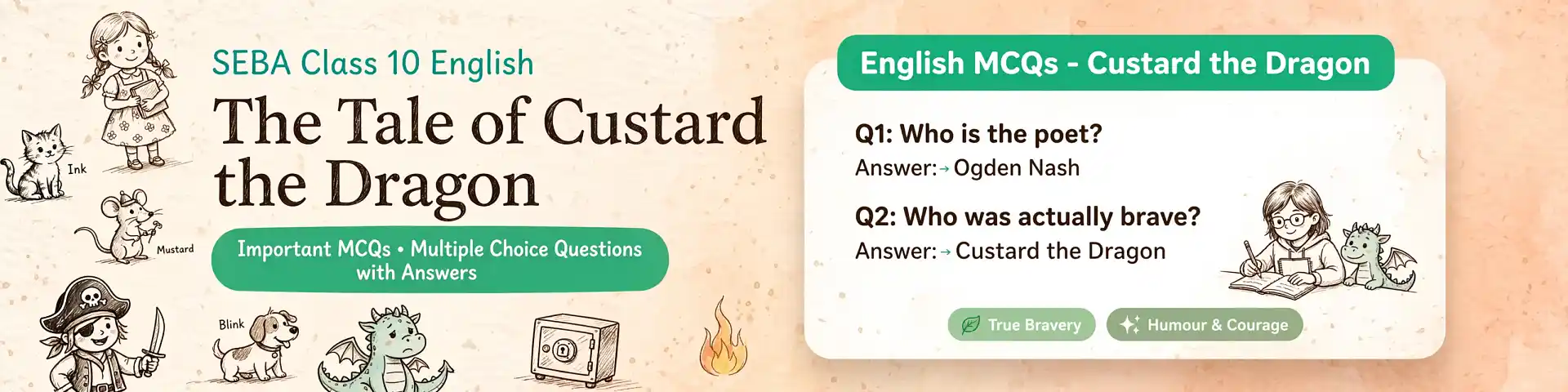
SEBA Class 10 English The Tale of Custard the Dragon Important MCQs help students prepare effectively for the 2026–27 Assam Board examination by revising one of Ogden Nash’s most humorous poems through focused objective practice. The poem appears playful on the surface, but its story of Belinda, her pets, and the supposedly cowardly Custard explores important ideas about real courage, appearance versus reality, humility, and the difference between boasting and actually facing danger. Understanding these contrasts is essential for answering both direct and interpretation-based questions. Students can also study the The Tale of Custard the Dragon solutions for a detailed understanding of the poem.
Students can use the interactive MCQ quiz to practise HSLC English The Tale of Custard the Dragon Important Questions along with relevant previous-year HSLC MCQs and explanations. The practice covers Custard’s character, the pirate’s arrival, the reactions of Belinda and the other animals, irony, humour, rhyme, poetic devices, and the poem’s message, with question formats such as assertion-reasoning, match-the-following, statement-based, and multiple-correct-option MCQs where suitable. For additional English preparation, students can also refer to the SEBA Class 10 MCQs, then attempt the quiz, check their score, and use the downloadable MCQ PDF for further revision.
Before You Start
Practice SEBA Class 10 English MCQs with PYQs based on the latest syllabus. Answer chapter-wise questions, get instant results with detailed explanations, and improve your exam preparation for Final
Chocolate was harmful for Amanda’s — HSLC ’23
Explanation
In Robin Klein’s poem, the speaker scolds Amanda: "Don’t eat that chocolate, Amanda! Remember your acne, Amanda!" Consuming chocolate is believed to trigger or worsen her facial pimples, prompting the mother to restrict her sweet treats.
Custard was the name of a — HSLC ’23
Explanation
In Ogden Nash's humorous ballad, Belinda lived in a little white house with four pets. Her cowardly pet dragon, who constantly cried for a nice safe cage, was called Custard.
From your reading of ‘The Tale of Custard the Dragon’, choose the correct option. HSLC 2024
Explanation
The poem introduces Belinda's household pets with their specific colours: the little kitten was black (named Ink), the little mouse was grey (named Blink), and the little dog was sharp as mustard (yellow).
In “The Tale of Custard, the Dragon,” how is Custard portrayed before the arrival of the pirates? HSLC 2025
Explanation
Prior to the pirate’s intrusion, Custard is depicted as cowardly and timid, constantly whimpering for a safe cage while Belinda, Ink, Blink, and Mustard mock his apparent lack of courage.
Where did young Belinda live along with her little pets?
Explanation
The ballad opens by describing Belinda’s cozy dwelling: "Belinda lived in a little white house, with a little black kitten and a little grey mouse." She shared this humble home with four domestic pets and a little red wagon.
Assertion (A): Belinda named her little black kitten Ink and her little grey mouse Blink.
Reason (R): The names were chosen playfully based on their appearance, size, and quick scurrying habits.
Explanation
- Assertion Analysis: The poet writes: "Now the name of the little black kitten was Ink, / And the little grey mouse, she called him Blink" (True).
- Reasoning Analysis: Ogden Nash cleverly assigned whimsical, rhyming names reflecting their visual traits—the kitten as dark as ink and the tiny mouse moving in the blink of an eye (True, and explains A).
What was the pet name given to the lively little black kitten?
Explanation
Belinda named her pitch-black kitten Ink to mirror its inky coat colour. Along with Blink, Ink was often boasted to be brave enough to chase lions down the stairs.
Match Belinda's household pets with their corresponding names and physical characteristics:
| Column A (Pet Animal) | Column B (Name & Description) |
|---|---|
| (a) Little grey mouse | (1) Mustard, sharp and yellow as mustard flower |
| (b) Little yellow dog | (2) Custard, cried constantly for a nice safe cage |
| (c) Big pet dragon | (3) Blink, nimble and living in a mousehole |
Explanation
- a – 3 (Grey mouse): Named Blink, who quickly "mouseholed" to hide from danger.
- b – 1 (Yellow dog): Named Mustard, compared to a fierce tiger in a rage.
- c – 2 (Dragon): Named Custard, mocked as cowardly because he cried for a safe cage.
What was the name of the little grey mouse sharing Belinda's home?
Explanation
The little grey mouse was christened Blink. Along with the other household companions, Blink routinely ridiculed Custard by rudely comparing him to the legendary knight Sir Percival.
Which pet animal in the poem was named Mustard because of its sharp yellow colour?
Explanation
Belinda’s dog was described: "the little dog was sharp as mustard," and therefore she called him Mustard, alluding to the pungent sharpness and yellow hue of the spice.
What unusual, un-dragonlike comfort did Custard always weep and cry for?
Explanation
Instead of displaying wild aggression or pride, Custard was exceedingly timid during peaceful times: "And Custard cried for a nice safe cage," earning him the label of a cowardly dragon from the household.
Assertion (A): Custard’s physical anatomy was described using striking, fiery imagery like a fireplace and chimney.
Reason (R): His mouth belched fire like a hearth, his nose breathed smoke like a chimney, and his toes resembled sharp daggers.
Explanation
- Assertion Analysis: The poet equips Custard with all the classic, terrifying attributes of a traditional mythical dragon (True).
- Reasoning Analysis: The text uses vivid metaphors: "Mouth like a fireplace, chimney for a nose, / And realio, trulio daggers on his toes" (True, and explains A).
In the poet's vivid figurative description, Custard’s mouth was compared to a —
Explanation
Using a simile, the poet writes: "Mouth like a fireplace," because a dragon breathes flames from its throat, followed by smoke billowing from its nostrils like a chimney.
What sharp, lethal weapon were the formidable claws and toes of Custard likened to?
Explanation
The poet emphasizes Custard's formidable claws by concluding the anatomical description with: "And realio, trulio daggers on his toes."
How was little dog Mustard’s supposed battlefield bravery boastfully described?
Explanation
The ballad uses an exaggerated comparison: "Mustard was as brave as a tiger in a rage," though this boast collapsed into squealing terror the moment genuine danger appeared.
According to the boasting household, what ferocious apex predators could Ink and Blink chase down the stairs?
Explanation
Belinda took immense pride in her tiny pets' supposed bravery, claiming: "Ink and Blink chased lions down the stairs," an obvious hyperbole designed to contrast with Custard's timidity.
Match the menacing physical details of the invading pirate with his weapons and features:
| Column A (Feature / Weapon) | Column B (Detail in Poem) |
|---|---|
| (a) Cutlass bright | (1) Held tightly between his teeth |
| (b) Pistol weapons | (2) Carried in his left and right hands |
| (c) Physical handicap | (3) One leg was made of wood |
Explanation
- a – 1 (Cutlass bright): A curved pirate sword clutched menacingly in his teeth.
- b – 2 (Pistols): Armed with loaded firearms in both his left and right hands.
- c – 3 (Physical handicap): Displayed the classic pirate trait: one leg was wood.
Where was the menacing, shiny cutlass held by the pirate as he climbed into the window?
Explanation
Holding pistols in each hand, the intruder gripped his blade with his mouth: "Pistol in his left hand, pistol in his right, / And he held in his teeth a cutlass bright."
What physical handicap did the pirate have, proving that he meant no good?
Explanation
The ballad describes the intruder's villainous appearance: "His beard was black, one leg was wood; / It was clear that the pirate meant no good."
How did Mustard, the "tiger-brave" dog, react when the armed pirate broke in through the window?
Explanation
The moment real danger struck, Mustard’s boasted courage vanished: "Mustard fled with a terrified yelp," abandoning Belinda on the spot.
What cowardly action did Blink the mouse take the second the pirate breached the house?
Explanation
Blink abandoned all his lion-chasing boasts in a flash: "little mouse Blink strategically mouseholed," ducking into his tiny hole to save his own life.
When all other pets abandoned Belinda, who stepped forward and swallowed the pirate whole?
Explanation
Custard jumped up snorting like an engine, clashed his tail like irons in a dungeon, charged the intruder like a robin at a worm, and gobbled the pirate every bit.
How did humble Custard behave immediately after saving everyone by killing the pirate?
Explanation
When Mustard, Ink, and Blink started making excuses and claiming they would have been thrice as brave, Custard gently replied: "I quite agree / That everybody is braver than me." True heroes don't boast.
Read the following statements regarding Custard's nature and choose the correct option:
Statement I: Custard looked fierce with big sharp teeth, spikes on top, and scales underneath.
Statement II: Custard was truly regarded as bold and brave before the pirate attacked.
Explanation
- Statement I is True: The poet details his formidable looks: "Custard the dragon had big sharp teeth, / And spikes on top of him and scales underneath."
- Statement II is False: Before the crisis, everyone treated him as a coward and teased him mercilessly because he cried for a cage.
Read the following statements regarding the confrontation with the pirate and choose the correct option:
Statement I: The pirate discharged two bullets from his pocket pistols at Custard.
Statement II: Both fired bullets struck Custard and left him severely wounded.
Explanation
- Statement I is True: The startled pirate "fired two bullets" at the charging dragon.
- Statement II is False: The poet notes: "but they didn’t hit, / And Custard gobbled him, every bit." Custard remained completely unharmed.
Read the following statements regarding Belinda's reaction to the pirate and choose the correct option:
Statement I: Belinda paled in terror and cried out desperately for help.
Statement II: Belinda stood her ground and bravely fought the pirate hand-to-hand.
Explanation
- Statement I is True: Despite claiming to be as brave as a barrel of bears, "Belinda paled, and she cried Help! Help!"
- Statement II is False: She did not fight the pirate at all; she panicked completely until Custard intervened.
Read the following statements regarding the poetic form and choose the correct option:
Statement I: ‘The Tale of Custard the Dragon’ is composed in the musical style of a ballad.
Statement II: The poem adopts a playful, humorous, and satirical tone throughout.
Explanation
Both statements are true: Ogden Nash parodies heroic folk poetry by shaping this piece as a musical ballad loaded with comic wordplays ("realio, trulio"), slapstick action, and humorous irony.
Read the following statements regarding the aftermath of the battle and choose the correct option:
Statement I: Once the pirate was killed, the cowardly pets resumed their empty boasting.
Statement II: Custard arrogantly claimed that he was the only truly brave creature in the house.
Explanation
- Statement I is True: The moment the peril passed, Mustard, Ink, and Blink immediately began bragging again about how brave they would have been.
- Statement II is False: Custard showed true humility, readily admitting that everybody else was braver than him and returning quietly to his desire for a safe cage.
How was Belinda’s supposed courage poetically exaggerated by Ogden Nash?
Explanation
In stanza four, the poet introduces Belinda's exaggerated bravery using alliteration and hyperbole: "Belinda was as brave as a barrel full of bears." Despite this boast, her courage evaporated into panicked screams the moment the armed pirate breached the house.
Assertion (A): The armed pirate gained entry into Belinda's little white house through the window.
Reason (R): Hearing a nasty sound, the pets looked around and saw a villainous pirate scaling the wooden sill into the room.
Explanation
- Assertion Analysis: The intruder broke in through an elevated opening rather than walking through the front door (True).
- Reasoning Analysis: The poet writes: "Suddenly, suddenly they heard a nasty sound... climbing in the winda" (poetic license for window), terrifying the household (True, and directly explains A).
Through which entry point did the villainous pirate break into the house?
Explanation
The ballad describes the sudden break-in using playful rhyme: "And there was a pirate, climbing in the winda" (intentionally misspelled to rhyme with Belinda), making the window his breach point.
Match the sounds and auditory reactions made by Belinda’s pets with their respective characters:
| Column A (Sound / Cry) | Column B (Pet Making the Sound) |
|---|---|
| (a) “Meowch!” | (1) Blink, giggling inside the house |
| (b) “Weeck!” | (2) Mustard, growling at the nasty noise |
| (c) Growled & yelped | (3) Ink, startled on seeing the pirate |
Explanation
- a – 3 (“Meowch!”): The alarmed yowl cried out by Ink the kitten when the pirate was spotted.
- b – 1 (“Weeck!”): The tiny giggling squeak made by Blink the mouse when teasing Custard.
- c – 2 (Growled & yelped): Mustard the dog first growled at the sound, then fled with a terrified yelp.
In the anatomical description of Custard, what was his smoke-emitting nose compared to?
Explanation
Using vivid domestic metaphors, Ogden Nash pairs the fiery mouth with his snout: "Mouth like a fireplace, chimney for a nose," highlighting the trail of hot smoke curling from the dragon's nostrils.
What startled sound did Ink the black kitten let out upon hearing the intruder at the window?
Explanation
When the pirate entered, the pets panicked in unison: "Mustard growled, and they all looked around. / Meowch! cried Ink, and Ooh! cried Belinda."
How did the poet onomatopoeically write the giggling sound made by Blink the mouse?
Explanation
When the household gathered to laugh at Custard's supposed cowardice, "Belinda giggled till she shook the house, / And Blink said Weeck! which is giggling for a mouse."
Before opening fire on the dragon, what container did the pirate draw liquor from to steady his nerves?
Explanation
Stunned by Custard's roaring defense, the pirate gaped and drank grog: "The pirate gaped at Belinda’s dragon, / And gulped some grog from his pocket flagon."
With what rapid, predatory simile did Custard launch his decisive counter-attack on the pirate?
Explanation
The poet uses a comical bird-and-prey comparison to depict Custard's swift assault: "He went at the pirate like a robin at a worm," gobbling him up in a single, decisive stroke.
Where did Ink the black kitten scurry off to hide when the pirate opened fire?
Explanation
Every boast of bravery collapsed during the attack: "little kitten Ink trickled down to the bottom of the household," sneaking into the deepest, lowest corner of the house to save his skin.
Which distinct physical handicap confirmed that the menacing pirate was up to no good?
Explanation
The visual portrait of the raider included classic villainous elements: "His beard was black, one leg was wood; / It was clear that the pirate meant no good."
Following Custard’s victory over the intruder, for whom did nobody in the white house shed a single tear?
Explanation
Rather than feeling remorse over the intruder's violent end, the household rejoiced: "Belinda embraced him, Mustard licked him, / No one mourned for his pirate victim."
Read the following statements regarding Custard's character and choose the correct option:
Statement I: Custard possessed a formidable exterior with spikes on top, scales underneath, and dagger-like toes.
Statement II: Custard’s outward ferocious appearance perfectly matched his daily timid behavior at home.
Explanation
- Statement I is True: The poem describes him as equipped with sharp teeth, spikes, scales, and dagger claws.
- Statement II is False: There is complete irony between his looks and his usual manner; despite looking like a monster, he whimpered for a safe cage, contradicting his fearsome appearance.
Read the following statements regarding Mustard’s conduct and choose the correct option:
Statement I: Mustard growled defensively when he first detected the strange, nasty noise.
Statement II: Mustard bravely charged the pirate and pinned him down to the floor.
Explanation
- Statement I is True: When the sound broke out, "Mustard growled, and they all looked around."
- Statement II is False: Instead of attacking, Mustard panicked and fled with a terrified yelp the second the pirate appeared.
Read the following statements regarding poetic devices in the ballad and choose the correct option:
Statement I: The poet deliberately invents and repeats the playful words “realio, trulio” across multiple stanzas.
Statement II: The repetition of “realio, trulio” is intended to introduce a sombre, serious, and tragic tone.
Explanation
- Statement I is True: Ogden Nash coinages like "realio, trulio" recur as a refrain throughout the ballad.
- Statement II is False: Far from being sombre, this repetition creates a lighthearted, rhythmic, and whimsical comic effect.
Read the following statements regarding domestic teasing and choose the correct option:
Statement I: Belinda tickled Custard unmercifully, while Ink, Blink, and Mustard teased him rudely as Percival.
Statement II: The pets regularly showered Custard with genuine praise and respect before the pirate arrived.
Explanation
- Statement I is True: Belinda "tickled him unmerciful" while the pets sarcastically mocked him as cowardly Percival.
- Statement II is False: They never praised him; they laughed at his desire for a cage until he saved them.
Read the following statements regarding the gunfire exchange and choose the correct option:
Statement I: The startled pirate drew his weapons and fired two bullets directly at charging Custard.
Statement II: The bullets struck Custard in the chest, forcing him to retreat.
Explanation
- Statement I is True: Confronted by a fire-breathing beast, the pirate discharged two shots point-blank.
- Statement II is False: The shots failed completely: "but they didn’t hit, / And Custard gobbled him, every bit."
Which character offered the excuse: “I’d have been twice as brave if I hadn’t been flustered”?
Explanation
To justify running away in terror, Mustard made an excuse: "And Mustard said, I’d have been twice as brave if I hadn’t been flustered," followed by Ink and Blink claiming they would have been thrice as brave.
To what subterranean acoustic sound was the clash of Custard’s heavy tail compared?
Explanation
Custard transformed into a ferocious beast before charging: "He went at the pirate... with a clatter and a clank and a jangling squirm, / clashed his tail like irons in a dungeon."
Despite proving himself to be the sole genuine hero, how does the poem conclude regarding Custard?
Explanation
The closing stanza repeats the opening setup, emphasizing humorous circularity: Belinda still lives in her white house boasting of bravery, while humble Custard still cries for a nice safe cage.
Read the following statements regarding the pets' celebration and choose the correct option:
Statement I: Ink and Blink danced and gyrated in glee in circles around Custard.
Statement II: The household pets mourned deeply for the loss of the pirate victim.
Explanation
- Statement I is True: Once the danger was over, "Ink and Blink in glee did gyrate / Around the dragon that ate the pirate."
- Statement II is False: No one felt sorry for the pirate; they celebrated his demise with joyful dancing.
Read the following statements regarding the literary merit of the ballad and choose the correct option:
Statement I: The poem relies on parody, intentional misspellings, and lighthearted humor.
Statement II: The story conveys the moral lesson that true bravery is proven through deeds rather than empty words.
Explanation
Both statements are true: Ogden Nash crafts a masterpiece of comic parody, while offering an insightful moral: boastful talkers run when real danger arrives, whereas true courage is demonstrated through action when it matters most.
🎉 Congratulations!
You have successfully completed this quiz.
🎓 Generate Your Personalized Certificate
Enter your full name exactly as you want it to appear on your certificate.