
Biology (Theory) – H.S. Final Exam 2022
Complete Answers
PART – I (BOTANY)
Q.1 What is Plasmid? (1)
Answer:A plasmid is a small, circular, double-stranded extrachromosomal DNA molecule found in bacteria that can replicate independently of chromosomal DNA.
Q.2 Name the plant body where bisexual and both unisexual male and female flowers are present. (1)
Answer: Cucurbita (Pumpkin).
Q.3 Write full form of VAM. (1)
Answer: Vesicular Arbuscular Mycorrhiza.
Q.4 Who proposed Mutation theory? (1)
Answer: Hugo de Vries proposed the Mutation theory.
Q.5 What is biogas? (2)
Answer: Biogas is a mixture of gases, mainly methane, produced by anaerobic decomposition of organic waste like cow dung by microorganisms and used as a fuel.
Q.6 Name two antibiotics produced from fungi. (1+1 = 2)
Answer: Penicillin and Cephalosporin.
Q.7 How is DNA isolated in purified form from a bacterial cell? (2)
Answer: Bacterial cells are lysed using enzymes and detergents, proteins are removed by protease treatment, and DNA is precipitated using cold alcohol to obtain purified DNA.
OR
What is recombinant DNA? List the tools of Genetic Engineering. (2)
Answer: Recombinant DNA is DNA formed by combining DNA from two different organisms.
Tools of genetic engineering include restriction enzymes, vectors, DNA ligase and host cells.
Q.8 What is triple fusion? Name the nuclei involved in the process. (1+1 = 2)
Answer: Triple fusion is the fusion of one male gamete with two polar nuclei during fertilization in angiosperms.
The nuclei involved are one male nucleus and two polar nuclei.
OR
What is polyembryony in angiosperms? Write its importance. (1+1 = 2)
Answer: Polyembryony is the occurrence of more than one embryo in a single seed.
It is important in producing disease-free and vigorous plants.
Q.9 What is totipotency of the cell? Write its importance in plant science. (1+1 = 2)
Answer: Totipotency is the ability of a single plant cell to develop into a complete plant.
It is important for plant tissue culture and micropropagation.
Q.10 Explain briefly (any two): (2+2 = 4)
(i) Gene Gun
Answer: Gene gun is a method of gene transfer used mainly in plants, in which microscopic metal particles such as gold or tungsten are coated with DNA and then shot at high speed into plant cells or tissues. The DNA enters the cell and integrates with the host genome, enabling the expression of the introduced gene.
(ii) Gene Cloning
Answer: Gene cloning is the process of producing multiple identical copies of a specific or desired gene. It involves inserting the gene into a suitable vector such as a plasmid, which is then introduced into a host organism like bacteria. As the host cell multiplies, the inserted gene is replicated, allowing large-scale production and study of the gene.
Q.11 Write the scientific names with their utilities (any three): (1½×3 = 3)
(i) Tobacco
Answer: Nicotiana tabacum — It is mainly used in the cigarette, cigar, and tobacco industry. It is also used for extracting nicotine, which is employed in insecticides and certain medicinal preparations.
(ii) Tulsi
Answer: Ocimum sanctum — Tulsi is widely used for medicinal purposes due to its antibacterial, antiviral, and immunity-boosting properties. It also holds great religious significance and is commonly used in traditional rituals and herbal remedies.
(iii) Jute
Answer: Corchorus capsularis — Jute is an important fibre crop used for making ropes, gunny bags, carpets, mats, and eco-friendly packaging materials. It is valued for its strength and biodegradability.
Q.12 How do biofertilizers enrich the fertility of the soil? (2)
Answer: Biofertilizers enrich soil fertility by increasing the availability of essential nutrients to plants. They fix atmospheric nitrogen, solubilize phosphates, and enhance soil microbial activity, which improves soil structure, nutrient cycling, and overall soil health.
Q.13 Describe the development of female gametophyte in angiosperms. (3)
Answer: In angiosperms, the female gametophyte or embryo sac develops from a diploid megaspore mother cell present in the ovule. The megaspore mother cell undergoes meiosis to form four haploid megaspores, out of which three degenerate and only one remains functional. The functional megaspore undergoes three successive mitotic divisions to produce an eight-nucleate structure, which organizes into a seven-celled embryo sac consisting of one egg cell, two synergids, three antipodal cells, and a central cell with two polar nuclei.
OR
Explain any three outbreeding devices. (3)
Answer: Three outbreeding devices are-
- Dichogamy: It refers to the difference in the timing of maturity of stamens and pistil in a flower, which prevents self-pollination. It may be of two types—protandry (stamens mature first) and protogyny (pistil matures first).
- Herkogamy: It is the physical or spatial separation of anther and stigma within the same flower, which reduces the chances of self-pollination.
- Self-incompatibility: It is a genetically controlled mechanism in which pollen from the same plant or genetically similar plants fails to fertilize the ovule, thereby preventing self-pollination and promoting cross-pollination.
PART – II (ZOOLOGY)
1. Fill in the blanks : (any two) (½×4 = 2)
(a) The main function of interstitial cells of seminiferous tubules is secretion of male hormone testosterone.
(b) Thomas Hunt Morgan proposed that nuclei are the bearers of hereditary characters.
(c) The AUG codon is called start codon / initiation codon.
(d) Elephantiasis is caused by Wuchereria bancrofti.
(e) Greenhouse effect is mainly caused due to carbon dioxide (CO₂).
Q.2 Answer any two: (1×2 = 2)
(a) What is Template strand?
Answer: Template strand is the DNA strand that guides synthesis of mRNA during transcription.
(b) Define Test cross.
Answer: Test cross is a cross between an organism with dominant phenotype and a homozygous recessive individual.
Q.3 Answer any four: (2×4 = 8)
(a) What is Menstrual cycle? Which hormones control it?
Answer: Menstrual cycle is the monthly cycle of changes in the female reproductive system’
Menstrual cycle is controlled by FSH, LH, estrogen and progesterone.
(b) What is Point mutation? Give one example.
Answer: Point mutation is a change in a single nucleotide base. Example: Sickle-cell anaemia.
(c) What is Adaptive radiation? Give one example.
Answer: Adaptive radiation is evolution of different species from a common ancestor.
Example: Darwin’s finches.
(d) Define Ecological pyramid with one example.
Answer: Ecological pyramid represents trophic levels graphically. Example: Pyramid of energy.
Q.5 Draw a labelled diagram of T.S. of ovary. (3)
Answer: 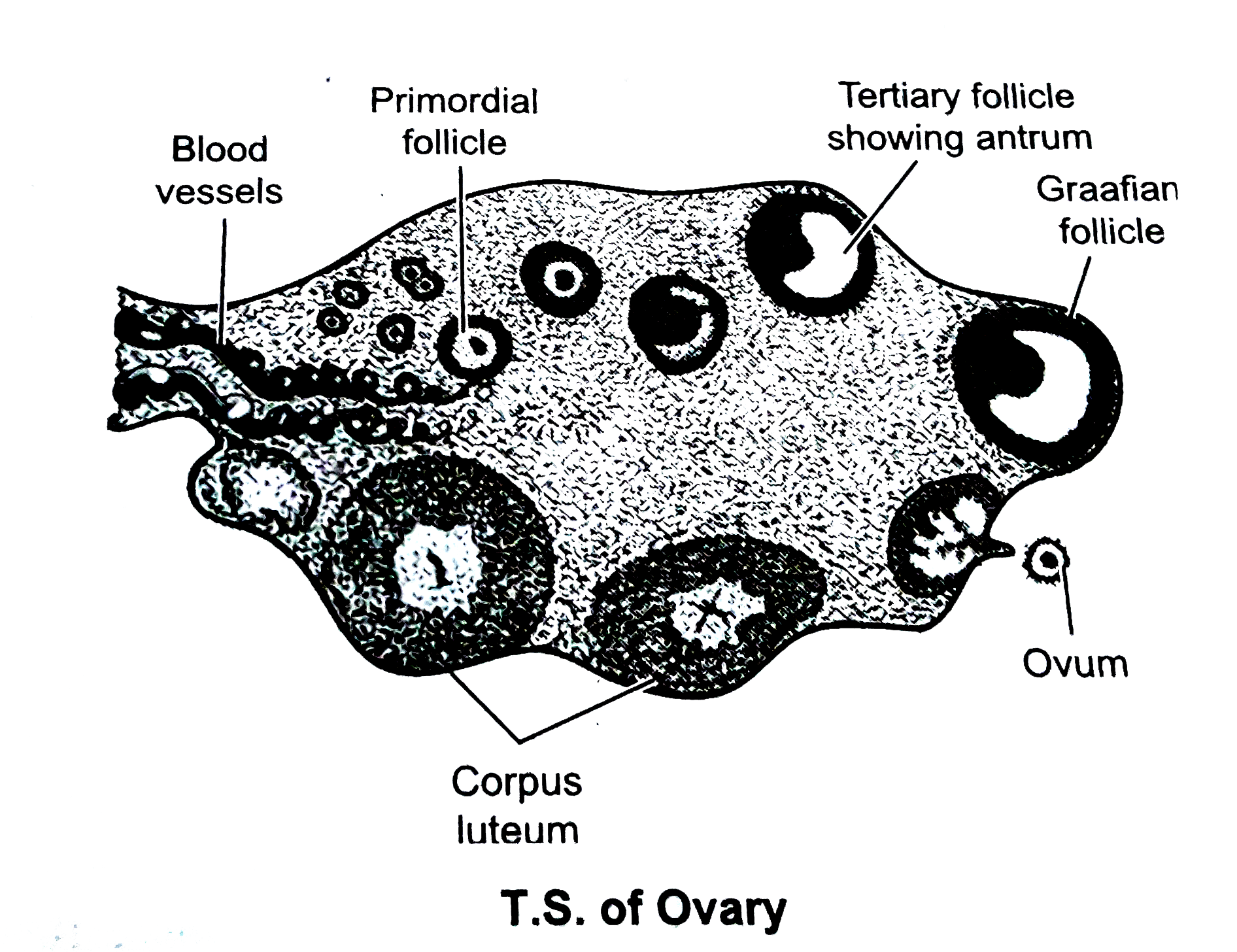
OR
Draw a labelled diagram of double helical structure of DNA. (3)
Answer:
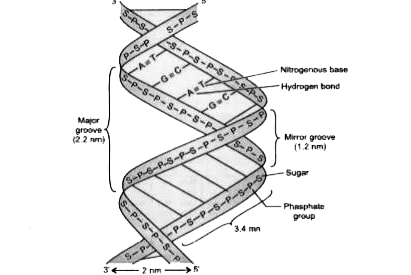
Q.6 What are sexually transmitted diseases? Mention causes. (1+2 = 3)
Answer: Sexually transmitted diseases (STDs) are diseases that are transmitted from one person to another mainly through sexual contact with an infected individual. The causes of STDs include infection by bacteria, viruses, protozoa, and sometimes fungi, which enter the body during unsafe sexual practices and spread through body fluids.
OR
Mention the effects of drugs and alcohols. (3)
Answer: Drugs and alcohol have several harmful effects on individuals and society. They cause addiction and dependence, making it difficult for individuals to control their consumption. Prolonged use leads to damage of vital organs such as the liver, brain, heart, and kidneys, and may result in serious health problems. Drugs and alcohol also cause mental disorders, impaired judgment, and behavioral changes, leading to social problems such as family conflicts, accidents, crime, and loss of productivity.
Q.7 Write the salient features of Human Genome. (3)
Answer: The human genome consists of about 3 billion base pairs of DNA present in 23 pairs of chromosomes. It contains approximately 20,000–25,000 genes that control various structural and functional characteristics of the human body. A large portion of the human genome is non-coding DNA, which does not code for proteins but plays important roles in regulation, evolution, and genetic stability.
OR
Write reasons for loss of biodiversity. (3)
Answer: Loss of biodiversity occurs due to several natural and human-induced factors. Habitat loss and destruction caused by deforestation, urbanization, and industrialization is a major reason for the decline of plant and animal species. Over-exploitation of natural resources through excessive hunting, fishing, and logging leads to depletion of species beyond their recovery capacity. Pollution and the introduction of invasive alien species further disturb ecosystems, resulting in the extinction or endangerment of many native species.
Note:
This question paper has been solved by subject experts of Assam Eduverse to help students understand answers clearly and score better in examinations. Our platform provides reliable Assam-specific study materials, ASSEB solutions, expert notes, and exam-oriented guidance in a simple and student-friendly manner.
Students are encouraged to visit our website for more quality learning resources and share this material with friends and classmates to help them in their exam preparation.