
Thinking about the Text
Activity
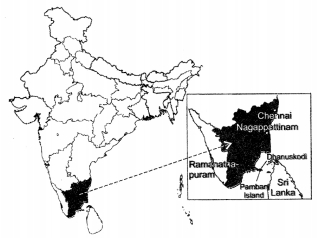
Find Dhanuskodi and Rameswaram on the map. What language(s) do you think are spoken there? What languages do you think the author, his family, his friends and his teachers spoke with one another?
Answer: Dhanuskodi and Rameswaram are located in the state of Tamil Nadu. The primary language spoken there is Tamil. The author, his family, his friends, and his teachers all spoke Tamil with one another.
I. Answer these questions in one or two sentences each.
Q1. Where was Abdul Kalam’s house?
Answer: Abdul Kalam’s house was on Mosque Street in the island town of Rameswaram, in the erstwhile Madras State.
Q2. What do you think Dinamani is the name of? Give a reason for your answer.
Answer: Dinamani is a newspaper. The reason is that Abdul Kalam mentions he would try to trace the stories about the war in the headlines in Dinamani.
Q3. Who were Abdul Kalam’s school friends? What did they later become?
Answer: Abdul Kalam’s three close school friends were Ramanadha Sastry, Aravindan, and Sivaprakasan. Ramanadha Sastry became the high priest of the Rameswaram temple, Aravindan went into the business of arranging transport for visiting pilgrims, and Sivaprakasan became a catering contractor for the Southern Railways.
Q4. How did Abdul Kalam earn his first wages?
Answer: Abdul Kalam earned his first wages by helping his cousin, Samsuddin, who distributed newspapers. He had to catch the newspaper bundles thrown from a moving train and helped him in distributing them.
Q5. Had he earned any money before that? In what way?
Answer: Yes, he had earned money before that by collecting and selling tamarind seeds to a provision shop. A day’s collection would earn him the princely sum of one anna.
II. Answer each of these questions in a short paragraph (about 30 words)
Q1. How does the author describe: (i) his father, (ii) his mother, (iii) himself?
Answer: (i) The author describes his father, Jainulabdeen, as a man with great innate wisdom and a true generosity of spirit, who avoided all inessential comforts and luxuries.
(ii) He describes his mother, Ashiamma, as his father’s ideal helpmate, who was a kind-hearted person and fed more outsiders than her own family members.
(iii) He describes himself as a short boy with rather undistinguished looks, born to tall and handsome parents.
Q2. What characteristics does he say he inherited from his parents?
Answer: From his father, Abdul Kalam says he inherited honesty and self-discipline. From his mother, he inherited faith in goodness and deep kindness.
III. Discuss these questions in class with your teacher and then write down your answers in two or three paragraphs each
Q1. “On the whole, the small society of Rameswaram was very rigid in terms of the segregation of different social groups,” says the author.
(i) Which social groups does he mention? Were these groups easily identifiable (for example, by the way they dressed)?
Answer: The social groups mentioned are Hindus and Muslims. These groups were easily identifiable by the way they dressed. For example, Abdul Kalam wore a cap that marked him as a Muslim, while his friend Ramanadha Sastry wore the sacred thread of a Hindu Brahmin.
(ii) Were they aware only of their differences or did they also naturally share friendships and experiences? (Think of the bedtime stories in Kalam’s house; of who his friends were; and of what used to take place in the pond near his house.)
Answer: They were aware of their differences, but they also naturally shared friendships and experiences. Abdul Kalam had three close friends from orthodox Hindu Brahmin families. The bedtime stories his mother and grandmother told included events from the Ramayana and the life of the Prophet. His family also arranged boats with a special platform for carrying idols of the Lord from the temple to the marriage site in the pond. These instances show a harmonious relationship and shared experiences.
(iii) The author speaks both of people who were very aware of the differences among them and those who tried to bridge these differences. Can you identify such people in the text?
Answer: The people who were aware of the differences were the new teacher in his school and Sivasubramania Iyer’s wife. The new teacher made Abdul Kalam sit on the back bench because he was a Muslim boy. Sivasubramania Iyer’s wife refused to serve a Muslim boy in her ritually pure kitchen. The people who tried to bridge these differences were Pakshi Lakshmana Sastry and Sivasubramania Iyer. Lakshmana Sastry summoned the teacher and asked him not to spread “the poison of social inequality and communal intolerance”. Sivasubramania Iyer, despite his orthodox background, was a rebel who did his best to break social barriers. He served Kalam himself and later convinced his wife to do the same.
(iv) Narrate two incidents that show how differences can be created, and also how they can be resolved. How can people change their attitudes?
Answer: The first incident is when a new teacher asked Abdul Kalam to sit on the back bench, creating a difference based on religion and social ranking. This was resolved when Ramanadha Sastry’s father, the high priest, summoned the teacher and asked him to either apologize or quit the school. The teacher regretted his behavior, and this incident brought about a change in his attitude. The second incident is when Sivasubramania Iyer’s wife refused to serve Kalam in her kitchen. Iyer served Kalam with his own hands and invited him again. The next time, his wife had changed her attitude and served him herself. People can change their attitudes through a strong sense of conviction, courage, and perseverance to confront and resolve such problems.
Q2. (i) Why did Abdul Kalam want to leave Rameswaram?
Answer: Abdul Kalam wanted to leave Rameswaram to pursue his education at the district headquarters in Ramanathapuram.
(ii) What did his father say to this?
Answer: His father told him that he knew Abdul had to go away to grow. He compared him to a seagull that flies across the sun, alone and without a nest.
(iii) What do you think his words mean? Why do you think he spoke those words?
Answer: His father’s words mean that a child must leave their parents to grow and find their own destiny. He spoke those words to encourage and reassure Abdul Kalam, and to give him permission to leave. He also said this to his wife, who was hesitant, by quoting Khalil Gibran, explaining that children are not a parent’s possession, but rather a manifestation of life itself.
Thinking about Language
Q1.Find the sentences in the text where these words occur:
[Erupt, surge, trace, undistinguished, casualty]
Look these words up in a dictionary which gives examples of how they are used. Now answer the following questions.
- erupt: For reasons I have never been able to understand, a sudden demand for tamarind seeds erupted in the market.
- surge: I can still feel the surge of pride in earning my own money for the first time.
- trace: My brother-in-law Jallaluddin would tell me stories about the War which I would later attempt to trace in the headlines in Dinamani.
- undistinguished: I was a short boy with rather undistinguished looks.
- casualty: The first casualty came in the form of the suspension of the train halt at Rameswaram station.
Now answer the following questions
Q1.What are the things that can erupt? Use examples to explain the various meanings of erupt. Now do the same for the word surge. What things can surge?
Answer:
- erupt: The word ‘erupt’ means to burst forth or break out suddenly.
- Volcanoes erupt. (A physical, violent breaking out).
- A sudden demand can erupt. (A non-physical, sudden occurrence).
- Laughter can erupt. (A sudden, loud burst of emotion).
- surge: The word ‘surge’ means to a sudden powerful forward or upward movement.
- Waves can surge. (A powerful movement of water).
- The pride in earning money can surge. (A sudden, strong feeling or emotion).
- An electric current can surge. (A sudden increase in power).
Q2.What are the meanings of the word trace and which of the meanings is closest to the word in the text?
Answer: ‘Trace’ can mean to find or discover something, or to copy a drawing or map by drawing over it. The meaning closest to the word in the text is ‘to find or discover something’, as Abdul Kalam wanted to find details about the war in the newspaper headlines.
Q3. Can you find the word undistinguished in your dictionary? (If not, look up the word distinguished and say what undistinguished must mean.)
Answer: The word ‘distinguished’ means famous or respected because of excellence. So, ‘undistinguished’ means not famous, not notable, or ordinary.
II.
1. Match the phrases in Column A with their meanings in Column B
A | B |
(i) broke out | (a) an attitude of kindness, a readiness to give freely |
(ii) in accordance with | (b) was not able to tolerate |
(iii) a helping hand | (c) began suddenly in a violent way |
(iv) could not stomach | (d) assistance |
(v) generosity of spirit | (e) persons with power to make decisions |
(vi) figures of authority | (f) according to a particular rule, principle, or system |
Answers:
A | B |
(i) broke out | (c) began suddenly in a violent way |
(ii) in accordance with | (f) according to a particular rule, principle, or system |
(iii) a helping hand | (d) assistance |
(iv) could not stomach | (b) was not able to tolerate |
(v) generosity of spirit | (a) an attitude of kindness, a readiness to give freely |
(vi) figures of authority | (e) persons with power to make decisions |
Q2.Study the words in italics in the sentences below. They are formed by prefixing un- or in- to their antonyms (words opposite in meaning).
- I was a short boy with rather undistinguished looks, (un + distinguished)
- My austere father used to avoid all inessential comforts, (in + essential)
- The area was completely unaffected by the war. (un + affected)
- He should not spread the poison of social inequality and communal intolerance, (in + equality, in + tolerance)
Now form the opposites of the words below by prefixing un- or in-. The pre-fix in- can also have the forms il-, ir-, or im- (For example : illiterate—il + literate, impractical—im + practical, irrational—ir + rational). You may consult a dictionary if you wish.
- inadequate
- unacceptable
- irregular
- intolerant
- undemanding
- inactive
- untrue
- impermanent
- undisputed
- inaccessible
- incoherent
- illegal
- irresponsible
- impossible
- unpatriotic
- illogical
III. Passive Voice
Study these sentences: The italicised verbs in these sentences are made up of a form of the verb be and a past participle. These sentences focus on what happens, rather than who does what.
IV. Rewrite the sentences below, changing the verbs in brackets into the passive form
- In yesterday’s competition the prizes (give away) by the Principal.
- In spite of financial difficulties, the labourers (pay) on time.
- On Republic Day, vehicles (not allow) beyond this point.
- Second-hand books (buy and sell) on the pavement every Saturday.
- Elections to the Lok Sabha (hold) every five years.
- Our National Anthem (compose) Rabindranath Tagore.
Answer:
- In yesterday’s competition the prizes were given away by the Principal.
- In spite of financial difficulties, the labourers were paid on time.
- On Republic Day, vehicles are not allowed beyond this point.
- Second-hand books are bought and sold on the pavement every Saturday.
- Elections to the Lok Sabha are held every five years.
- Our National Anthem was composed by Rabindranath Tagore.
V. Rewrite the paragraphs below, using the correct form of the verb given in brackets
- How Helmets Came To Be Used in Cricket
Nari Contractor was the Captain and an opening batsman for India in the 1960s. The Indian cricket team went on a tour to the West Indies in 1962. In a match against Barbados in Bridgetown, Nari Contractor was seriously injured and collapsed. In those days helmets were not worn. Contractor was hit on the head by a bouncer from1 Charlie Griffith. Contractor’s skull was fractured. The entire team was deeply concerned. The West Indies players were worried. Contractor was rushed to hospital. He was accompanied by Frank Worrell, the Captain of the West Indies Team. Blood was donated by the West Indies players. Thanks to the timely help, Contractor was saved. Nowadays helmets are routinely used against bowlers.2
- Oil from Seeds
Vegetable oils are made from seeds and fruits of many plants growing all over the world, from tiny sesame seeds to big, juicy coconuts. Oil is produced from cotton seeds, groundnuts, soya beans and sunflower seeds. Olive oil is used for cooking, salad dressing etc. Olives are shaken from the trees and are gathered up, usually by hand. The olives are ground to a thick paste which is spread onto special mats. Then the mats are layered up on the pressing machine which will gently squeeze them to produce olive o5il.
Dictation
Let the class divide itself into three groups. Let each group take down one passage that the teacher dictates. Then put the passages together in the right order.
Answer:
Let the class divide itself into three groups. Let each group take down one passage that the teacher dictates. Then put the passages together in the right order.
To Sir, with Love
- From Rameswaram to the Rashtrapati Bhavan, it’s been a long journey. Talking to Nona Walia on the eve of Teacher’s Day, President Dr. A.PJ. Abdul Kalam talks about life’s toughest lessons learnt and his mission—being a teacher to the Indian Youth. “A proper education would help nurture a sense of dignity and self-respect among our youth”, says President Kalam. There’s still a child in him though, and he’s still curious about learning new things. Life’s a mission for President Kalam.
- Nonetheless, he remembers his first lesson in life and how it changed his destiny. “I was studying in Standard V, and must have been all of 10. My teacher, Sri Sivasubramania Iyer was telling us how birds fly. He drew a diagram of a bird on the blackboard, depicting the wings, tail and the body with the head and then explained how birds soar to the sky. At the end of the class, I said I didn’t understand. Then he asked the other students if they had understood, but nobody had understood how birds fly,” he recalls.
- “That evening, the entire class was taken to Rameswaram shore” the President continues. “My teacher showed us sea birds. We saw marvellous formations of them flying and how their wings flapped. Then my teacher asked us, ‘Where is the birds’ engine and how is it powered?’ I knew then that birds are powered by their own life and motivation. I understood all about birds’ dynamics. This was real teaching—a theoretical lesson coupled with a live practical example. Sri Sivasubramania Iyer was a great teacher. ” That day, my future was decided. My destiny was changed. I knew my future had to be about flight and flight systems.
Answer:
For attempt at class level. Paragraphs are put together as given below:
To Sir, With Love
From Rameswaram to the Rashtrapati Bhavan, it’s been a long journey. Talking to Nona Walia on the eve of Teacher’s Day, President Dr. A.P.J. Abdul Kalam talks about life’s toughest lessons learnt, and his mission—being a teacher to the Indian Youth. “A proper education would help nurture a sense of dignity and self-respect among our youth”, says President Kalam. There’s still a child in him though, he’s still curious about learning new things. Life’s a mission for President Kalam.
Nonetheless, he remembers his first lesson in life and how it changed his destiny. “I was studying in standard V, and must have been all of 10. My teacher, Sri Sivasubramania Iyer was telling us how birds fly. He drew a diagram of a bird on the blackboard, depicting the wings, tail and the body with the head and then explained how birds soar to the sky. At the end of the class, I said I did not understand. Then he asked the other students if they had understood, but nobody had understood how birds fly”, he recalls. “That evening, the entire class was taken to Rameswaram shore”, the President continues. “My teacher showed us sea birds. We saw marvellous formations of them flying and how their wings flapped. Then my teacher asked us, “Where is the bird’s engine and how is it powered?” I knew then that birds are powered by their own life and motivation. I understood all about birds’ dynamics. This was real teaching—a theoretical lesson coupled with a live practical example. Sri Sivasubramania Iyer was a great teacher. That day, my future was decided. My destiny was changed. I knew my future had to be about flight and flight systems.
Speaking
Here is a topic for you to think about and give your opinion on. think about;
- think about;
- give your opinion on.
Find out what other people think about it. Ask your friends/seniors/parents to give you their opinion.
‘Career Building Is the Only Goal of Education.’
Or
‘Getting a Good Job Is More Important than Being a Good Human Being.’
You can use the following phrases.
(i) while giving your opinion:
- I think that…
- In my opinion …
- It seems to me that…
- I am of the view that…
- As far as I know …
- If you ask me …
(ii) saying what other people think:
- According to some …
- Quite a few think …
- Some others favour…
- Thirty per cent of the people disagree …
- Fifty per cent of them strongly feel…
(iii) asking for other’s opinions:
- What do you think about…
- What do you think of…
- What is your opinion about…
- Do you agree …
- Does this make you believe …
Career Building is the Only Goal of Education
The eminent educationists aver that education does not make a child a bookworm. It sharpens the pupils’ intellect and inspires them to build their career by getting themselves enrolled in professional courses. In my opinion, the fundamental goal of education is to help a learner in opting for a perfect stream and assist him in earning his livelihood.
Answer: This is a classroom activity for students to discuss and give their opinions.
Writing
Think and write a short account of what life in Rameswaram in the 1940s must have been like. (Were people rich or poor? Hard working or lazy? Hopeful of change, or resistant to it?).
Answer: Based on the chapter, life in Rameswaram in the 1940s was simple and largely unaffected by the outside world, at least initially. The society was rigid in terms of social groups, with clear segregation between Hindus and Muslims. However, there was also a sense of harmony and mutual respect, as seen in the friendship between Abdul Kalam and his Brahmin friends, and the shared bedtime stories about different religions. People were not rich; Kalam’s father was austere and avoided inessential comforts. However, they were hard-working and hopeful of change, especially with the coming of India’s independence. While some people were resistant to change, like the new teacher and Sivasubramania Iyer’s wife, there were also rebels like Sivasubramania Iyer himself, who actively worked to break social barriers. Overall, it was a time of tradition coexisting with a growing hope for a more tolerant and independent future.