
Thinking about the Text
Q1. Here are some headings for paragraphs in the text. Write the number(s) of the paragraph(s) for each title against the heading. The first one is done for you.
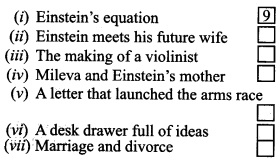
Answer:
(i) Einstein’s equation: 91
(ii) Einstein meets his future wife: 72
(iii) The making of a violinist: 33
(iv) Mileva and Einstein’s mother: 104
(v) A letter that launched the arms race: 155
(vi) A desk drawer full of ideas: 86
(vii) Marriage and divorce: 11
Q2. Who had these opinions about Einstein?
(i) He was boring.
Answer: His playmates had this opinion about him and called him “Brother Boring.”
(ii) He was stupid and would never succeed in life.
Answer: A headmaster once told his father that whatever profession Einstein chose, “he’ll never make a success at anything.”
(iii) He was a freak.
Answer: His mother thought Albert was a “freak” because his head seemed much too large.
Q3. Explain what the reasons for the following are.
(i) Einstein leaving the school in Munich for good.
Answer: Einstein left the school in Munich for good because he hated its “regimentation” or strict discipline. He felt so stifled that he decided to leave.
(ii) Einstein wanting to study in Switzerland rather than in Munich.
Answer: Einstein wanted to study in Switzerland because it was in a city that was more liberal than Munich. He found the environment in Munich to be very suffocating and restrictive.
(iii) Einstein seeing in Mileva an ally.
Answer: Einstein saw in Mileva an ally because she was a “clever creature” and an intelligent person. He found in her someone who was against the “philistines” – the people in his family and at the university who did not like art, literature, or music.
(iv) What do these tell you about Einstein?
Answer: These instances tell us that Einstein was a liberal, unconventional person who valued personal freedom and intellectual pursuits. He was a non-conformist who did not like strict rules and discipline, and he sought out people who shared his interests and beliefs.
Q4. What did Einstein call his desk drawer at the patent office? Why?
Answer: Einstein jokingly called his desk drawer at the patent office the “bureau of theoretical physics.” He called it this because while he was supposed to be assessing other people’s inventions, he was secretly developing his own ideas.
Q5. Why did Einstein write a letter to Franklin Roosevelt?
Answer: At the urging of a colleague, Einstein wrote a letter to the American President, Franklin D. Roosevelt, on August 2, 1939. He warned him that a single atomic bomb could destroy a whole port and its surrounding territory.
Q6. How did Einstein react to the bombing of Hiroshima and Nagasaki?
Answer: Einstein was deeply shaken by the extent of the destruction caused by the bombing of Hiroshima and Nagasaki. He wrote a public letter to the United Nations proposing the formation of a world government and later became deeply involved in politics, campaigning for peace and democracy.
Q7. Why does the world remember Einstein as a “world citizen”?
Answer: The world remembers Einstein as a “world citizen” because he was deeply involved in politics and campaigned for peace and democracy. After the bombing of Hiroshima and Nagasaki, he proposed the formation of a world government and spent the rest of his life advocating for an end to the arms build-up.
Q8. Here are some facts from Einstein’s life. Arrange them in chronological order.
[ ] Einstein publishes his special theory of relativity.
[ ] He is awarded the Nobel Prize in Physics.
[ ] Einstein writes a letter to U.S. President, Franklin D. Roosevelt, and warns against Germany’s building of an atomic bomb.
[ ] Einstein attends a high school in Munich.
[ ] Einstein’s family moves to Milan.
[ ] Einstein is bom in the German city of Ulm.
[ ] Einstein joins a University in Zurich, where he meets Mileva.
[ ] Einstein dies.
[ ] He provides a new interpretation of gravity.
[ ] Tired of the school’s regimentation, Einstein withdraws from school.
[ ] He works in a patent office as a technical expert.
[ ] When Hitler comes to power, Einstein leaves Germany for the United States.
Answer:
- Einstein is born in the German city of Ulm.
- Einstein attends a high school in Munich.
- Einstein’s family moves to Milan.
- Tired of the school’s regimentation, Einstein withdraws from school.
- Einstein joins a university in Zurich, where he meets Mileva.
- He works in a patent office as a technical expert.
- Einstein publishes his special theory of relativity.
- He provides a new interpretation of gravity.
- He is awarded the Nobel Prize in Physics.
- When Hitler comes to power, Einstein leaves Germany for the United States.2
- Einstein writes a letter to U.S. P21resident, Franklin D. Roosevelt, and warns against Germany’s building of an atomic bomb.
- Einstein dies.
Thinking about Language
Here are some sentences from the story. Choose the word from the brackets which can be substituted for the italicised words in the sentences.
- A few years later, the marriage faltered, (failed, broke, became weak)
- Einstein was constantly at odds with people at the university, (on bad terms, in disagreement, unhappy)
- The newspapers proclaimed his work as “a scientific revolution”, (declared, praised, showed)
- Einstein got ever more involved in politics, agitating for an end to the arms build up. (campaigning, fighting, supporting)
- At the age of 15, Einstein felt so stifled that he left the school for good. (permanently, for his benefit, for a short time)
- Five years later, the discovery of nuclear fission in Berlin had American physicists in an uproar, (in a state of commotion, full of criticism, in a desperate state)
- Science wasn’t the only thing that appealed to the dashing young man with the walrus moustache, (interested, challenged, worried)
Answers:
- A few years later, the marriage faltered. (became weak)
- Einstein was constantly at odds with people at the university. (in disagreement)
- The newspapers proclaimed his work as “a scientific revolution.” (declared)
- Einstein got ever more involved in politics, agitating for an end to the arms buildup. (campaigning)
- At the age of 15, Einstein felt so stifled that he left the school for good. (permanently)
- Five years later, the discovery of nuclear fission in Berlin had American physicists in an uproar. (in a state of commotion)
- Science wasn’t the only thing that appealed to the dashing young man with the walrus moustache. (interested)
II. Study the following sentences.
- Einstein became a gifted amateur violinist, maintaining this skill throughout his life.
- Letters survive in which they put their affection into words, mixing science with tenderness.
The parts in italics in the above sentences begin with ing verbs, and are called participial phrases. Participial phrases say something more about the person or thing talked about or the idea expressed by the sentence as a whole. For example:
—Einstein became a gifted amateur violinist. He maintained this skill throughout his life.
Complete the sentences below by filling in the blanks with suitable participial clauses. The information that has to be used in the phrases is provided as a sentence in brackets.
- ……………. the firefighters finally put out the fire. (They worked round the clock.)
- She watched the sunset above the mountain, ……………. (She noticed the colours blending softly into one another.)
- The excited horse pawed the ground rapidly, ……………. (While it neighed continually.)
- ……………. ,I found myself in Bangalore, instead of Benaras. (I had taken the wrong train.)
- ……………., I was desperate to get to the bathroom. (I had not bathed for two days)
- The stone steps, ……………. needed to be replaced. (They were worn down).
- The actor received hundreds of letters from his fans, ……………. (They asked him to send them his photograph.)
Answers:
- Working round the clock, the firefighters finally put out the fire.
- She watched the sunset above the mountain, noticing the colours blending softly into one another.
- The excited horse pawed the ground rapidly, while it neighed continually.
- Having taken the wrong train, I found myself in Bangalore, instead of Benaras.
- Having not bathed for two days, I was desperate to get to the bathroom.
- The stone steps, worn down, needed to be replaced.
- The actor received hundreds of letters from his fans, asking him to send them his photograph.
Writing Newspaper Reports
Here are some notes which you could use to write a report.
Write a report which has four paragraphs, one each on:
- What was unearthed.
- Who unearthed it and when.
- What the document contained.
- Where it will be kept.
Your report could begin like this:
Answer:
26
Student Unearths Einstein Manuscript27
21 AUGUST 2005. An original handwritten Albert Einstein manuscript has been unearthed at a university in the N28etherlands by a student named Rowdy Boeynik. Boeynik was researching papers belonging to an old friend of Einstein’s when he discovered the 16-page document.
The document, dated 1924, contains Einstein’s work on his last theory regarding the behaviour of atoms at low temperatures. This theory is now known as the Bose-Einstein condensation. The manuscript even has Einstein’s fingerprints on the papers.
The discovery has created great excitement in the scientific community. The manuscript will be kept at Leyden University, where Einstein was awarded the Nobel Prize, for preservation and future study.
Dictation
Your teacher will dictate these paragraphs to you. Write down the paragraphs with correct punctuation marks.
Answer:
In 1931, Charlie Chaplin invited Albert Einstein, who was visiting Hollywood, to a private screening of his new film, City Lights. As the two men drove into town together, passersby waved and cheered. Chaplin turned to his guest and explained: “The people are applauding you because none of them understands you and applauding me because everybody understands me.”
One of Einstein’s colleagues asked him for his telephone number one day. Einstein reached for a telephone directory and looked it up. “You don’t remember your own number?” the man asked, startled. “No,” Einstein answered. “Why should I memorise something I can so easily get from a book?” (In fact, Einstein claimed never to memorise anything which could be looked up in less than two minutes.)