
EXERCISE
Q1. Give a definition of “Human Geography” and mention its major branches.
Answer: Human Geography is a branch of geography that studies the relationship between human beings and the natural environment. It examines the human-made environment that results from this interaction from a spatial and temporal perspective.
The major branches of Human Geography include:
- Settlement geography
- Social geography
- Economic geography
- Cultural geography
- Political geography
- Urban geography
- Population geography
- Medical geography
- Historical geography
- Geography of regional development and planning
Q2. Briefly write about the subject matter of Human Geography.
Answer: The subject matter of Human Geography focuses on human beings and their activities on Earth. It studies the growth, distribution, and characteristics of populations, including their physical traits, religions, languages, social behavior, customs, and economic activities. It also examines how humans modify the environment to create man-made surroundings and how these human-influenced environments differ across regions due to variations in natural conditions and human qualities.
Q3. Write briefly, what you mean by “human race”.
Answer: A human race is a biological concept, not a cultural one. It refers to a group of people who share similar physical traits, such as skin colour, hair colour, height, and facial structure, and who pass these characteristics on from one generation to another through reproduction. Based on these similar physical characteristics, humans have been broadly classified into three major racial groups: Caucasoid, Negroid, and Mongoloid.
Q4. Write briefly the bases or criteria of division of human race.
Answer: The division of human races is based on physical characteristics that are passed down through generations. The main criteria for this division are:
- Skin colour
- Hair colour and structure
- Height
- Structure of the nose and face
Q5. Discuss in brief the origin of human and human race.
Answer: According to the theory of evolution, humans (Homo sapiens) originated from certain mammals in central Africa around 5-6 lakhs years ago. As humans migrated to different regions, their physical features changed to adapt to local climatic and geographical conditions. Those in hot African regions developed dark skin (Negroid), in cold Europe white skin (Caucasoid), and in central Asia yellowish skin (Mongoloid). Over time, migration and intermixing of populations have made it difficult to identify any “pure” human race today.
Q6. Divide man on the earth based on the physical characteristics like hair, nose, face, height, skin, etc.
Answer: Based on various physical characteristics human beings on Earth can be divided into three major racial groups:
- Caucasoid: Characterized by white to olive-brown skin, straight or wavy black or brown hair, and a sharp, narrow nose.
- Negroid: Characterized by dark or dark-brown skin, curly hair, and a wide, blunt nose. They are often tall.
- Mongoloid: Characterized by yellowish skin, small eyes, and straight hair.
Q7. Mention the characteristics of the three major human races in the world.
Answer: The characteristics of the three major human races in the world are-
- Caucasoid Race: This is the largest human race. Their skin colour ranges from very white to olive brown. Their hair is generally straight or wavy and black or brown. They typically have a sharp and narrow nose.
- Negroid Race: The people of this race have dark or dark-brown skin, curly hair, and a wide and blunt nose. Most of them are quite tall.
- Mongoloid Race: People of this race generally have yellowish skin, smaller eyes, and straight hair.
Q8. Which regions of the world are considered first origin of man? With the help of sketch briefly write about the spread and distribution of major human races in the world.
Answer: The central part of tropical Africa is considered the primary region of human origin. From here, humans gradually migrated to other parts of the world over thousands of years.
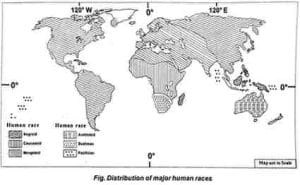
The spread and distribution of major human races in the world are :
- Negroid Race: Spread from central Africa to other parts of Africa and some regions of Asia.
- Caucasoid Race: Migrated from south-west Asia to Europe, North Africa, and South Asia.
- Mongoloid Race: Spread from central Asia to eastern Asia and across the Bering Strait into North and South America.
Q9. What are the major religions? Discuss the salient characteristics and distribution of these religious groups along with there population size.
Answer: The four major religions in the world in terms of population size are Christianity, Islam, Hinduism, and Buddhism.
1. Christianity
- Characteristics: Monotheistic; believes in one God. Two main divisions: Roman Catholic and Protestant. Holy book: Bible.
- Population Size: About 213 crore (33% of world population in 2006).
- Distribution: Largest religious group globally; prevalent in Europe, North & South America, parts of Asia and Oceania. Over 90% of people in Europe, North & South America are Christians.
2. Islam
- Characteristics: Monotheistic; founded by Prophet Mohammed. Two major divisions: Shia and Sunni. Holy book: Quran.
- Population Size: About 135 crore (21% of world population in 2006).
- Distribution: Concentrated in North Africa, Middle East, Pakistan, Bangladesh, and parts of Southeast Asia.
3. Hinduism
- Characteristics: Oldest religion; polytheistic, based on many Gods and Goddesses. Main holy book: Vedas.
- Population Size: About 90 crore (14% of world population in 2006).
- Distribution: Primarily in India and Nepal; about 80% of Hindus live in India.
4. Buddhism
- Characteristics: Founded by Gautam Buddha; based on Hindu principles with reforms. Two divisions: Hinayana and Mahayana. Main holy book: Tripitaka.
- Population Size: About 38 crore (6% of world population in 2006).
- Distribution: Although originating in India, most Buddhists live in Sri Lanka, Myanmar, Thailand, Laos, Cambodia, Tibet, Mongolia, China, and Japan.
Q10. Write in brief about religious composition and distribution of population in India.
Answer: India is a multi-religious country with a dominant Hindu population. According to the 2001 Census:
- Hinduism: 81.4%
- Islam: 12.4%
- Christianity: 2.3%
- Sikhism: 1.9%
- Buddhism: 0.8%
Most of the states in India have a Hindu majority. Jammu and Kashmir is predominantly Muslim, Punjab is Sikh-dominant, and Nagaland, Mizoram, and Meghalaya are Christian-dominant. Buddhists are found in small numbers in Sikkim, Arunachal Pradesh, West Bengal, and Bihar.
Q11. Write short notes on:
(a) Man and Human Geography
Answer: Human geography is the study of the relationship between humans and their environment. It focuses on how humans have adapted to, modified, and used the Earth’s surface. The field is human-centric and covers a wide range of topics, including human settlements, economic activities, cultural practices, and population distribution.
(b) Human Race
Answer: A human race is a biological classification of people based on shared physical traits such as skin colour, hair type, and facial features. The three major human races are Caucasoid, Negroid, and Mongoloid, each with distinct physical characteristics that developed over time as humans adapted to different environments. However, due to widespread migration and intermixing, pure races are now very rare.
(c) Negroid population group
Answer: The Negroid racial group is one of the three major human races, largely found in Africa, parts of Southern India, Sri Lanka, and Southeast Asia. They are characterized by dark skin, curly hair, and a wide, blunt nose. They are often tall in stature.
(d) Religious Composition
Answer: Religious composition refers to the proportion of people belonging to different religious groups within a country or a region. The world’s religious composition is dominated by four major religions: Christianity, Islam, Hinduism, and Buddhism.
(e) Buddhist Religion
Answer: Buddhism is a religion founded by Gautam Buddha in northern India around 2500 years ago. It has two main divisions: Hinayana and Mahayana. The main holy book is the Tripitaka. It is the fourth-largest religion in the world and has a large following in Sri Lanka, Myanmar, China, Japan, and other parts of Southeast Asia.
(f) People of Christian religion in India
Answer: In India, Christians are a minority religious group, constituting 2.3% of the total population (2001 Census). They are primarily concentrated in the states of Nagaland, Mizoram, and Meghalaya, where they form a majority. Christian communities also exist in other states like Kerala and Goa.
Q12. Choose the correct answer:
(a) When was human being born on the earth?
(i) 5-6 lakh years ago
(ii) 1-2 lakh years ago
(iii) 50-60 lakh years ago
(iv) 10-12 lakh years ago
Answer: (i) 5-6 lakh years ago
(b) Which is the largest religious group in terms of
population?
(i) Islam
(ii) Hindu
(iii)Christian
(iv) Chinese Folk religion
Answer: (iii) Christian
(c) In which continent did man appear/originate first?
(i) Asia
(ii) Africa
(iii) Europe
(iv) Oceania
Answer: (ii) Africa
(d) With which racial group did the people of China
belong?
(i) Caucasoid group
(ii) Negroid group
(iii)Mongoloid group
(iv) Australoid group
Answer: (iii) Mongoloid group
Q13. Collect data about religious composition of population
in your village or locality under the guidance of your
teacher and prepare a table.
Answer:
| Religion | Population | Percentage |
|---|---|---|
| Hindu | 420 | 52% |
| Muslim | 200 | 25% |
| Christian | 120 | 15% |
| Sikh | 30 | 4% |
| Others | 30 | 4% |
| Total | 800 | 100% |
Q14. Divide the human
population of the world on the basis of hair colour,
shape of the nose and face, height and skin colour.
Answer:
| Feature | Type | Percentage |
|---|---|---|
| Hair Colour | Black | 75% |
| Brown | 15% | |
| Blonde | 8% | |
| Red | 2% | |
| Nose Shape | Straight | 60% |
| Aquiline (Curved) | 30% | |
| Flat/Nubian | 10% | |
| Face Shape | Oval | 50% |
| Round | 30% | |
| Square | 20% | |
| Height | Short (<160 cm) | 35% |
| Medium (160–175 cm) | 50% | |
| Tall (>175 cm) | 15% | |
| Skin Colour | Light | 30% |
| Medium | 50% | |
| Dark | 20% |
Q15. Draw a sketch map of the world and show there
in the migration of people from the original area of
birth.
Answer:

- Centre of Human Origin: Central Africa
- Negroid Migration: Spread across Africa and some parts of Asia
- Caucasoid Migration: Spread from South-west Asia to Europe, North Africa, South Asia
- Mongoloid Migration: Spread from Central Asia to East Asia and across the Bering Strait into North and South America