
EXERCISE
Q1. What do you mean ‘weather’ and ‘climate’? Distinguish between weather and climate.
Answer: Weather refers to the state of the atmosphere of a place for a short period of time, such as a few hours, a day, or a week. Climate, on the other hand, is the average atmospheric condition of a place over a long period, which is typically considered to be at least 30 years.
The main distinctions between weather and climate are:
- Weather is a short-term phenomenon, while climate is a long-term average.
- Weather describes the atmospheric conditions of a small area, whereas climate describes the conditions of a large area or extensive region.
- Weather changes frequently, even within a day. Climate is relatively stable and changes very slowly over centuries.
Q2. Mention the elements of weather and climate.
Answer: The principal elements of weather and climate are temperature, pressure, humidity, wind and precipitation
Q3. State the elements of weather and climate.
Answer: The elements of weather and climate are:
- Temperature: This is the degree of hotness or coldness of the atmosphere, which is heated by the sun’s energy reflected from the Earth’s surface. It varies with time, altitude, and latitude.
- Pressure: This is the force exerted by the air on a unit area. Air pressure is highest at sea level and decreases with increasing altitude. It also varies with temperature.
- Humidity: This is the amount of water vapour present in the air. Warm air can hold more moisture than cold air.
- Wind: This is the movement of air from a high-pressure region to a low-pressure region.
- Precipitation: This is the process by which condensed water vapour falls back to the Earth’s surface in solid or liquid form, such as rainfall, snowfall, or drizzle.
Q4. Explain the relationships among temperature, pressure and humidity.
Answer: Temperature, pressure, and humidity are closely related elements of the atmosphere. When air is heated, it expands, becomes lighter, and results in a fall in atmospheric pressure, while cooled air contracts, becomes denser, and increases the pressure. This is why equatorial regions with high temperatures generally have low pressure, whereas the cold polar regions have high pressure. The humidity of air also depends on temperature, as warm air can hold a larger amount of water vapour than cold air. Similarly, humidity and pressure are connected because humid air is lighter than dry air, so areas with high humidity usually experience lower atmospheric pressure.
Q5. How are the variations in atmospheric pressure caused?
Answer: Atmospheric pressure variations are mainly caused by two factors:
Air Temperature: Places with high temperatures have low atmospheric pressure because warm air expands and rises. In contrast, places with low temperatures have high pressure because cold air is dense and tends to sink.
Surface Elevation: As elevation increases, the amount of air above a given point decreases, which results in a decrease in atmospheric pressure. For every 900 feet increase in elevation, atmospheric pressure decreases by about 34 mb.
Q6. Why does wind blow?
Answer: Wind blows due to the variation in atmospheric pressure. Air naturally moves from a high-pressure area to a low-pressure area in order to maintain a balance in the atmosphere. The greater the difference in pressure between two areas, the faster the wind blows.
Q7. What is precipitation? Name the different types of precipitation.
Answer: Precipitation is the process where water vapour particles in the atmosphere, after condensing and enlarging in size, fall back to the Earth’s surface due to gravity. Precipitation can be in solid or liquid form.
The different types of precipitation are:
- Dews
- Fog
- Mist
- Sleet
- Snowfall
- Rainfall
- Drizzle
Q8. Mention the factors affecting weather and climate.
Answer: The factors affecting weather and climate are:
- Latitude
- Elevation
- Nearness to sea
- Ocean currents
- Location of hills and mountains
- Wind
- Characteristics of land
- Slope of the land
- Vegetation
Q9. Explain with exmples the factors of weather and climate.
Answer: The factors of weather and climate are:
- Latitude: Sun’s rays are vertical near the equator causing high temperatures, while oblique rays at the poles cause low temperatures.
- Elevation: Temperature decreases with height at about 6.5°C per km, so higher places are cooler.
- Nearness to sea: Coastal areas have moderate climate, while inland areas face extreme temperatures.
- Ocean currents: Warm currents raise temperatures and cold currents lower them in nearby coastal regions.
- Hills and mountains: They block winds; windward sides get rainfall, while leeward sides remain dry.
- Wind: Winds from oceans bring rain; those from hot or cold regions affect temperature.
- Land: Sandy and rocky soils heat and cool quickly; wet soils remain moderate.
- Slope: Sun-facing slopes are warmer than shaded ones.
- Vegetation: Dense vegetation increases humidity and rainfall; barren areas remain dry.
Q10. What are the types of climate?
Answer: The types of climate are:
- Equatorial climate
- Monsoon climate
- Savanna climate
- Hot desert climate
- Temperate desert climate
- Mediterranean climate
- Temperate humid climate
- Temperate grassland climate
- Temperate maritime climate
- Humid east-coast climate
- Sub-Polar (Taiga) climate
- Tundra climate
- Mountain climate
Q11. State the various types of climate with suitable diagram.
Answer:
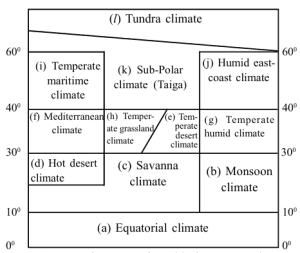 The various types of climate are :
(a) Equatorial climate: Hot and humid, found between the equator and N and S. High temperature and rainfall throughout the year, with no distinct seasons.
(b) Monsoon climate: Characterized by high temperature and rainfall during summer and low temperature and rainfall during winter. Found in parts of Asia, Australia, and Africa.
(c) Savanna climate: Also known as Sudan climate. Experiences distinct wet and dry seasons. Grasslands are common.
(d) Hot desert climate: Very low rainfall (less than 10 cm annually) and high temperatures. Found near the Tropics of Cancer and Capricorn.
(e) Temperate desert climate: Annual rainfall is less than 10 cm, but experiences hot summers () and cold winters (dropping to ).
(f) Mediterranean climate: Found in the western coastal regions of continents between and N and S. Mild temperatures with rainfall occurring mostly in winter. Suitable for horticulture.
(g) Temperate humid climate: Also called Chinese type of climate. Annual rainfall of 60 to 100 cm. Rainfall occurs mostly in summer.
(h) Temperate grassland climate: Characterized by extensive grasslands due to low rainfall. Summers are hot and winters are very cold.
(i) Temperate maritime climate: Found on the western parts of continents between and N and S. Moderate climate with rain year-round.
(j) Humid east-coast climate: Found on the eastern coastal regions between and N and S. Summers are warm and winters are cold, with about 100 cm of annual rainfall.
(k) Sub-Polar (Taiga) climate: Low temperatures with extensive coniferous forests (Taiga).
(l) Tundra climate: Found in regions within the Arctic and Antarctic circles. Very cold climate with the ground covered in ice for most of the year.
Q12. Write Short notes on the following:
(a) Relative humidity
Answer: Relative humidity is the ratio of the actual amount of water vapour present in a given volume of air at a specific temperature to the maximum amount of water vapour that the same volume of air can hold at that same temperature, expressed as a percentage. It is a key measure of how close the air is to saturation.
(b) Atmospheric pressure
Answer: Atmospheric pressure is the force exerted by the weight of the air on a unit area of the Earth’s surface. It is measured with a barometer. At sea level, the average atmospheric pressure is considered to be 14.7 pounds per square inch or 1013.2 millibars (mb). Atmospheric pressure decreases as elevation increases because the column of air above a given point becomes shorter.
(c) Pressure belts
Answer: Pressure belts are large-scale, permanent belts of high and low atmospheric pressure that encircle the Earth. These belts are a result of the unequal heating of the Earth’s surface and its rotation. The four main pressure belts are:
- Equatorial Low-Pressure Belt
- Sub-Tropical High-Pressure Belts
- Sub-Polar Low-Pressure Belts
- Polar High-Pressure Belts
(d) Types of rainfall
Answer: Rainfall is one of the most important forms of precipitation. Its major types are:
- Convectional rainfall: Caused by intense heating of air, which rises, cools, and condenses to form rain. Common in equatorial regions.
- Orographic rainfall: Occurs when moist winds rise over mountains; condensation causes rain on the windward side, leaving the leeward side dry.
- Cyclonic rainfall: Associated with cyclones; spiral winds converge towards a low-pressure centre, carrying moisture that leads to heavy rain.
- Latitudinal rainfall: Linked to planetary winds in specific latitudinal belts, which influence rainfall distribution.
- Forest rainfall: Dense forests increase humidity, causing localized rainfall.
(e) Effect of latitudes on climate
Answer: Latitude is a primary factor affecting climate because it determines the amount of solar radiation a region receives. The Earth’s curvature means that at the equator (low latitudes), the sun’s rays are direct and concentrated over a small area, resulting in high temperatures. As you move towards the poles (high latitudes), the sun’s rays become more oblique, are spread over a larger area, and travel a longer distance through the atmosphere, leading to lower temperatures. This creates distinct climate zones from hot equatorial climates to cold polar climates.
(f) Effect of vegetation on climate
Answer: Vegetation has a direct impact on the climate of a region. Dense forests and plant cover release a large amount of water vapour into the atmosphere through transpiration, increasing the humidity. This humid air helps in the formation of clouds and increases the chances of rainfall. Conversely, regions with little or no vegetation, such as deserts, have very dry air and experience low rainfall and high temperature variation.
(g) Monsoon climate
Answer: Monsoon climate is a type of climate characterized by a seasonal reversal of winds, which brings significant rainfall during the summer and relatively dry conditions during the winter. This climate is prevalent in many parts of Asia, including India, Bangladesh, and Southeast Asia. The main characteristics are high temperature and rainfall in summer and low temperature and rainfall in winter.
(h) Taiga type of climate
Answer: The Taiga climate, also known as Sub-Polar climate, is found in the high latitudes between and N and S. This climate is characterized by long, extremely cold winters and short, mild summers. The temperature is generally low, and heavy snowfall is common. This region is famous for its extensive coniferous forests, which are called ‘Taiga’ in Siberia.
(i) Mediterranean climate
Answer: This climate is found in the western coastal regions of continents between and N and S latitudes. It is characterized by dry, hot summers and wet, mild winters. This climate is ideal for the cultivation of fruits and is associated with a distinctive vegetation type, including evergreen trees and shrubs. It is named after the Mediterranean Sea region, where it is most prominent.
(j) Savanna climate
Answer: Savanna climate, or Sudan climate, is a type of tropical climate with a distinct dry season and a wet season. It is characterized by high temperatures and moderate rainfall that supports the growth of extensive grasslands with scattered trees and bushes. These grasslands are known as ‘Savanna’ in Africa and ‘Campos’ in Brazil.
(k) Tundra climate
Answer: Tundra climate is an extremely cold climate found in the polar regions, within the Arctic and Antarctic circles. The ground remains covered with ice for most of the year. The summers are very short and cool, with the temperature rising to a maximum of . Due to the harsh conditions, only low-lying vegetation like mosses and lichens can grow.
(l) Mountain climate
Answer: Mountain climate is a type of climate that is unique to hills and mountains and changes significantly with elevation. The climate at the foothills may be warm, but as you ascend, the temperature decreases, and the climate becomes colder, often with snowfall. This change in climate also affects the type of vegetation found at different altitudes, with a wide variety of plant life from the base to the summit.
Q13. Answer briefly :
(a) How far does the atmosphere extend above from the earth’s surface?
Answer: The atmosphere extends up to a height of about 10,000 km from the Earth’s surface.
(b) What is lapse rate?
Answer: Lapse rate is the rate at which air temperature decreases with an increase in altitude in the troposphere. The average lapse rate is per kilometre.
(c) What is the average atmospheric pressure on the sea level?
Answer: The average atmospheric pressure at sea level is 14.7 pounds per square inch or 1013.2 millibars (mb).
(d) What is humidity of air?
Answer: Humidity of air refers to the amount of water vapour contained in the air.
(e) What do you mean by the term ‘saturated air’?
Answer: Saturated air is a parcel of air that contains the maximum amount of water vapour it can hold at a particular temperature.
(f) What is the latitudinal extenssion of the equatorial climate?
Answer: The equatorial climate extends latitudinally between the equator and N and S.
(g) In which climate the Campos grassland is found?
Answer: The Campos grassland is found in the Savanna climate.
(h) Mention the latitudinal extension of the Temperate Desert climatic region.
Answer: The Temperate Desert climatic region is found in the central parts of the continents located between and north and south of the equator.
(i) What is the other name of the chinese climate?
Answer: The other name for the Chinese climate is Temperate Humid climate.
(j) Give an example of the irregular wind.
Answer: Winds caused by cyclones can be considered irregular winds.
(k) Why does the warm airmass have the capacity to hold more water-vapour?
Answer: Warm air molecules are more spread out and move faster than cold air molecules. This allows more space for water vapour molecules to fit between them, thus increasing the capacity of the air to hold more water vapour.
(l) Why there is more atmospheric pressure at the lower level of the atmosphere?
Answer: Atmospheric pressure is the weight of the air column above. At the lower levels of the atmosphere, there is a greater depth of air above, which exerts more weight and, therefore, higher pressure. Air is also compressible, so the air at lower levels gets compressed and becomes denser, further increasing the pressure.
Q14. Draw a diagram of the barometer of your school and label its different parts. Collect the barometer readings on the atmospheric pressure for a week with the help of your teacher and draw a graph from the data so collected.
Answer:
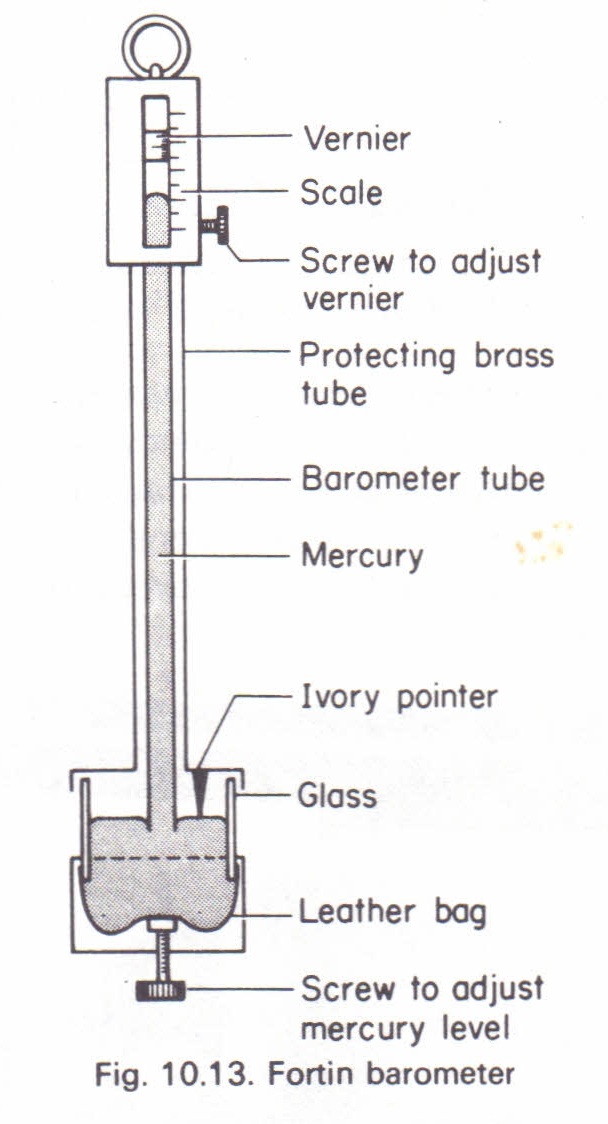
A barometer measures atmospheric pressure. The table below shows sample readings for a week (in mm of Hg):
| Day | Atmospheric Pressure (mm Hg) |
|---|---|
| Monday | 756 |
| Tuesday | 758 |
| Wednesday | 754 |
| Thursday | 759 |
| Friday | 757 |
| Saturday | 760 |
| Sunday | 758 |
Graph of Atmospheric Pressure over the Week:
Observation:
- The highest pressure was 760 mm Hg on Saturday.
- The lowest pressure was 754 mm Hg on Wednesday.
- Pressure fluctuated slightly during the week, showing normal daily variation.
Q15. Record the weather reports and data from the radio or television for a week and compare these data with the next week.
Answer:
Students should record daily weather reports (temperature, rainfall, humidity, wind direction, and pressure) for one week from radio/television.
In the following week, the same data should be recorded again.
The two weeks’ data should then be compared to study variations, for example:
Changes in temperature (rise or fall)
Variations in rainfall or humidity
Differences in wind pattern and pressure
This activity helps understand short-term weather changes and their effect on the local environment.