
EXERCISE
Q1. What is landform?
Answer: The features present on the Earth’s surface, such as mountains, hills, plateaus, river valleys on the continents, and submerged highlands and lowlands on the ocean bottom, are collectively called landforms.
Q2. Define geomorphology. Answer: Geomorphology is a specific branch of geography that studies the origin, evolution, morphology, and distribution of the various landforms on the Earth’s surface.
Q3. Write down the meaning of the geomorphic processes.
Answer: Geomorphic processes are the natural processes involved in the creation and modification of landforms on the Earth’s surface. These processes are a result of the interaction between exogenic factors and endogenic factors.
Q4. Mention the exogenic processes or factors.
Answer: The exogenic processes or factors are wind, rainfall, rivers, glaciers, ocean waves, and currents.
Q5. What do you mean by the term ‘deflation’?
Answer: Deflation is an erosional process caused by wind. In desert areas with little vegetation, the wind easily carries away sand and small rock particles, causing the surface to be lowered. This process is known as deflation.
Q6. What is inselberg? Explain with diagram.
Answer: Inselberg is an isolated low hillock found in desert areas. It is formed by the process of abrasion, where wind-blown sand at high velocity erodes the elevated lands. The upper part of an inselberg is steep because of more intense wind action on that part compared to its lower part.
 Q7. What is oasis? What is its significance?
Answer: An oasis is a depression in a desert that is formed by the process of deflation. The wind removes sand and rock particles, lowering the surface level almost to the level of the underground water. As a result, vegetation can grow here, and a small amount of agriculture can be practiced.
An oasis is significant because it provides a source of water and life in an otherwise dry and harsh desert environment, allowing for human habitation and agricultural activities.
Q8. What are sand dunes? How are they formed?
Answer: Sand dunes are hill-like deposits of sand that are formed by the deposition of wind-blown sands. They are a characteristic feature of desert landscapes.
They are formed when the wind, which has transported sand and other materials through the desert, loses its energy and deposits these materials. Over time, these deposits accumulate to form hills of sand called sand dunes.
Q9. What is abrasion? What are the features formed due to abrasion? Answer: Abrasion is an erosional process caused by the friction of wind-blown sand and rock particles against elevated lands. When strong winds carry sand at high velocities, they hit and wear away rock surfaces. This process is called abrasion.
The features formed due to abrasion include inselbergs and yardangs.
Q10. Define attrition.
Answer: Attrition is a process of wind erosion in deserts where wind-blown sand particles collide with each other while being transported. This mutual collision causes the particles to gradually break down into smaller pieces.
Q11. What are glaciers? What is the reason for their slow movement?
Answer: Glaciers are slow-moving blocks of snow and ice that move downward following the slope of the surface.
The main reasons for their slow movement are:
- The downward pressure of the vast deposits of snow from the upslope zone.
- The force of gravity pulling the ice mass downwards.
Q12. What are the different types of glaciers? Write briefly about each of them.
Answer: Based on their location and environment, glaciers can be divided into three main types:
- Continental glaciers: These are vast sheets of ice that cover extensive areas of the polar regions, such as Greenland and Antarctica. They move very slowly, following the gentle slope of the land.
- Mountain or Alpine or Valley glaciers: These glaciers originate in the high-altitude regions of mountains, like the Himalayas and the Alps. They flow through existing valleys and are comparatively faster than continental glaciers.
- Piedmont glaciers: These are formed when several mountain or valley glaciers flow downwards and meet at the foot of the mountains. They then spread out to cover a large area of the nearby plains.
Q13. Draw a figure to show the shape of a glacier valley.
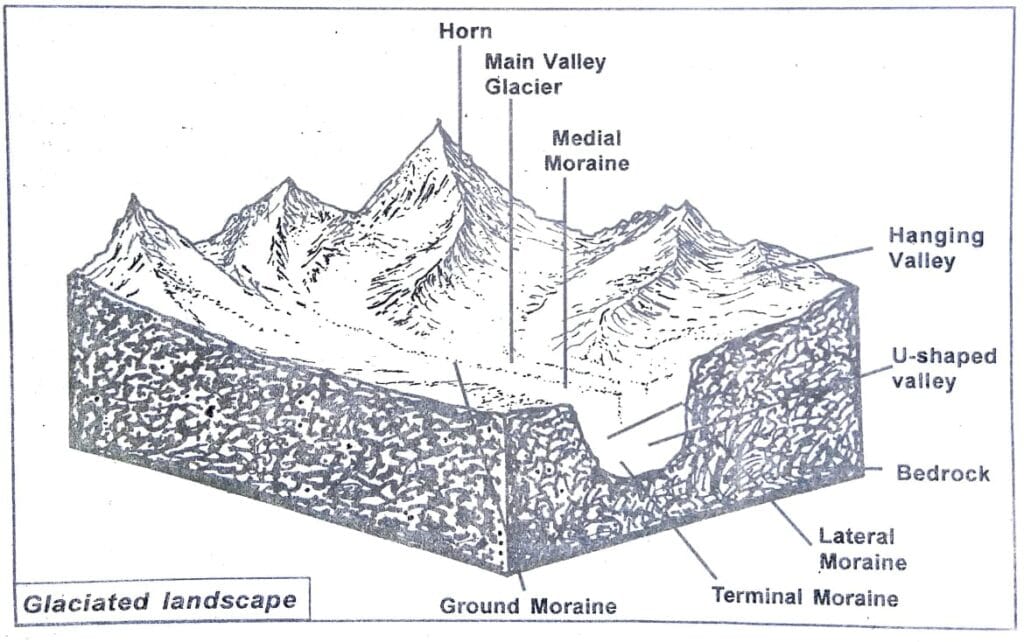
Answer: A glacier valley is typically U-shaped. This is because the glacier, with its strong friction, erodes the valley floor and sides uniformly, creating a wide, flat bottom and steep, straight sides.
Q14. What is a hanging valley?
Answer: A hanging valley is a landform created by glaciers. It forms when a smaller tributary glacier meets a much larger main glacier. The main glacier cuts its valley deeper and wider, while the smaller one remains at a higher level. After the glaciers melt, the tributary valley looks as if it is “hanging” above the main valley, and often waterfalls flow down from it.
Q15. What are moraines? What are their different types? Show the location of different moraines with the help of a figure.
Answer: Moraines are the rocks, soil, and sediments carried and left behind by glaciers. They are formed when glaciers move and then melt, depositing the materials they had picked up. Depending on where they are deposited, moraines are of different types:
- Lateral Moraines: Found along the sides of a glacier.
- Medial Moraines: Formed when two glaciers meet and their side moraines join in the middle of the glacier.
- Ground Moraines: Found at the bottom of the glacier valley.
- Terminal (End) Moraines: Deposited at the far end of a glacier where it melts, usually forming a ridge.

Q16. Based on your general knowledge, state how global warming may have its various effects on glaciers.
Answer: Global warming has serious effects on glaciers:
- Melting: Rising temperatures make glaciers melt faster, reducing their size.
- Sea-level rise: Meltwater adds to oceans, causing sea levels to rise and flooding coastal areas.
- Freshwater loss: Glaciers supply rivers; their melting can cause water shortages in the future.
- Landscape change: Retreating glaciers create new landforms and lakes, which may also cause floods.