
NCERT Class 10 Science Chapter 13: Our Environment Solutions | Assam Eduverse
Chapter Overview
Assam Eduverse presents detailed and student-friendly NCERT Solutions for Class 10 Science Chapter 13 – Our Environment as per CBSE Cirriculum . These solutions cover all intext and exercise questions with step-by-step explanations. Students can use these expert-curated answers to boost exam scores and understand key concepts. This chapter explores ecosystem components, food chains and webs, energy flow, biodegradable and non-biodegradable waste, and environmental issues like ozone layer depletion and waste disposal.
The following sections include intext questions and exercise questions from the textbook.
NCERT Solutions for Class 10 Science Chapter 13 Intext Questions
📝 Page 212
Q1: What are trophic levels? Give an example of a food chain and state the different trophic levels in it.
Ans:
Trophic Levels : The various steps in a food chain at which the transfer of food (or energy) takes place are called trophic levels.
Example of a food chain:
Grass → Grasshopper → Frog→Eagle
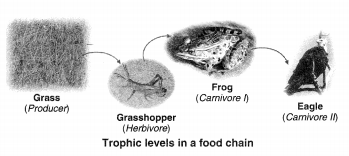
1st Trophic Level: Grass (Producer)
2nd Trophic Level: Grasshopper (Primary Consumer)
3rd Trophic Level: Frog (Secondary Consumer)
4th Trophic Level: Eagle (Tertiary Consumer)
Q2: What is the role of decomposers in the ecosystem?
Ans:
Decomposers like fungi and bacteria break down dead organisms and waste materials into simple substances. They help recycle nutrients back into the soil, ensuring the continuity of life by replenishing nutrients for producers.
📝 Page 214
Q1: Why are some substances biodegradable and some non-biodegradable?
Answer:
Some substances are biodegradable because they can be broken down by microorganisms (like bacteria and fungi) into harmless substances.
Others are non-biodegradable because microorganisms cannot decompose them, so they remain in the environment for a long time, causing pollution.
Q2: Give any two ways in which biodegradable substances would affect the environment.
Answer:
- They may produce a foul smell during decomposition, affecting air quality.
- Excess biodegradable waste can use up oxygen in water bodies, harming aquatic life.
Q3: Give any two ways in which non-biodegradable substances would affect the environment.
Answer:
Non-biodegradable substances accumulate in soil and water, leading to long-term pollution.
Some of them (like plastics) can harm animals if ingested or cause blockages in drains and water systems.
📝 Page 216
Q1: What is ozone and how does it affect any ecosystem?
Ans:
Ozone (O₃) is a gas made up of three oxygen atoms. In the upper atmosphere, it protects life on Earth by absorbing harmful ultraviolet (UV) rays from the sun. Without the ozone layer, these rays can cause skin cancer and damage ecosystems.
Q2: How can you help in reducing the problem of waste disposal? Give any two methods.
Ans:
By segregating biodegradable and non-biodegradable waste and recycling the latter.
Reducing the use of plastic and encouraging the use of reusable items like cloth bags.
NCERT Solutions for Class 10 Science Chapter 15 Intext Questions
Q1: Which of the following groups contain only biodegradable items?
(a) Grass, flowers and leather
(b) Grass, wood and plastic
(c) Fruit-peels, cake and lime-juice
(d) Cake, wood and grass
Ans: (a) Grass, flowers and leather
Q2: Which of the following constitute a food-chain?
(a) Grass, wheat and mango
(b) Grass, goat and human
(c) Goat, cow and elephant
(d) Grass, fish and goat
Ans: (b) Grass, goat and human
Q3: Which of the following are environment-friendly practices?
(a) Carrying cloth-bags to put purchases in while shopping
(b) Switching off unnecessary lights and fans
(c) Walking to school instead of getting your mother to drop you on her scooter
(d) All of the above
Ans: (d) All of the above
Q4: What will happen if we kill all the organisms in one trophic level?
Ans:
Killing all organisms in one trophic level will disrupt the food chain. The previous level would overpopulate due to lack of predators, and the next level would starve due to lack of food, affecting the entire ecosystem.
Q5: Will the impact of removing all the organisms in a trophic level be different for different trophic levels? Can the organisms of any trophic level be removed without causing any damage to the ecosystem?
Ans:
Yes, the impact will differ. Removal of producers will collapse the whole food chain, while removing top consumers may cause overpopulation of prey. No trophic level can be removed without damaging the ecosystem.
Q6: What is biological magnification? Will the levels of this magnification be different at different levels of the ecosystem?
Ans:
Biological magnification is the accumulation of harmful substances (like pesticides) in organisms at higher trophic levels. Yes, the level of magnification increases with each higher trophic level, making top-level consumers most affected.
Q7: What are the problems caused by the non-biodegradable wastes that we generate?
Ans:
Non-biodegradable waste accumulates in the environment, causing land and water pollution, harming wildlife, and entering the food chain, affecting health and ecological balance.
Q8: If all the waste we generate is biodegradable, will this have no impact on the environment?
Ans:
Even biodegradable waste can cause pollution if it accumulates excessively. It may lead to bad odors, attract disease-causing organisms, and create unhygienic conditions if not managed properly.
Q9: Why is damage to the ozone layer a cause for concern? What steps are being taken to limit this damage?
Ans:
The damage to the ozone layer is a cause for concern because if the ozone layer in the atmosphere disappears completely, then all the extremely harmful ultraviolet radiations coming from the sun would reach the earth. These ultraviolet radiations would cause skin cancer and other ailments in men and animals and also damage the plants.
Steps to limit this damage include banning ozone-depleting substances like CFCs and promoting eco-friendly technologies (e.g., UNEP’s agreement in 1987 to freeze CFC production).
🎓 About Assam Eduverse
This solution is prepare by Assam Eduverse – your reliable educational hub for academic content, study materials, and exam preparation for Assam Board and other state-level exams. Follow Assam Eduverse for accurate, exam-ready NCERT solutions, notes, MCQs, and free study materials.