
Q1: The human eye can focus objects at different distances by adjusting the focal length of the eye lens. This is due to
(a) presbyopia
(b) accommodation
(c) near – sightedness
(d) far – sightedness
Answer:
(b) Accommodation
Q2: The human eye forms the image of an object at its
(a) cornea
(b) iris
(c) pupil
(d) retina
Answer:
(d) Retina
Q3: The least distance of distinct vision for a young adult with normal vision is about
(a) 25 m
(b) 2.5 cm
(c) 25 cm
(d) 2.5 m
Answer:
(c) 25 cm
Q4: The change in focal length of an eye lens is caused by the action of the
(a) pupil
(b) retina
(c) ciliary muscles
(d) iris
Answer:
(c) Ciliary muscles
Q5: A person needs a lens of power –5.5 dioptres for correcting his distant vision. For correcting his near vision he needs a lens of power +1.5 dioptres. What is the focal length of the lens required for correcting (i) distant vision, and (ii) near vision?
Answer:
We use the formula:P = 100/f(m) or f (in m) = 1 / P
(i) For distant vision:
Given power P = –5.5 D
f = 1 / –5.5 = –0.1818 m = –18.18 cm
(ii) For near vision:
Given power P = +1.5 D
f = 1 / 1.5 = 0.6667 m = 66.67 cm
Q6: The far point of a myopic person is 80 cm in front of the eye. What is the nature and power of the lens required to correct the problem?
Answer:
To correct myopia, a concave lens (negative focal length) is used.
The remedial lens should make the objects at infinity appear at the far point.
Therefore, for object at infinity, u = ∞
Far point distance of the defected eye, ν = – 80 cm
Nature: Concave lens
Power: –1.25 dioptres
Q7: Make a diagram to show how hypermetropia is corrected. The near point of a hypermetropic eye is 1 m. What is the power of the lens required to correct this defect? Assume that the near point of the normal eye is 25 cm.
Answer:
(i) The near point N of hypermetropic eye is farther away from the normal near point N.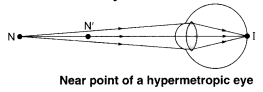
(ii) In a hypermetropic eye, the image of nearby object lying at normal near point N (at 25 cm) is formed behind the retina.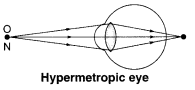
(iii) Correction of hypermetropia : The convex lens forms a virtual image of the object (lying at normal near point N) at the near point N’ of this eye.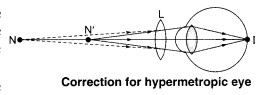
The object placed at 25 cm from the correcting lens must produce a virtual image at 1 m or 100 cm.
Therefore, u = – 25 cm, ν = 100 cm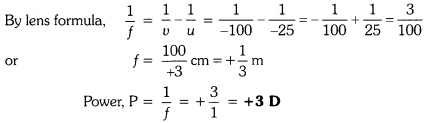
The positive sign shows that it is a convex lens.
Q8: Why is a normal eye not able to see clearly the objects placed closer than 25 cm?
Answer:
A normal eye cannot see objects clearly placed closer than 25 cm because the ciliary muscles cannot contract further to increase the curvature of the lens. Thus, the lens cannot become thick enough to focus the diverging rays from a nearby object onto the retina.
Q9: What happens to the image distance in the eye when we increase the distance of an object from the eye?
Answer:
When the distance of the object from the eye increases, the image distance remains constant because the image is always formed on the retina. The focal length of the lens is adjusted to maintain the image on the retina.
Q10: Why do stars twinkle?
Answer:
Stars twinkle due to the refraction of starlight by the Earth’s atmosphere. The temperature and density variations in different atmospheric layers bend the light rays continuously, changing the star’s apparent position and brightness.
Q11: Explain why the planets do not twinkle.
Answer:
Planets do not twinkle because they appear as extended sources of light due to their proximity to Earth. The light from planets comes from multiple points which average out the twinkling effects caused by atmospheric turbulence.
Q12: Why does the sky appear dark instead of blue to an astronaut?
Answer:
The sky appears dark to an astronaut because there is no atmosphere in space to scatter sunlight. Since scattering is absent, the sky does not appear blue but remains dark or black.