
NCERT Class 10 Science Chapter 5: Life Processes Solutions | Assam Eduverse
Chapter Overview
Assam Eduverse presents detailed and student-friendly NCERT Solutions for Class 10 Science Chapter 5 – Life Processes as per CBSE Cirriculum These solutions cover all intext and exercise questions with step-by-step explanations. Students can use these expert-curated answers to boost exam scores and understand key concepts. This chapter explores vital life processes such as nutrition, respiration, transportation, and excretion in both plants and animals.
The following sections include intext questions , exercise questions from the textbook, and multiple-choice questions (MCQs) with answers and explanations.
CBSE Solutions for Class 10 Science Chapter 5 Intext Questions
Page 81
Q1: Why is diffusion insufficient to meet the oxygen requirements of multicellular organisms like humans?
Answer:
In multicellular organisms like humans, cells are located deep inside the body and are not in direct contact with the surrounding environment. Diffusion is a slow process and cannot effectively transport oxygen to all cells in a large organism. Hence, a specialized respiratory system is needed to deliver oxygen efficiently to every cell.
Q2: What criteria do we use to decide whether something is alive?
Answer:
The main criteria to decide if something is alive include growth, movement, respiration, reproduction, excretion, and other metabolic activities. Among these, metabolism and response to stimuli are considered fundamental characteristics of living beings.
Q3: What are outside raw materials used by an organism?
Answer:
Outside raw materials used by an organism include:
Oxygen (for respiration)
Water (for metabolic reactions)
Carbon dioxide (for photosynthesis in plants)
Food (in animals and humans for energy)
Q4: What processes would you consider essential for maintaining life?
Answer:
Essential life processes include:
Nutrition
Respiration
Transportation
Excretion
These processes ensure the survival and proper functioning of an organism.
Page 87
Q1: What are the differences between autotrophic and heterotrophic nutrition?
Answer:
| Feature | Autotrophic Nutrition | Heterotrophic Nutrition |
|---|---|---|
| Definition | Organisms prepare their own food | Organisms depend on others for food |
| Example | Green plants | Humans, animals |
| Source | Uses CO₂ and sunlight | Consumes plants/animals |
Q2: Where do plants get each of the raw materials required for photosynthesis?
Answer:
Carbon dioxide (CO₂): From the atmosphere through stomata
Water (H₂O): Absorbed from the soil by roots
Sunlight: From the sun, absorbed by chlorophyll in leaves
Q3: What is the role of the acid in our stomach?
Answer:
The hydrochloric acid (HCl) in our stomach:
Kills harmful bacteria
Creates an acidic medium for the enzyme pepsin to function and digest proteins
Q4: What is the function of digestive enzymes?
Answer:
Digestive enzymes break down complex food substances (like carbohydrates, proteins, and fats) into simpler, absorbable forms such as glucose, amino acids, and fatty acids.
Q5: How is the small intestine designed to absorb digested food?
Answer:
The small intestine has finger-like projections called villi which:
Increase surface area for absorption
Contain blood vessels for transporting nutrients
Page 91
Q1: What advantage over an aquatic organism does a terrestrial organism have with regard to obtaining oxygen for respiration?
Answer:
Terrestrial organisms use atmospheric oxygen, which is more abundant and diffuses faster than dissolved oxygen in water, giving them an advantage in efficient respiration.
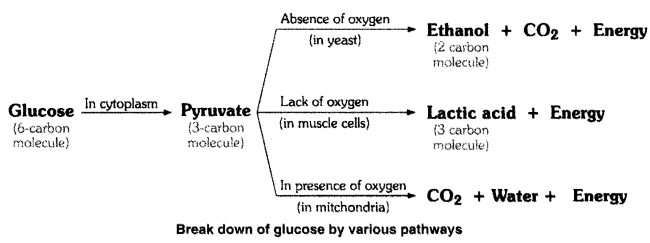
Q2: What are the different ways in which glucose is oxidized to provide energy in various organisms?
Answer:
| Organism Type | Condition | End Products |
|---|---|---|
| All organisms | Glycolysis | Pyruvate |
| In presence of oxygen (aerobic) | Pyruvate → CO₂ + H₂O | |
| In absence of oxygen (anaerobic) in yeast | Pyruvate → Alcohol + CO₂ | |
| In lack of oxygen in muscles | Pyruvate → Lactic acid |
Or
Q3: How is oxygen and carbon dioxide transported in human beings?
Answer:
Oxygen: Transported by red blood cells (RBCs) in the form of oxyhemoglobin
Carbon dioxide: Transported mainly as bicarbonate ions in plasma and also as carbaminohemoglobin
Q4: How are the lungs designed in human beings to maximize the area for exchange of gases?
Answer:
Lungs contain millions of alveoli with large surface area, thin walls, and rich blood supply, ensuring efficient gas exchange.
Page 96
Q1: What are the components of the transport system in human beings? What are the functions of these components?
Answer:
Heart: Pumps blood
Arteries: Carry oxygenated blood from heart
Veins: Bring deoxygenated blood back to heart
Capillaries: Exchange of gases and nutrients
Blood: Transports oxygen, nutrients, hormones, waste
Q2: Why is it necessary to separate oxygenated and deoxygenated blood in mammals and birds?
Answer:
To maintain high metabolic rate and efficient energy production, mammals and birds need to keep oxygen-rich and oxygen-poor blood separate. This ensures maximum oxygen reaches body tissues.
Q3: What are the components of the transport system in highly organised plants?
Answer:
Xylem: Transports water and minerals
Phloem: Transports food from leaves to other parts
Q4: How are water and minerals transported in plants?
Answer:
Water and minerals are absorbed by roots and transported upward through xylem via transpiration pull, root pressure, and capillary action.
Q5: How is food transported in plants?
Answer:
Food is transported from leaves to other parts by phloem through a process called translocation, which requires energy (ATP).
Page 98
Q1: Describe the structure and function of nephrons.
Answer:
A nephron is the functional unit of the kidney. It has:
Bowman’s capsule: Filtration of blood
Tubule: Reabsorption of essential substances
Collecting duct: Collects urine
Function: Excretes waste, maintains salt and water balance.
Q2: What are the methods used by plants to get rid of excretory products?
Answer:
Storing waste in vacuoles
Shedding leaves and bark
Releasing gases via stomata
Excreting through resins and gums
Q3: How is the amount of urine produced regulated?
Answer:
The amount of urine depends on:
Water intake
Hormone ADH (Anti-diuretic hormone)
Salt levels in blood
CBSE Solutions for Class 10 Science Chapter 5 Textbook Chapter End Questions
Q1: The kidneys in human beings are a part of the system for:
(i) nutrition
(ii) respiration
(iii) excretion
(iv) transportation
Answer: (d) Excretion
Q2: The xylem in plants is responsible for:
(i) transport of water
(ii) transport of food
(iii) transport of amino acids
(iv) transport of oxygen
Answer: (b) Transport of water
Q3: The autotrophic mode of nutrition requires:
a) carbon dioxide and water.
(b) chlorophyll
(c) sunlight
(d)all of the above
Answer: (d) All of the above
Q4: The breakdown of pyruvate to give carbon dioxide, water, and energy takes place in:
(i) cytoplasm
(ii) mitochondria
(iii) chloroplast
(iv) nucleus
Answer: (b) Mitochondria
Q5: How are fats digested in our bodies? Where does this process take place?
Answer:
Fats are broken down by bile salts (from liver) and lipase enzyme into fatty acids and glycerol. This takes place in the small intestine.
Q6: What is the role of saliva in the digestion of food?
Answer:
Saliva plays an important role in the digestion of food:
Contains salivary amylase : This enzyme breaks down starch (a complex carbohydrate) into maltose (a simpler sugar).
Moistens food: Makes it easier to chew and swallow.
Lubricates the food: Aids in smooth passage through the esophagus.
Q7: What are the necessary conditions for autotrophic nutrition and what are its byproducts?
Answer:
Necessary conditions for autotrophic nutrition:
Sunlight – Source of energy.
Chlorophyll – Traps solar energy.
Carbon dioxide (CO₂) – From the atmosphere.
Water (H₂O) – Absorbed from the soil.
Byproducts of autotrophic nutrition:
Glucose (C₆H₁₂O₆) – Main product, used for energy and storage.
Oxygen (O₂) – Released as a byproduct into the atmosphere.
Q8: What are the differences between aerobic and anaerobic respiration? Name some organisms that use the anaerobic mode of respiration.
Answer:
| Aerobic respiration | Anaerobic respiration |
| 1. It takes place in the presence of oxygen. | 1. It takes place in the absence of oxygen. |
| 2. Complete breakdown of food occurs in aerobic respiration. | 2. Partial breakdown of food occurs in anaerobic respiration. |
| 3. The end products in aerobic respiration are carbon dioxide and water. | 3. The end products in anaerobic respiration may be ethanol and carbon dioxide |
| 4. Aerobic respiration produces a considerable amount of energy. | 4. Much less energy is produced in anaerobic respiration. |
Examples of anaerobic organisms are yeast, bacteria etc.
Q9: How are the alveoli designed to maximise the exchange of gases?
Answer:
Alveoli are tiny air sacs in the lungs designed for efficient gas exchange:
Large surface area due to millions of alveoli.
Thin walls (one-cell thick) for quick diffusion.
Rich blood supply through capillaries for rapid transport of gases.
Moist surface to dissolve gases for easy diffusion.
This structure allows for efficient oxygen intake and carbon dioxide removal.
Q10: What would be the consequences of a deficiency of haemoglobin in our bodies?
Answer:
Due to the deficiency of haemoglobin in blood, its oxygen carrying capacity decreases. As a result the production of energy by oxidation will become slower. Therefore, one would fall sick and would feel fatigue most of the time.
Q11: Describe double circulation of blood in human beings. Why is it necessary?
Answer:
In humans, blood passes through the heart twice during one complete cycle—this is called double circulation. First, the deoxygenated blood (which has less oxygen) from the body enters the right atrium of the heart through the vena cava. It then moves into the right ventricle, which pumps this blood to the lungs through the pulmonary artery. In the lungs, the blood picks up oxygen and releases carbon dioxide. This oxygen-rich blood then returns to the heart, entering the left atrium through the pulmonary veins. From the left atrium, the blood flows into the left ventricle, which finally pumps it to the rest of the body through the arteries. Since the blood goes through the heart two times—once for the lungs and once for the rest of the body—we call this double circulation.
Necessity of double circulation: The right side and the left side of the human heart are useful to keep deoxygenated and oxygenated blood from mixing. This type of separation of oxygenated and deoxygenated blood ensures a highly efficient supply of oxygen to the body. This is useful in case of humans who constantly need energy to maintain their body temperature.
Q12: What are the differences between the transport of materials in xylem and phloem?
Answer:
| Xylem | Phloem |
| 1. Xylem conducts water and dissolved minerals from roots to leaves and other parts. | 1. Phloem conducts prepared food material from leaves to other parts of plant in dissolved form. |
| 2. In xylem, the transport of material takes place through vessels and tracheids which are dead tissues. | 2. In phloem, transport of material takes place through sieve tubes with the help of companion cells, which are living cells. |
| 3. In xylem upward movement of water and dissolved minerals is mainly achieved by transpiration pull. It is caused due to suction created by evaporation of water molecules from the cells of a leaf. | 3. In translocation, material is transferred into phloem tissue using energy from ATP. This increases the osmotic pressure that moves the material in the phloem to tissues which have less pressure |
Q12: Compare the functioning of alveoli in the lungs and nephrons in the kidneys with respect to their structure and functioning.
Answer:
| Alveoli | Nephron |
| 1. Alveoli are functional unit of lungs. | 1. Nephrons are functional unit of kidney. |
| 2. A mature lung has about 30 crore alveoli. | 2. A kidney has about 10 lakh nephrons. |
| 3. Alveoli provide a wide surface for gaseous exchange. | 3. The surface area of a nephron is not much more. |
| 4. The exchange of O2 and CO2 takes place through the network of capillaries in alveoli. | 4. The Bowman’s capsule in nephron regulates the concentration of water and salts. |
Q13: Compare the functioning of alveoli in the lungs and nephrons in the kidneys with respect to their structure and functioning.
Answer:
| Feature | Alveoli (Lungs) | Nephrons (Kidneys) |
|---|---|---|
| Function | Gaseous exchange (O₂ and CO₂) | Filtration and formation of urine |
| Structure | Thin-walled air sacs with capillaries | Bowman’s capsule + tubule + capillaries |
| Surface Area | Large surface area for diffusion | Large surface area for filtration and reabsorption |
| Mechanism | Diffusion of gases | Filtration, reabsorption, secretion |
Both structures are highly vascularised and specialised to perform exchange functions – gases in alveoli and wastes in nephrons.
About Assam Eduverse
This solution is prepare by Assam Eduverse – your reliable educational hub for academic content, study materials, and exam preparation for Assam Board and other state-level exams. Follow Assam Eduverse for accurate, exam-ready NCERT solutions, notes, MCQs, and free study materials.