
class 10 sc ch 7 cbse

NCERT Class 10 Science Chapter 7 : How Do Organisms Reproduce? Solutions | Assam Eduverse

Chapter Overview

Assam Eduverse presents detailed and student-friendly NCERT Solutions for Class 10 Science Chapter 7 – How Do Organisms Reproduce? as per CBSE Cirriculum. These solutions cover all intext and exercise questions with step-by-step explanations. Students can use these expert-curated answers to boost exam scores and understand key concepts. This chapter explores modes of reproduction in unicellular and multicellular organisms, including asexual reproduction (fission, budding, fragmentation, spore formation, regeneration) and sexual reproduction in animals and plants. It also discusses reproductive health and methods of contraception.

The following sections include intext questions , exercise questions from the textbook, and multiple-choice questions (MCQs) with answers and explanations.

NCERT Solutions for Class 10 Science Chapter 7 Intext Questions

📝 Page 114

Q1: What is the importance of DNA copying in reproduction?

Ans: DNA copying is important in reproduction because it ensures that the genetic information is passed from parents to offspring. This allows the organism to maintain its identity and characteristics. Minor variations due to inaccuracies in DNA copying can lead to evolution over generations.


Q2: Why is variation beneficial to the species but not necessarily for the individual?

Ans: Variation helps a species survive in changing environments. If all individuals were identical, a single change could wipe out the whole population. However, variation is not always beneficial to an individual because it may result in disadvantageous traits.


📝 Page 119

Q1: How does binary fission differ from multiple fission?

Ans: In binary fission, a single organism splits into two daughter cells (e.g., Amoeba). In multiple fission, the organism divides into many daughter cells simultaneously (e.g., Plasmodium).


Q2: How will an organism be benefited if it reproduces through spores?

Ans: Reproduction through spores helps organisms survive in unfavorable conditions. Spores are lightweight, can be dispersed easily, and can remain dormant for long periods until conditions become favorable.


Q3: Can you think of reasons why more complex organisms cannot give rise to new individuals through regeneration?

Ans: In complex organisms, cells are specialized and organized into tissues and organs. Regeneration of the whole organism is not possible because simple cell division cannot recreate the complete body structure and functions.


Q4: Why is vegetative propagation practiced for growing some types of plants?

Ans: Vegetative propagation is practiced because:

  • It is faster.

  • It produces genetically identical plants.

  • It helps preserve desirable traits.

  • It enables propagation of plants that do not produce viable seeds.


Q5: Why is DNA copying an essential part of the process of reproduction?

Ans: DNA copying is essential because it passes genetic information to the next generation, enabling the continuity of life and maintaining the organism’s characteristics.


📝 Page 126

Q1: How is the process of pollination different from fertilization?

Ans:

  • Pollination is the transfer of pollen from the anther to the stigma.

  • Fertilization is the fusion of male and female gametes to form a zygote.


Q2: What is the role of the seminal vesicles and the prostate gland?

Ans: The seminal vesicles and prostate gland secrete fluids that nourish the sperm and make their transport easier by forming semen.


Q3: What are the changes seen in girls at the time of puberty?

Ans:

  1. Hair grow under armpits and pubic region.
  2. Mammary glands (or breasts) develop and enlarge.
  3. The hips broaden.
  4. Ovaries start to release eggs.
  5. Menstruation (monthly periods) starts.

Q4: How does the embryo get nourishment inside the mother’s body?

Ans: The embryo receives nourishment through the placenta, a special tissue that connects it to the mother’s uterus. The placenta supplies oxygen and nutrients and removes waste.


Q5: If a woman is using a copper-T, will it help in protecting her from sexually transmitted diseases?

Ans: No. A copper-T prevents pregnancy but not sexually transmitted diseases (STDs). Only barrier methods like condoms can prevent STDs.

NCERT Solutions for Class 10 Science Chapter 7 Textbook Chapter End Questions

Q1: Asexual reproduction takes place through budding in:

(a) Amoeba
(b) Yeast
(c) Plasmodium
(d) Leishmania

Ans: (b) Yeast


Q2: Which of the following is not a part of the female reproductive system?

(a) Ovary
(b) Uterus
(c) Vas deferens
(d) Fallopian tube

Ans: (c) Vas deferens


Q3: The anther contains:

(a) Sepals
(b) Ovules
(c) Carpel
(d) Pollen grains

Ans: (d) Pollen grains


Q4: What are the advantages of sexual reproduction over asexual reproduction?

Ans:

  • Leads to genetic variation in offspring

  • Increases adaptability

  • Helps in evolution

  • Enables survival in changing environments


Q5: What are the functions performed by the testis in human beings?

Ans:

  • Production of sperm

  • Secretion of the male hormone testosterone


Q6: Why does menstruation occur?

Ans: If fertilization does not occur, the thickened lining of the uterus breaks down and is expelled through the vagina. This is called menstruation.


Q7: Draw a labeled diagram of the longitudinal section of a flower.

Ans:
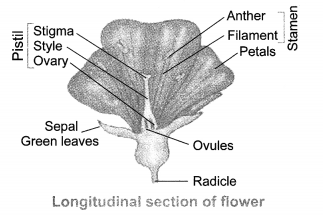
NCERT Solutions for Class 10 Science Chapter 8 How Do Organisms Reproduce Chapter End Questions Q8


Q8: What are the different methods of contraception?

Ans:

  • Barrier methods: Condoms, diaphragms

  • Chemical methods: Oral pills, spermicides

  • Intrauterine devices (IUDs): Copper-T

  • Surgical methods: Vasectomy, tubectomy


Q9: How are the modes of reproduction different in unicellular and multicellular organisms?

Ans:

  • Unicellular organisms use simple methods like binary fission, budding.

  • Multicellular organisms use complex methods like vegetative propagation or sexual reproduction involving specialized organs and cells.


Q10: How does reproduction help in providing stability to populations of species?

Ans: Reproduction ensures continuity of species. It replaces dying individuals, maintains population size, and allows adaptation through variation.


Q11: What could be the reasons for adopting contraceptive methods?

Ans:

  • Prevent unwanted pregnancies

  • Control population growth

  • Ensure spacing between children

  • Prevent sexually transmitted diseases (only in some methods)


🔹 EXTRA MCQs: How Do Organisms Reproduce?

Q1: Which method of reproduction is common in Planaria?

(a) Budding
(b) Regeneration
(c) Spore formation
(d) Fission

Ans: (b) Regeneration


Q2: In which of the following organisms does fertilization occur outside the body?

(a) Human
(b) Cow
(c) Frog
(d) Dog

Ans: (c) Frog


Q3: Which of the following is a contraceptive device?

(a) Vaccine
(b) Copper-T
(c) Stethoscope
(d) Insulin

Ans: (b) Copper-T


Q4: Which organ in females produces the egg?

(a) Uterus
(b) Oviduct
(c) Ovary
(d) Cervix

Ans: (c) Ovary


Q5: Which hormone is secreted by the testes?

(a) Estrogen
(b) Progesterone
(c) Testosterone
(d) Insulin

Ans: (c) Testosterone

🎓 About Assam Eduverse

This solution is prepare by Assam Eduverse – your reliable educational hub for academic content, study materials, and exam preparation for Assam Board and other state-level exams. Follow Assam Eduverse for accurate, exam-ready NCERT solutions, notes, MCQs, and free study materials.

Leave a Comment