
📝 Page 129
Q1: If a trait A exists in 10% of a population of an asexually reproducing species and a trait B exists in 60% of the same population, which trait is likely to have arisen earlier?
Answer:
Trait B is more common (60%) than trait A (10%), so it is likely to have arisen earlier in the population. In asexual reproduction, traits are passed unchanged, so older traits are more widespread.
Q2: How does the creation of variations in a species promote survival?
Answer:
Variations help species adapt to changing environments. If a change occurs, some individuals with beneficial variations can survive and reproduce, ensuring the species’ survival.
📝 Page 133
Q1: How do Mendel’s experiments show that traits may be dominant or recessive?
Answer:
Mendel found that when he crossed tall and short plants, all first-generation (F1) plants were tall. The short trait reappeared in the second generation (F2). This showed that the short trait was recessive, and tall was dominant.
Q2: How do Mendel’s experiments show that traits are inherited independently?
Answer:
Mendel crossed plants with two different traits (like tall plants with violet flowers and short plants with white flowers). The offspring showed new combinations, proving that traits are inherited independently, not linked.
Q3: A man with blood group A marries a woman with blood group O and their daughter has blood group O. Is this enough to say which trait is dominant?
Answer:
No, this information alone is not enough. Blood group A can be AA or AO. Since the child is O, the father must be AO and the mother OO. This suggests A is dominant over O, but we cannot confirm just from one example.
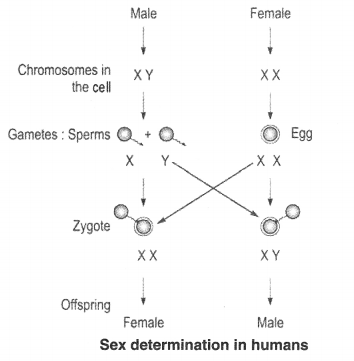
Q4: How is the sex of the child determined in human beings?
Answer:
Humans have XX (female) and XY (male) chromosomes. The mother always gives X, while the father can give X or Y. If the child gets X from father → girl (XX), if Y → boy (XY). So, the father decides the child’s sex.
Q1: A Mendelian experiment consisted of breeding tall pea plants bearing violet flowers with short pea plants bearing white flowers. The progeny all bore violet flowers, but almost half of them were short. This suggests that the genetic make-up of the tall parent can be depicted as:(a) TTWW
(b) TTww
(c) TtWW
(d) TtWw
Answer: (c) TtWW
Explanation:
- All progeny have violet flowers → violet is dominant. So, the parent must have WW or Ww (at least one dominant allele).
- Half the offspring are short → height trait is segregating. So, the tall parent must be heterozygous (Tt).
- So, the correct genotype is TtWW.
Q2: A study found that children with light-coloured eyes are likely to have parents with light-coloured eyes. On this basis, can we say anything about whether the light eye colour trait is dominant or recessive? Why or why not?
Answer:
No, we cannot say whether the light eye colour trait is dominant or recessive based on this single observation.
To determine dominance, we need to observe several generations and track how the trait is passed on. One example is not enough for a conclusion.
Q3: Outline a project which aims to find the dominant coat colour in dogs.
Answer: To find the dominant coat colour in dogs, mate two dogs with different coat colours and observe the offspring. If one colour consistently appears in all or most puppies, it is likely the dominant trait. Repeating the experiment with other dogs helps confirm the result.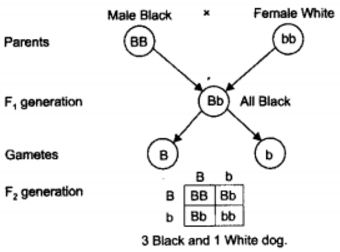
Q11: How is the equal genetic contribution of male and female parents ensured in the progeny?
Answer:
In human beings, equal genetic contribution from both male and female parents is ensured through the process of sexual reproduction. Each parent has 23 pairs of chromosomes, and during the formation of gametes (sperm and egg), each contributes only half — that is, 23 chromosomes. When the sperm from the father and the egg from the mother fuse during fertilization, the resulting zygote receives 23 chromosomes from each parent, making a total of 46 chromosomes. This way, the child inherits half of its genetic material from the father and half from the mother, ensuring equal genetic contribution from both parents.
Q4: Only variations that confer an advantage to an individual organism will survive in a population. Do you agree with this statement? Why or why not?
Answer:
Yes, this is generally true.
Beneficial variations help organisms survive and reproduce better.
These variations get passed on to future generations.
Harmful or neutral variations may be lost over time.
This process is called natural selection and is key to evolution.
 About Assam Eduverse
This solution is prepare by Assam Eduverse – your reliable educational hub for academic content, study materials, and exam preparation for Assam Board and other state-level exams. Follow Assam Eduverse for accurate, exam-ready NCERT solutions, notes, MCQs, and free study materials.