
EXERCISES
Q1. Name the parts of an angiosperm flower in which development of male and female gametophyte take place.
Answer: The development of the male gametophyte (pollen grain) takes place in the microsporangia (or pollen sacs) of the anther. The development of the female gametophyte (embryo sac) takes place in the nucellus (specifically, from a megaspore mother cell in the micropylar region) inside the ovule.
Q2. Differentiate between microsporogenesis and megasporogenesis. Which type of cell division occurs during these events? Name the structures formed at the end of these two events.
Answer:
| Feature | Microsporogenesis | Megasporogenesis |
|---|---|---|
| Definition | The process of formation of microspores from a pollen mother cell (PMC). | The process of formation of megaspores from the megaspore mother cell (MMC). |
| Location | Inside the microsporangium of the anther. | Inside the ovule (in the micropylar region of the nucellus). |
| Cells Involved | Pollen mother cell (PMC). | Megaspore mother cell (MMC). |
| Type of Cell Division | Meiotic division occurs in both microsporogenesis and megasporogenesis. | Meiotic division occurs in both microsporogenesis and megasporogenesis |
| Structures Formed at the End | Microsporogenesis results in the formation of a microspore tetrad (which later dissociates into individual pollen grains or microspores). | Megasporogenesis results in the production of four megaspores. |
Q3. Arrange the following terms in the correct developmental sequence: Pollen grain, sporogenous tissue, microspore tetrad, pollen mother cell, male gametes.
Answer: The correct developmental sequence is:
Sporogenous tissue → Pollen mother cell → Microspore tetrad → Pollen grain → Male gametes.
Q4. With a neat, labelled diagram, describe the parts of a typical angiosperm ovule.
Answer: A typical angiosperm ovule (megasporangium) is a small structure attached to the placenta.
Parts of a Typical Ovule:
- Funicle: The stalk by which the ovule is attached to the placenta.
- Hilum: The region where the body of the ovule fuses with the funicle, representing the junction between the two.
- Integuments: One or two protective envelopes that encircle the nucellus.
- Micropyle: A small opening at the tip of the integuments where they do not encircle the nucellus.
- Chalaza: The basal part of the ovule, located opposite the micropylar end.
- Nucellus: A mass of cells enclosed within the integuments that have abundant reserve food materials.
- Embryo Sac (Female Gametophyte): Located in the nucellus; an ovule generally has a single embryo sac.
Q5. What is meant by monosporic development of female gametophyte?
Answer: Monosporic development is the method of embryo sac (female gametophyte) formation where only a single functional megaspore develops into the entire embryo sac. In most flowering plants, out of the four megaspores formed during megasporogenesis, one is functional, while the other three degenerate. The nucleus of this single functional megaspore then undergoes three sequential mitotic nuclear divisions to form the 8-nucleate, 7-celled mature embryo sac.
Q6. With a neat diagram explain the 7-celled, 8-nucleate nature of the female gametophyte.
Answer: The female gametophyte (or embryo sac) in a typical angiosperm is 7-celled and 8-nucleate at maturity.
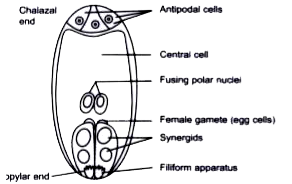
Structure:
- Egg Apparatus (Micropylar End): Consists of three cells – two synergids (with filiform apparatus guiding pollen tube entry) and one egg cell (female gamete).
- Antipodals (Chalazal End): Consist of three cells.
- Central Cell: The largest cell, situated below the egg apparatus, containing two polar nuclei (which move to the center after the 8-nucleate stage).
Counting Cells and Nuclei:
Cells = 3 (Egg Apparatus) + 3 (Antipodals) + 1 (Central Cell) = 7 cells.
Nuclei = 3 (Egg Apparatus) + 3 (Antipodals) + 2 (Polar Nuclei in Central Cell) = 8 nuclei.
Q7. What are chasmogamous flowers? Can cross-pollination occur in cleistogamous flowers? Give reasons for your answer.
Answer:
Chasmogamous Flowers: These are flowers with exposed anthers and stigma that open up, allowing both self-pollination and cross-pollination.
Cross-Pollination in Cleistogamous Flowers: No, cross-pollination cannot occur in cleistogamous flowers because they never open. Their anthers and stigma lie very close, and when anthers dehisce, pollen directly falls on the stigma, resulting only in self-pollination.
Q8. Mention two strategies evolved to prevent self-pollination in flowers.
Answer: Two common strategies evolved to prevent self-pollination are:
- Non-synchrony in Pollen Release and Stigma Receptivity (Dichogamy): Pollen and stigma are not mature at the same time.
- Different Positioning of Anther and Stigma (Herkogamy): Physical separation prevents autogamy.
Other strategies include self-incompatibility and unisexual flowers.
Q9. What is self-incompatibility? Why does self-pollination not lead to seed formation in self-incompatible species?
Answer: Self-incompatibility is a genetic mechanism that prevents self-pollen from fertilizing the ovules. The pistil recognizes the self-pollen as incompatible and inhibits pollen germination or pollen tube growth, preventing fertilization and thus seed formation.
Q10. What is bagging technique? How is it useful in a plant breeding programme?
Answer: The bagging technique involves covering an emasculated flower with a butter paper bag to prevent unwanted pollen contamination.
It ensures the stigma is protected until it becomes receptive, after which desired pollen is manually dusted, followed by re-bagging. This helps ensure only controlled cross-pollination occurs.
Q11. What is triple fusion? Where and how does it take place? Name the nuclei involved in triple fusion.
Answer: Triple fusion is the fusion of three haploid nuclei inside the central cell of the embryo sac. After pollen tube entry, one male gamete fuses with the egg (syngamy), and the other fuses with two polar nuclei — this is triple fusion. The nuclei involved are one male gamete and two polar nuclei, producing a triploid primary endosperm nucleus.
Q12. Why do you think the zygote is dormant for some time in a fertilised ovule?
Answer: The zygote remains dormant for a period to allow endosperm formation first. The endosperm provides nutrition to the developing embryo, ensuring its successful development.
Q13. Differentiate between:
(a) hypocotyl and epicotyl;
(b) coleoptile and coleorrhiza;
(c) integument and testa;
(d) perisperm and pericarp
Answer:
(a) Hypocotyl and Epicotyl
| Feature | Hypocotyl | Epicotyl |
|---|---|---|
| Location | Portion of the embryonal axis below cotyledons. | Portion above cotyledons. |
| Terminal End | Ends in the radicle (root tip). | Ends in the plumule (stem tip). |
| Function | Develops into lower part of stem/root axis. | Develops into shoot system. |
(b) Coleoptile and Coleorrhiza
| Feature | Coleoptile | Coleorrhiza |
|---|---|---|
| Structure | Hollow foliar structure enclosing the shoot apex. | Sheath enclosing radicle and root cap. |
| Location | Above scutellum. | At lower end of embryonal axis. |
| Function | Protects the developing plumule. | Protects the radicle and root cap. |
(c) Integument and Testa
| Feature | Integument | Testa (Seed Coat) |
|---|---|---|
| Origin | Protective envelope around nucellus before fertilisation. | Develops from integuments after fertilisation. |
| Function | Protects nucellus and embryo sac. | Protects embryo and aids in dormancy. |
| Ploidy | Diploid (2n). | Diploid (2n). |
(d) Perisperm and Pericarp
| Feature | Perisperm | Pericarp |
|---|---|---|
| Origin | Remnants of nucellus in some seeds. | Wall of fruit developed from ovary wall. |
| Nature | Residual nucellus (seed part). | Fruit wall, fleshy or dry. |
| Ploidy | Diploid (2n). | Diploid (2n). |
Q14. Why is apple called a false fruit? Which part(s) of the flower forms the fruit?
Answer: Apple is called a false fruit because the thalamus, in addition to the ovary, contributes to fruit formation. The ovary develops into the fruit, and its wall becomes the pericarp.
Q15. What is meant by emasculation? When and why does a plant breeder employ this technique?
Answer: Emasculation is the removal of anthers from a bisexual flower before they release pollen. It is used in hybridisation to prevent self-pollination, ensuring only desired pollen fertilizes the flower.
Q16. If one can induce parthenocarpy through the application of growth substances, which fruits would you select to induce parthenocarpy and why?
Answer: Parthenocarpy is fruit development without fertilisation. It can be induced in fruits like watermelon, grapes, and oranges to produce seedless varieties for consumer appeal and commercial value. Banana is naturally parthenocarpic.
Q17. Explain the role of tapetum in the formation of pollen-grain wall.
Answer: The tapetum is the innermost layer of the microsporangium. It nourishes developing pollen and secretes precursors for sporopollenin. The main component of the pollen wall’s outer exine layer thus indirectly forming the pollen grain wall.
Q18. What is apomixis and what is its importance?
Answer: Apomixis is seed formation without fertilisation, seen in some Asteraceae and grasses.
Importance of apomixis are-
- Maintains hybrid characters across generations without segregation.
- Reduces seed cost, as farmers can reuse seeds each season, making hybrid cultivation more affordable.