
-: Questions :-
Q1. Who noticed the human cell for the first time?
Answer: The document doesn’t explicitly state who first noticed the human cell, but it does mention that the cell in general was first discovered in 1665 by Robert Hooke, who was the curator of the Royal Society of London.
Q2. What are the two main parts of the cell?
Answer: The two main parts of the cell, as described by the major components of protoplasm, are the cytoplasm and the nucleus. The protoplasm itself is considered the “material basis of life”.
Q3. What are the two main types of human cell?
Answer: Human cells can be divided into two main types: Somatic cells (or body cells) and Germ cells (or reproductive cells).
Q4. Define human cell.
Answer: A cell is defined as the basic structural, functional, and biological unit of all organisms. More formally, a complete definition of a cell (put forward by Lowey and Seikevitz in 1963) is: “A cell is the smallest unit of the fundamental structure and function of all living organisms, which is capable of independent existence and self-reproduction in a suitable environment”.
Q5. What do you mean by cell division?
Answer: Cell division is the process by which a cell divides. In unicellular organisms, it is essentially the process of reproduction. In multicellular organisms, cell division is what allows a single fertilized cell (zygote) to undergo repeated divisions to form a complex body with different organ systems.
Q6. Who put forward the idea of cell division?
Answer: The document does not name a single person who first put forward the idea of cell division. However, it does credit Walter Flemming with first observing mitosis in detail in 1882, and Farmer & Moore with coining the term ‘meiosis’ in 1903.
Q7. What are the main stages of mitosis cell division?
Answer: The whole process of mitosis can be studied under the following four main stages: Prophase, Metaphase, Anaphase, and Telophase.
Q8. Who described the word chromosome for the first time?
Answer: The term chromosome was first used by Waldeyer in 1888. However, chromosomes themselves were first described by Strausburger in 1875.
Q9. How many chromosomes are there in the human body?
Answer: The number of chromosomes in a normal human somatic cell is 46. This number is represented as 44+XY in a male and 44+XX in a female.
Q10. Write the names of protein found in chromosome.
Answer: The proteins found in chromosomes are Histone and Nonhistone.
Q11. What is the root word for gene?
Answer: The word gene has been derived from the Greek word genom, which means to produce.
Q12. Draw a human cell and describe its different parts
Answer: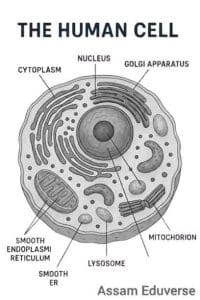
Description of the parts are :
- Protoplasm: The entire contents of the cell, composed of the nucleus and cytoplasm, and considered the “material basis of life”.
- Cell Membrane (or Plasma Membrane): The specialized, thick outer boundary of the cell, which controls the movement of chemical substances in and out.
- Cytoplasm: A semi-fluid, jelly-like substance that contains various living and non-living bodies.
- Nucleus: A denser, generally spherical body that controls all cell activity and is considered the dynamic center of life.
Nuclear Membrane, Nucleoplasm, Chromatin fibre, and Nucleollus are the structures that compose the nucleus. - Mitochondria and Golgi body: Examples of living bodies found within the cytoplasm.
Q13. Describe the mitosis cell division.
Answer: Mitosis is an elaborate process of cell division that results in two daughter cells from a single mother cell, with each new cell being identical to the parent cell in every respect. Mitosis involves the duplication of chromosomal pairs.
The stages of mitosis cell division are:
- Prophase – The cell prepares to divide the chromosomes. The chromosomes, which were long and loosely packed, contract and thicken. Each chromosome becomes visible as two identical strands called chromatids.
- Metaphase – The nucleolus and nuclear membrane disappear. A nuclear spindle forms in the center of the cell. The chromosomes move to the equatorial plane (the center) of the spindle and attach to it by their centromeres.
- Anaphase – The chromosomes begin to separate. The centromere divides equally, and the two identical sets of chromatids are pulled apart towards opposite poles of the spindle. Once completely separated, the chromatids are called daughter chromosomes.
- Telophase – The daughter chromosomes group at the opposite poles. They uncoil, becoming thin and long again. The nuclear membrane and nucleoli reappear around the chromosome groups, and the cytoplasm divides. This ultimately results in the formation of two daughter cells.
Q14. Write the differences between mitosis and meiosis cell division
Answer:
| Feature | Mitosis | Meiosis |
|---|---|---|
| Daughter Cells | Produces two daughter cells | Ultimately produces four daughter nuclei/cells |
| Chromosome Number | The number of chromosomes remains identical to the parent cell (Diploid to Diploid). | The diploid number of chromosomes is reduced to the haploid (half) number (Diploid to Haploid). |
| Divisions | One division process. | Always involves two successive divisions. |
| Purpose | Essential for cellular reproduction and growth. | Essential for reproduction (germ cell formation) and to prevent the doubling of chromosomes across generations. |
| Cell Type | Occurs in somatic (body) cells. | Occurs shortly before germ cells (male and female gametes) are formed. |
Q15. Show the different parts of a human chromosome.
Answer:
Different parts of a human chromosome
Q16. What are the different parts of a chromosome.
Answer: A chromosome is an elongated, rod-shaped structure that becomes clearly visible during cell division. The main parts of a chromosome are:
- Pellicle – The thin, outer membranous covering of the chromosome.
- Matrix (Hyalonema) – The ground substance beneath the pellicle in which the chromonemata are embedded.
- Chromonema – A coiled, thread-like filament present inside the chromosome; it bears the genes.
- Chromomeres – Small, bead-like swellings seen along the length of the chromonema.
- Primary Constriction (Centromere) – The narrow region dividing the chromosome into two arms; it is the point of attachment for spindle fibers during cell division.
- Secondary Constriction I (Nucleolar Organizer Region) – A constriction usually near one end of the chromosome, associated with the formation of the nucleolus.
- Secondary Constriction II – An additional constriction present in certain specific chromosomes.
- Satellite – A small, rounded body attached to the chromosome by a secondary constriction; chromosomes bearing satellites are called SAT-chromosomes.
Telomeres – The terminal ends of the chromosome that protect it and prevent fusion with other chromosomes.
Q17. What are the different types of nucleic acid and write their names?
Answer: Nucleic acids are biomolecules that store and transmit genetic information in all living organisms. They are made up of smaller units called nucleotides. There are two main types of nucleic acids are :
- Deoxyribonucleic Acid (DNA): DNA carries the hereditary or genetic information of an organism. It is usually double-stranded and forms a characteristic double-helix structure. The sugar present in DNA is deoxyribose, and its nitrogenous bases include adenine (A), thymine (T), cytosine (C), and guanine (G).
- RNA (Ribonucleic Acid): RNA helps in the synthesis of proteins and acts as a messenger between DNA and ribosomes. It is usually single-stranded in structure. The sugar present in RNA is ribose, and its nitrogenous bases are adenine (A), uracil (U), cytosine (C), and guanine (G).
Q18. Who for the first time used the words mitosis and meiosis?
Answer: The word mitosis was first observed in detail by Walter Flemming in 1882. The term meiosis was coined by Farmer & Moore in 1903.
Q19. What is the meaning of the word chromosome?
Answer: The word chromosome is derived from Greek roots: ‘chroma’ means colour and ‘soma’ means body.
Q20. Who used the word enzymes for the first time?
Answer: The word enzyme was first used by Friedrich Withelm Kunne in 1878.
Q21. Write the functions of enzymes.
Answer: Enzymes are protein-based biological catalysts that speed up specific chemical reactions in the cell without being consumed. They play a vital role in maintaining the efficiency and regulation of cellular processes. Some of the key functions of enzymes include:
- Aiding Digestion (Metabolism): Enzymes break down food into energy.
- Energy Generation: Enzymes help convert energy into usable chemical forms and store it in molecules like ATP (Adenosine Triphosphate).
- Signal Transduction: Enzymes transmit chemical or physical signals within cells, triggering appropriate cellular responses.
- Macromolecule Degradation (Catabolism and Anabolism): Enzymes break down large molecules for absorption and use smaller fragments for tissue repair and growth.
- Cell Regulation and Movement: Enzymes assist in moving cell structures, delivering cellular components, separating chromosomes during mitosis, and facilitating cell movement.
- Defense and Clearance: Enzymes convert toxic or non-nutritive substances into forms that can be used or safely eliminated.
- Other Roles: Enzymes are essential for respiration, muscle and nerve function, blood clotting, immune responses, and aging processes.