
EXERCISES
Q1. Draw illustrations to bring out the anatomical difference between
(a) Monocot root and Dicot root
(b) Monocot stem and Dicot stem
Answer:
(a) Monocot root and Dicot root: In a dicot root, there are fewer xylem bundles, usually two to four, and the pith is small or absent. Secondary growth occurs due to the presence of cambium, and the arrangement of tissues is radial.
In a monocot root, the xylem bundles are many, generally more than six, and the pith is large and well-developed. Secondary growth does not occur as cambium is absent.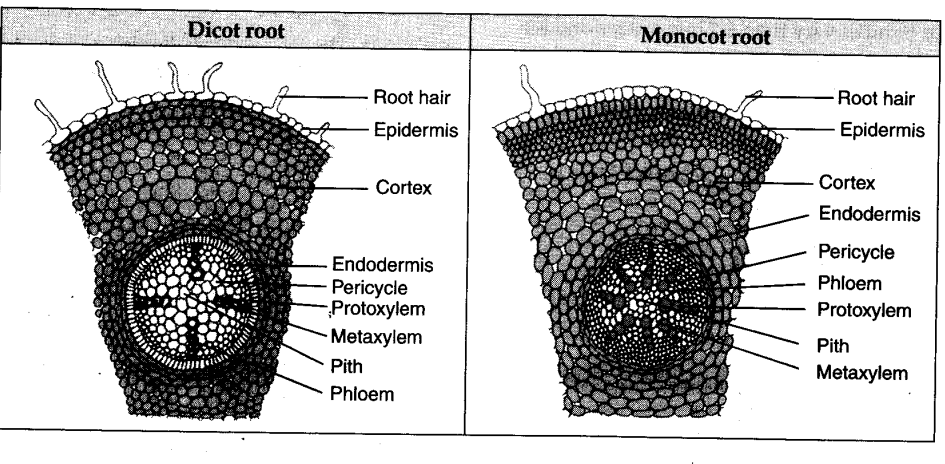
(b) Monocot stem and Dicot stem: In a dicot stem, vascular bundles are arranged in a ring and are open because cambium is present, allowing secondary growth. The ground tissue is differentiated into cortex, endodermis, pericycle, and pith, and the hypodermis is collenchymatous.
In a monocot stem, vascular bundles are scattered in the ground tissue and are closed due to the absence of cambium. The ground tissue is undifferentiated, the hypodermis is sclerenchymatous, and each vascular bundle is surrounded by a distinct bundle sheath.
Q2. Cut a transverse section of young stem of a plant from your school garden and observe it under the microscope. How would you ascertain whether it is a monocot stem or a dicot stem? Give reasons.
Answer: To find whether the stem is monocot or dicot, observe the vascular bundle pattern. If bundles are arranged in a ring, it is a dicot stem; if scattered, it is monocot. The presence of cambium (open bundle) also shows a dicot stem. If ground tissue is undifferentiated and cambium is absent, it indicates a monocot stem.
Q3. The transverse section of a plant material shows the following anatomical features – (a) the vascular bundles are conjoint, scattered and surrounded by a sclerenchymatous bundle sheath. (b) phloem parenchyma is absent. What will you identify it as?
Answer: It should be identified as a monocot stem because its vascular bundles are scattered, surrounded by a sclerenchymatous bundle sheath, and lack phloem parenchyma — all typical features of monocot stems.
Q4. What is stomatal apparatus? Explain the structure of stomata with diagram.
Answer: The stomatal apparatus includes the stoma, guard cells, and subsidiary cells. Each stoma has a pore surrounded by two guard cells. In dicots, guard cells are bean-shaped; in monocots, they are dumbbell-shaped. The inner walls are thick, outer walls are thin, and they contain chloroplasts to regulate opening and closing. The subsidiary cells around them support the guard cells.

Q5. Name the three basic tissue systems in the flowering plants. Give the tissue names under each system.
Answer: The three tissue systems are:
- Epidermal tissue system – includes epidermal cells, stomata, and epidermal appendages like hairs or trichomes.
- Ground or fundamental tissue system – includes parenchyma, collenchyma, and sclerenchyma forming cortex, pith, and medullary rays.
- Vascular or conducting tissue system – includes xylem and phloem forming vascular bundles.
Q6. How is the study of plant anatomy useful to us?
Answer: Studying plant anatomy helps us understand internal organization of cells and tissues. It helps in classifying plants as monocots or dicots, identifying tissue types and their functions, and understanding adaptations like cuticle or bulliform cells for water conservation. It also explains how tissues coordinate to perform functions.
Q7. Describe the internal structure of a dorsiventral leaf with the help of labelled diagrams.
Answer: A dorsiventral (dicot) leaf has three main parts. The epidermis covers both upper (adaxial) and lower (abaxial) surfaces, with cuticle and stomata (more on lower side). The mesophyll lies between the two epidermal layers and has chloroplasts for photosynthesis; it is divided into palisade parenchyma (elongated cells on top) and spongy parenchyma (loosely arranged cells below). The vascular system has veins with xylem on the upper side and phloem on the lower side, surrounded by a bundle sheath.