
EXERCISES
Q1. From which root word has the term “family” originated?
Answer: The word “family” in English is derived from the Latin word “famulus”.
Q2. What is ‘famulus’?
Answer: “Famulus” is a Latin word meaning “servant”.
Q3. What do you understand by a descent group?
Answer: A descent group is an association of consanguineal kinsmen. A descent group refers to a group of people sharing blood relationships, tracing their origin from a common ancestor.
Q4. Give two examples of social units.
Answer: Two examples of social units are family and clan.
(Family is the most significant social institution and the smallest social institution. Clan is a larger descent group.)
Q5. Write a definition of social anthropology as provided in your textbook.
Answer: According to S.C. Dube, “Social Anthropology is that part of cultural anthropology, which devotes its primary attention to the study of social structure and religion rather than material aspect of culture”.
Q6. What do you understand by “human society”?
Answer: The term “society” refers to a complex web of conventions, interaction, and relationship that develop among a group of people who are simply linked by social life. It is an abstract concept based on social relationships and reciprocal awareness.
Q7. How many groups can social scientists’ definition of society be divided into?
Answer: Social scientists have been defining society from two views:
(a) Functional definition
(b) Structural definition
Q8. What do you understand by “simple society”?
Answer: A simple society is a community that has fewer people and the economic and technical aspects are simple or not developed. They are small in scale in terms of population, area, and the variety of social interactions.
Q9. What do you understand by “complex society”?
Answer: A complex society is one in which the social structure, religion, material aspects, and technological aspects are more complex or developed than in a simple society. They are large in terms of population, area, and the variety of social interactions.
Q10. Write down any one of the social group definition given in your textbook.
Answer: According to Ogburn and Nimkoff, “Wherever two or more individuals come together and influence one another, they may be said to constitute a social group”.
Q11. What do you understand by “social unit”?
Answer: A “social unit” refers to a permanent grouping of people. (The smallest social institution is the family).
Q12. Why is the family regarded as a universal social unit?
Answer: The family is considered a universal social institution as it is the most basic and essential social institution in human society. There is no society without families. Since it exists in all societies throughout the universe, a family is a universal social unit or institution.
Q13. Give a definition of the family?
Answer: MacIver and Page stated, “A family is a group defined by a sex relationship sufficiently precise and enduring to provide for the procreation and upbringing of children”.
Q14. What is a joint family?
Answer: A joint family comprises parents and their unmarried and married children who share a common kitchen and live under the same roof. In such a family, there is joint authority and sharing of property in common.
Q15. Give four examples of unilateral descent groups.
Answer: Four types of unilateral descent groups are lineage, clan, moiety, and phratry.
Q16. What are primary and secondary groups?
Answer:
- Primary Group: A social group in which members have a direct and intimate relationship with one another. They are characterised by intimate face-to-face association and co-operation, and are fundamental in forming the social nature and ideals of the individual.
- Secondary Group: These groups are relatively short-lived and have no face-to-face relationships among their members. They are large, and the members are scattered over a large area, lacking intimate relationships.
Q17. How do you define internal and external groups?
Answer: The social groups can also be divided into In-Group and Out-Group on the basis of the attitudes of the members.
- In-Group: A social group where members have reciprocal love, sympathetic feelings, and loyalty, or “we feelings”. When an individual is a member of a group, it is an “in-group” for that person.
- Out-Group: An individual who is not a member of a group and has an apathetic or hostile attitude toward that group is considered an “out-group” for him.
Q18. Write a short note about the community.
Answer: A community is a population segment that shares a common area, exhibits “we feelings,” develops a feeling of togetherness, and leads similar lives. Key characteristics include occupying a definite territory, possessing community sentiment (a sense of belonging together), exhibiting homogeneity, and being a permanent social group. It develops through a natural or spontaneous process.
Q19. Write the different characteristic features of the family.
Answer: The characteristic features of a family include:
- It is founded on a socially approved sexual union between a man and a woman.
- Every family possesses a unique identity and generally adopts a hereditary name and surname.
- A common residence is a significant feature, where all members live and share the same kitchen.
- There is economic interdependency among the members.
Q20. What do you understand by patriarchal and matriarchal families?
Answer:
- Patriarchal Family: A family in which the father, husband, or an elderly male member is the head of the family or enjoys superior authority.
- Matriarchal Family: A family in which the descent or authority is vested upon a woman or mother, and the decision-making and authority rest upon the eldest female member.
Q21. How do patrilineal and matrilineal families differ?
Answer: In patrilineal family the descent and inheritance are traced through the male line; children inherit the father’s name, traditions, surnames, and properties. whereas in matrilineal family the descent and inheritance are traced through the female line (from mother to daughter); children are affiliated to the mother’s kin group.
Q22. What is the family of orientation and the family of procreation? Draw a diagram to illustrate your point.
Answer:
Family of orientation: The family in which an individual is born and brought up is the family of orientation for him.
Family of procreation: After marriage, when an individual procreates children and thus creates a family, it is known as a family of procreation for the person.
Diagram: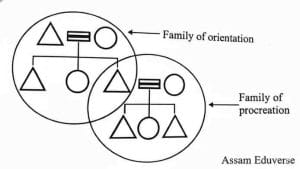
Q23. Write about the changes that have taken place in India’s joint families.
Answer: The popularity and number of joint families are decreasing in India due to various factors:
- Impact of Education: Modern education, especially for women, increases literacy and brings changes in beliefs, values, and ideologies, leading to a preference for independent nuclear families.
- Communication and Transport: Improvements in roads and railways enable people to move easily, causing joint family members to reside closer to their workplaces, which disintegrates the joint family structure.
- Industrialization and Urbanization: The establishment of factories and industries causes domestic crafts to diminish and agriculture to be pressurized, leading members to migrate to towns in search of work, thereby breaking up joint families.
- Changes in Marriage System: Modern youth exercise their own choices in selecting mates and marry at a mature age, sometimes against parents’ disapproval, leading to the formation of nuclear families.
- New Social Legislation: Laws like the Hindu Marriage Act (1955) and the Hindu Succession Act (1956) prohibit child marriage, permit divorce, and grant daughters equal inheritance rights, which weaken the traditional joint family structure.
- Individualistic View: Modern individualistic views lead members to prefer living independently in a separate household, contributing to the downfall of the joint family.
Q24. Describe what you understand by the rules of descent.
Answer: The rules according to which an individual is affiliated to a kindred or having a common ancestor are called “rule of descent”. Descent refers solely to a cultural principle whereby an individual is socially allocated to a specific group of consanguineal kinsmen. Members of a descent group trace their origin from an actual common ancestor, are related by blood relationships, and marital ties are strictly prohibited among them.
Q25. What are unilateral and bilateral descent?
Answer:
- Bilateral descent: The descent rules include both sides, meaning descent is reckoned through both paternal and maternal lines, affiliating a child to relations from both the mother’s and father’s sides.
- Unilateral descent: Members of a unilateral descent group trace their origins either through the paternal or maternal line. Patrilineal or matrilineal descent are the two types of unilateral descent.
Q26. Write a short note on unilateral descent.
Answer: Unilateral descent is a rule of descent where members trace their origins either through the paternal or maternal line. The two types are:
- Patrilineal descent: Affiliation, inheritance, and succession are reckoned through the father’s kin group.
- Matrilineal descent: Affiliation, inheritance, and succession are reckoned through the mother’s kin group and passed through the mother to the daughter.
Unilineal descent groups include lineage, clan, moiety, and phratry.
Q27. Write down the characteristic features of society.
Answer: The characteristic features of society include:
- Population: Society consists of people, the first requirement for its continuation.
- Likeness: Likeness is a significant trait, as society is founded on a feeling of similarity, or “Conscious of Kind”.
- Differences: Society depends on individual diversity and differences, which help to create the division of labour.
- Interdependence: Members are reliant on others for food, shelter, security, and the satisfaction of needs, which is crucial to their existence and well-being.
- Co-operation: Cooperation is crucial for the development and foundation of society, preventing mutual destruction.
- Culture holder: Every society holds and transmits its culture, which is the total way of life of its members, from generation to generation.
- Change: Society is dynamic and evolving, constantly undergoing changes as new customs and values are accumulated or replaced.
Q28. Mention the characteristics of a simple society.
Answer: The characteristics of a simple society include:
- They are small in scale in terms of population, area, and the variety of social interactions.
- They have a simple economy and simple technology.
- People generally share the same status (absence of complex social stratification).
- Relationships based on kinship and locality are much more significant.
- Absence of writing or literature, and any systematic art, science, and theology.
- The people are culturally homogenous.
- Economic life is self-sufficient.
- Money is not commonly used, and the barter system is generally prevalent.
Q29. Write down the characteristics of a complex society.
Answer: The characteristics of a complex society include:
- They are large in terms of population, area, and the variety of social interactions.
- Occupations vary more, leading to greater specialization of work.
- High technology is used for more efficient tasks.
- The institutionalized form of education is important, and writing and literature are present.
- The economic system is complex, and trade and commerce are prevalent.
- Political and judicial departments are separate.
- Transport and communication systems (radio, television, internet, etc.) are developed.
- Economic life is not self-sufficient, leading to a greater division of labour.
Q30. Make a comparison between complex and simple societies.
Answer:
| Determining aspect | Simple Society | Complex Society |
|---|---|---|
| Size of community | Comparatively low size and population. | Comparatively bigger population size. |
| Economy/Technology | Simple economy and simple technology. | Complex economic system with high technology. |
| Specialization | Occupations are less varied, less specialization. | Occupations vary more, greater specialization of work. |
| Social Stratification | Simple societies have the same status (absence of complex stratification). | High social class and status divisions. |
| Education | Informal education is received from family members and the elderly. | Institutionalized form of education, writing and literature are present. |
| Judicial/Political | Political and judicial departments are not separate. | Political and judicial departments are separate. |
| Trade | Barter system is generally prevalent. | Trade and commerce are prevalent, use of money is common. |
Q31. What are the distinctions between rural and urban cultures?
Answer: The distinctions between rural and urban cultures, based on traditional societies, are:
| Determining aspect | Rural Society | Urban Society |
|---|---|---|
| Source of livelihood | Agriculture is the main source of income. | Relies primarily on non-agricultural sources (trade, commerce, government jobs). |
| Environment | Natural environment has more importance; close relationship with nature. | Generally separated from nature; man-made environment attains more priority. |
| Density of population | Density of population is low. | Population density is high. |
| Homogeneity | More homogeneous in aspects of racial and psychological thinking. | Diversity cohabits among the population (different caste, religions, cultures). |
| Social Status | Less division of class; fewer social differences in status. | Social class and status divisions vary; more social differences. |
| Social Relationships | Bonds of relatives and family gain priority; relationships are more permanent, simple, and close. | Relationships are comparatively temporary, various, complex, and superficial. |
Q32. Write the characteristics of the social group.
Answer: The characteristics of a social group are:
- Reciprocal relationship: Two or more individuals must have a reciprocal relationship for a social group to form.
- We feeling: Members should have feelings of ‘we are of the same group’ and collectively share happiness or sorrow.
- Shared interests and ideals: A group has common interests or ideology that drives its formation and continuation.
- Feelings of unity: A sense of unity and sympathy consistently brings members together.
- Group norms: Every group has its own set of rules or norms (codes and conduct) that members are expected to follow.
- Changeability: Social groups are not static and incorporate changes due to various internal or external agencies.
- Personality development: Social groups help to develop the talents and personalities of their members.
Q33. Mention the rules for social group formation.
Answer: Social groups are formed on the basis of:
Ascribed Status: Based on birth, sex, age, religion, social stratification, community, birthplace, or status in the family. Examples:
- Sex-based social groups.
- Age-based social groups.
- Kinship-based social groups (family, lineage, clan).
- Locality-based social units (village, hamlets).
- Social groups based on social stratification (caste and class).
- Social groups based on political power.
- Religious or magical social group.
Achieved Status: Based on an individual’s effort, such as a good player or musician. Examples:
Social group based on occupation.
Q34. Explain two social groups with examples.
Answer:
1. Sex-based social groups: These groupings are created based on sex (males, females, or transgender individuals). In simple societies, male-forming groups are often given higher priority. Examples include the male secret societies among Australian aboriginals and bachelor’s dormitories for young, unmarried boys among tribes like the Naga, Nocte, Wanchoo in tribal India. In complex societies, self-help groups (SHG) for women are an example.
2. Age-based social groups: Age determines the formation of some social groups. For instance, among the “Chongli” clan of the Ao Nagas, the bachelor’s dormitories allow only young people, who attain different age grades and status over time, such as “Changpur,” “Changmen,” and “Achujen,” before they get married and are referred to as “Arichugro”.
Q35. Write about the distinctive features of a community.
Answer: The distinctive features of a community are:
- Group of people: A community is a group of individuals who live together and share the fundamental conditions of common life.
- Definite territory: The people of a community occupy a definite land area.
- Community Sentiment: They have a sense of belonging together (“We feelings”), common language, value system, aim, and philosophy of life.
- Homogeneity: There is homogeneity of rules and regulations, language, behaviour, and material possessions among the individuals.
- Permanency: A community is a stable social group; it is never created with a specific temporary goal.
- Natural or Spontaneous Growth: A community emerges and develops naturally, as a person is born into it and adopts it as their home.
- A Particular Name: A community has a particular name which identifies itself (e.g., Gujrati, Panjabi, Assamese community).
Q36. Write about the characteristics of the social institution.
Answer: The characteristics of social institutions are:
- Universal: Social institutions are universal, meaning they govern all societies.
- Collective Objectives: They are formed to fulfil collective objectives.
- Distinct Behavioural Patterns: They have distinct behavioural patterns shaped by specific doctrines, rules, and regulations.
- Mandatory Adherence: Members abide by the rules and regulations compulsorily.
- Social Control: They are a measure of social control, maintaining peace and discipline in society.
- Fulfillment of Basic Needs: They play a major role in fulfilling basic needs.
- Permanent: In comparison to other regulatory bodies, social institutions are permanent.
- Inter-functional and Interwoven: They are not individual entities but are interwoven with various other institutions like family, marriage, religious, educational, etc.
Q37. Write about the nature of family.
Answer: The nature of the family are:
- Universal: The family has existed in all societies of the world and is a universal social unit/institution.
- Psychological Satisfaction: It is a fundamental unit resting upon psychological satisfaction, where members share love, affection, mutual help, and cooperation.
- Institutionalized Manner: A family teaches its members to lead their lives in an institutionalized manner.
- Social Role: Every individual family contributes aptly to the formation of a society, playing a noteworthy social role.
- Duties and Responsibilities: Every member has their own duties and responsibilities towards the family.
- Conformity to Norms: Each family is part of society and has to maintain and follow the traditionally accepted norms and values.
- Size: Each family has its own size, often determined by economic reasons.
- Permanent yet Temporary: A family can be considered a temporary unit due to loss of members (death, marriage, divorce), but as an inseparable part of society, it is permanent.
Q38. Mention the primary as well as universal functions of the family.
Answer: The primary and universal functions of a family are:
- Biological functions: Regulating reproductive activity to maintain the continuity of human society and providing food, clothing, and shelter for its members.
- Psychological Functions: Providing an emotional relationship of shared love, affection, help, and cooperation, binding family members together in moments of joy and grief.
- Regulation of sexual relations: Regulating the sexual need through the institutionalization of sexual relations between a husband and wife, and regulating sexual relations among familial ties.
- Child rearing and care: Performing the task of raising and caring for children from birth until they become independent.
Q39. Write about the traditional functions of the family.
Answer: The traditional functions of the family include:
- Economic function: Encompassing arrangements of earnings, division of labour (based on age and sex), and maintenance and distribution of properties (house, land, ornaments, money, etc.).
- Social function: Establishing a social status (caste, class, religion) for its members, upholding social norms, and passing down social legacy and standards through the process of socialization.
- Selection of life partner: Playing an important role in finding and helping members marry at an appropriate age as per social norms.
- Religious function: Imparting religious education to members; the religion of the parents is the religion of the children.
- Cultural function: Preserving the cultural heritage and continuity of the society by providing education about one’s own distinctive culture.
- Recreational function: Making arrangements for social festivals, functions, and religious performances, creating provisions for recreation and enjoyment.
- Health care: Taking care of the physical and emotional well-being of its members and making necessary arrangements for the same.
Q40. What distinguishing characteristics allow the families to be distinguished?
Answer: A family may primarily be categorized and distinguished on the basis of:
- Descent or authority.
- Inheritance.
- Residence.
- Size.
- Marriage.
Q41. Write about the different types of families based on residence.
Answer: Based on residence, the family can be divided into six types:
- Patrilocal family: The newly wed couple occupies or resides in the groom’s father’s house after the wedding.
- Matrilocal family: After marriage, the married couple resides with the wife’s family; the bride is not supposed to leave her parental house.
- Matri-Patrilocal family: The married couple lives in the bride’s residence for a certain period and then shifts to the groom’s father’s residence, generally after the birth of the first child.
- Bilocal family: A married couple may live in either the bride’s or groom’s house according to their own choice.
- Neolocal family: A married couple chooses not to stay at either the father’s or mother’s residence but lives independently in a newly constructed house.
- Avunculocal family: A newly married couple settles into the family of the groom’s maternal uncle.