
EXERCISES
Q1. Define the following:
(a) Exocrine gland
(b) Endocrine gland
(c) Hormone
Answer:
(a) Exocrine gland: A gland that possesses ducts and releases its secretions through them (implied, contrasted with endocrine glands)
(b) Endocrine gland: A gland that lacks ducts and is hence called a ductless gland. Its secretions, called hormones, are released directly into the blood.
(c) Hormone: Non-nutrient chemicals that act as intercellular messengers and are produced in trace amounts.
Answer:
Q2. Diagrammatically indicate the location of the various endocrine glands in our body.
Answer:
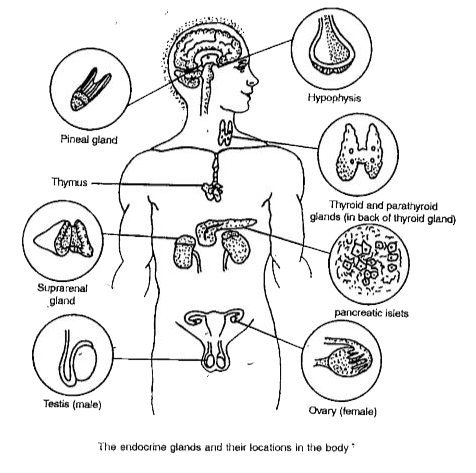
Q3. List the hormones secreted by the following:
(a) Hypothalamus (b) Pituitary (c) Thyroid (d) Parathyroid
(e) Adrenal (f) Pancreas (g) Testis (h) Ovary
(i) Thymus (j) Atrium (k) Kidney (l) G-I Tract
Answer: List of Hormones Secreted by Different Glands
(a) Hypothalamus:
- Releasing and inhibiting hormones such as:
- TRH (Thyrotropin Releasing Hormone)
- GnRH (Gonadotropin Releasing Hormone)
- GHRH (Growth Hormone Releasing Hormone)
- CRH (Corticotropin Releasing Hormone)
- Somatostatin (Growth Hormone Inhibiting Hormone)
- Dopamine (Prolactin Inhibiting Hormone)
(b) Pituitary Gland:
Anterior Pituitary (Front part):
- GH (Growth Hormone)
- PRL (Prolactin)
- TSH (Thyroid Stimulating Hormone)
- ACTH (Adrenocorticotropic Hormone)
- FSH (Follicle Stimulating Hormone)
- LH (Luteinizing Hormone)
- MSH (Melanocyte Stimulating Hormone)
- Oxytocin
- Vasopressin (ADH – Anti-diuretic Hormone)
(c) Thyroid Gland:
- T₄ (Thyroxine or Tetraiodothyronine)
- T₃ (Triiodothyronine)
- TCT (Thyrocalcitonin)
(d) Parathyroid Gland:
- PTH (Parathyroid Hormone)
(e) Adrenal Gland:
- Adrenaline (Epinephrine)
- Noradrenaline (Norepinephrine)
- Glucocorticoids (e.g., Cortisol)
- Mineralocorticoids (e.g., Aldosterone)
- Androgenic Steroids
(f) Pancreas (Islets of Langerhans):
- Glucagon (from α-cells)
- Insulin (from β-cells)
(g) Testis:- Androgens (mainly Testosterone)
(h) Ovary:
- Estrogen
- Progesterone
(i) Thymus: Thymosins
(j) Atrium (Heart):- ANF (Atrial Natriuretic Factor)
(k) Kidney (Juxtaglomerular cells):- Erythropoietin
(l) G-I Tract (Digestive Tract):
- Gastrin
- Secretin
- CCK (Cholecystokinin)
- GIP (Gastric Inhibitory Peptide)
Q4. Fill in the blanks:Hormones Target gland
(a) Hypothalamic hormones __________________
(b) Thyrotrophin (TSH) __________________
(c) Corticotrophin (ACTH) __________________
(d) Gonadotrophins (LH, FSH) __________________
(e) Melanotrophin (MSH) __________________
Answer: As shown in the table below-
| Hormones | Target Gland |
|---|---|
| (a) Hypothalamic hormones | Pituitary (Anterior) |
| (b) Thyrotrophin (TSH) | Thyroid |
| (c) Corticotrophin (ACTH) | Adrenal Cortex |
| (d) Gonadotrophins (LH, FSH) | Gonads (Testis/Ovary) |
| (e) Melanotrophin (MSH) | Melanocytes |
Q5. Write short notes on the functions of the following hormones:
(a) Parathyroid hormone (PTH) (b) Thyroid hormones
(c) Thymosins (d) Androgens
(e) Estrogens (f) Insulin and Glucagon
Answer:
(a) Parathyroid hormone (PTH): PTH is a hypercalcemic hormone that increases the Ca²⁺ levels in the blood. It does this by stimulating bone resorption (demineralisation), stimulating Ca²⁺ reabsorption by the renal tubules, and increasing Ca²⁺ absorption from digested food.
(b) Thyroid hormones (T₃/T₄): These hormones regulate the basal metabolic rate, support RBC formation, control the metabolism of carbohydrates, proteins, and fats, and influence the maintenance of water and electrolyte balance. They are also essential for the development and maturation of the central neural system.
(c) Thymosins: These are peptide hormones secreted by the Thymus gland. They play a major role in the differentiation of T-lymphocytes (for cell-mediated immunity) and promote the production of antibodies (for humoral immunity).
(d) Androgens (Testosterone): These hormones regulate the development, maturation, and functions of male accessory sex organs. They stimulate muscular growth, growth of facial/axillary hair, aggressiveness, and a low pitch of voice. They also stimulate spermatogenesis, influence male sexual behaviour (libido), and produce anabolic effects on protein and carbohydrate metabolism.
(e) Estrogens: These steroid hormones stimulate the growth and activities of female secondary sex organs and are essential for the development of growing ovarian follicles. They cause the appearance of female secondary sex characters (e.g., high pitch of voice) and mammary gland development. Estrogens also regulate female sexual behaviour.
(f) Insulin and Glucagon: These hormones jointly maintain glucose homeostasis in the blood.
Insulin: Is a hypoglycemic hormone that decreases blood glucose levels. It enhances cellular glucose uptake/utilization and stimulates conversion of glucose to glycogen (glycogenesis).
Glucagon: Is a hyperglycemic hormone that increases blood glucose levels. It stimulates breakdown of glycogen (glycogenolysis) and the formation of glucose from non-carbohydrate sources (gluconeogenesis).
Q6. Give example(s) of:
(a) Hyperglycemic hormone and hypoglycemic hormone
(b) Hypercalcemic hormone
(c) Gonadotrophic hormones
(d) Progestational hormone
(e) Blood pressure lowering hormone
(f) Androgens and estrogens
Answer:
(a) Hyperglycemic hormone and hypoglycemic hormone
- Hyperglycemic hormone: Glucagon (raises blood sugar level)
- Hypoglycemic hormone: Insulin (lowers blood sugar level)
(b) Hypercalcemic hormone
Example: Parathyroid Hormone (PTH)
(c) Gonadotrophic hormones
Examples: FSH (Follicle Stimulating Hormone) and LH (Luteinizing Hormone)
(d) Progestational hormone
Example: Progesterone
(e) Blood pressure lowering hormone
Example: ANF (Atrial Natriuretic Factor)
(f) Androgens and Estrogens
- Androgen: Testosterone (main male sex hormone)
- Estrogen: Estradiol (one of the main female sex hormones)
Q7. Which hormonal deficiency is responsible for the following:
(a) Diabetes mellitus (b) Goitre (c) Cretinism
Answer:
(a) Diabetes mellitus: Deficiency of Insulin (or insulin resistance).
(b) Goitre: Deficiency of Iodine (essential for thyroid hormone synthesis), leading to Thyroxine (T₄/T₃) deficiency (hypothyroidism).
(c) Cretinism: Deficiency of Thyroid hormones (hypothyroidism) during pregnancy, leading to defective development of the baby.
Q8. Briefly mention the mechanism of action of FSH.
Answer: FSH (Follicle Stimulating Hormone) is a protein hormone and therefore typically acts via a membrane-bound receptor.
Binding: FSH binds to its specific membrane-bound receptor located on the surface of the ovarian cell membrane (target tissue).
Second Messenger Generation: The Hormone-Receptor complex formation does not allow FSH to enter the cell; instead, it generates second messengers (e.g., cyclic AMP, Ca²⁺) inside the cell.
Physiological Response: These second messengers regulate cellular metabolism, which leads to biochemical responses and eventually the physiological response of FSH, such as stimulating the growth and development of the ovarian follicles in females.
Q9. Match the following:
| Column I | Column II |
|---|---|
| (a) T₄ | (ii) Thyroid |
| (b) PTH | (iv) Parathyroid |
| (c) GnRH | (i) Hypothalamus |
| (d) LH | (iii) Pituitary |
Answer:
(a) → (ii) (T₄ is Thyroxine, a hormone synthesized by the thyroid gland)
(b) → (iv) (PTH is Parathyroid Hormone, secreted by the parathyroid glands)
(c) → (i) (GnRH is a Gonadotrophin releasing hormone secreted by the hypothalamus)
(d) → (iii) (LH is a Gonadotrophin secreted by the Anterior Pituitary)