
EXERCISES
Q1. Differentiate between (a) Respiration and Combustion
Answer:
(a) Respiration and Combustion.
Answer: The difference between respiration and combustion. are-
- Respiration is a slow, step-wise biological process controlled by enzymes, whereas combustion is a fast, one-step chemical reaction.
- Respiration occurs inside living cells, whereas combustion occurs outside cells.
- Energy in respiration is released gradually and stored as ATP, whereas in combustion, energy is released suddenly as heat and light.
- Respiration takes place at normal body temperature, whereas combustion requires a high ignition temperature.
- Respiration needs enzymes to proceed, whereas combustion does not require enzymes.
(b) Glycolysis and Krebs’ Cycle
Answer: The difference between glycolysis and krebs’ cycle are-
- Glycolysis occurs in the cytoplasm, whereas the Krebs’ cycle occurs in the mitochondrial matrix.
- Glycolysis starts with glucose (6C), whereas the Krebs’ cycle starts with acetyl CoA (2C).
- Glycolysis forms pyruvic acid as the end product, whereas the Krebs’ cycle regenerates oxaloacetic acid (OAA).
- Glycolysis can occur without oxygen (anaerobic), whereas the Krebs’ cycle requires oxygen (aerobic).
- No CO₂ is released in glycolysis, whereas CO₂ is released during the Krebs’ cycle.
(c) Aerobic Respiration and Fermentation
Answer: The difference between aerobic respiration and fermentation are-
- Aerobic respiration occurs in the presence of oxygen, whereas fermentation takes place in the absence of oxygen.
- Aerobic respiration involves complete oxidation of glucose, whereas fermentation causes partial oxidation.
- The end products of aerobic respiration are CO₂ and H₂O, whereas fermentation produces alcohol and CO₂ or lactic acid.
- Aerobic respiration yields a large amount of energy (up to 38 ATP), whereas fermentation produces only 2 ATP molecules.
- NADH is rapidly oxidized to NAD⁺ in aerobic respiration, whereas this oxidation is slower in fermentation.
Q2. What are respiratory substrates? Name the most common respiratory substrate.
Answer:
Respiratory Substrates: The compounds that are oxidised during the process of respiration, leading to the release of considerable amounts of energy, are known as respiratory substrates.
Most Common Respiratory
Common Substrate: Carbohydrates are usually the most common respiratory substrate used to release energy. Other substrates like proteins, fats, and organic acids can also be used under certain conditions.
Q3. Give the schematic representation of glycolysis.
Answer: Glycolysis (EMP Pathway) is the partial oxidation of glucose that occurs in the cytoplasm of all living organisms, forming two molecules of pyruvic acid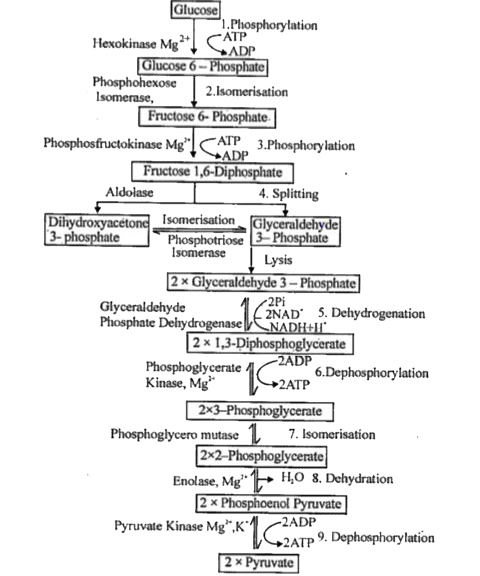
Answer: Aerobic respiration is the process of complete oxidation of organic substances in the presence of oxygen, releasing CO₂, water, and a large amount of energy.
Main Steps in Aerobic Respiration:
- Glycolysis: Breakdown of glucose into two molecules of pyruvic acid (Pyruvate).
- Oxidative Decarboxylation: Pyruvic acid is converted into Acetyl CoA with the release of CO₂.
- Tricarboxylic Acid Cycle (TCA or Krebs’ Cycle): Acetyl CoA undergoes oxidation, releasing CO₂ and generating NADH and FADH₂.
- Electron Transport System (ETS) and Oxidative Phosphorylation: The energy from NADH and FADH₂ is used to form ATP.
Location of Aerobic Respiration:
- Glycolysis: Cytoplasm
- Oxidative Decarboxylation and TCA Cycle: Mitochondrial Matrix
- ETS and Oxidative Phosphorylation: Inner Mitochondrial Membrane
Q5. Give the schematic representation of an overall view of Krebs’ cycle.
Answer:
Q6. Explain ETS.
Answer: ETS (Electron Transport System) is a series of protein complexes located on the inner mitochondrial membrane. It releases and utilizes the energy from NADH and FADH₂ produced during respiration. Electrons move through Complexes I–IV, pumping protons into the intermembrane space. Oxygen acts as the final electron acceptor, forming water. The proton gradient drives ATP synthase (Complex V) to generate ATP.
Output: 1 NADH = 3 ATP; 1 FADH₂ = 2 ATP.
Q7. Distinguish between the following:
(a) Aerobic respiration and Anaerobic respiration
(b) Glycolysis and Fermentation
(c) Glycolysis and Citric acid Cycle
Answer:
(a) Aerobic respiration and Anaerobic respiration
Answer:
| Feature | Aerobic Respiration | Fermentation (Anaerobic Respiration) |
|---|---|---|
| Oxygen Requirement | Requires O₂ supply for the complete process. | Occurs under anaerobic conditions. |
| Glucose Degradation | Complete oxidation of organic substances to CO₂ and H₂O. | Partial/Incomplete oxidation of glucose. |
| End Products | CO₂, H₂O, and a large amount of energy. | CO₂ and Ethanol (alcoholic fermentation) or Lactic Acid (lactic acid fermentation). |
| ATP Net Gain | Large net gain (up to 38 ATP molecules per glucose). | Net gain of only two ATP molecules per glucose (from glycolysis only). |
| NADH Oxidation | Vigorous oxidation of NADH to NAD⁺ in the ETS. | Slow oxidation of NADH to NAD⁺. |
(b) Glycolysis and Fermentation: The difference between glycolysis and fermentation are-
- Glycolysis is the process of partial oxidation of glucose to pyruvic acid, whereas fermentation converts pyruvic acid into ethanol and CO₂ or lactic acid.
- Glycolysis is common to both aerobic and anaerobic respiration, whereas fermentation occurs only under anaerobic conditions.
- The end product of glycolysis is pyruvic acid, whereas in fermentation it is alcohol or lactic acid.
- Both processes yield 2 ATP molecules, but glycolysis prepares pyruvate for further oxidation, whereas fermentation regenerates NAD⁺ to allow glycolysis to continue.
(c) Glycolysis and Citric Acid Cycle : The difference between glycolysis and fermentation are-
- Glycolysis occurs in the cytoplasm, whereas the citric acid cycle (Krebs’ cycle) occurs in the mitochondrial matrix.
- Glycolysis starts with glucose (6-carbon), whereas the citric acid cycle starts with acetyl CoA (2-carbon).
- Glycolysis produces pyruvic acid as its end product, whereas the citric acid cycle regenerates oxaloacetic acid (OAA).
- Glycolysis can occur without oxygen (anaerobic), whereas the citric acid cycle requires oxygen (aerobic).
- No CO₂ is released during glycolysis, whereas CO₂ is released in the citric acid cycle during complete oxidation of pyruvate.
Q8. What are the assumptions made during the calculation of net gain of ATP?
Answer: The assumptions made during the calculation of net gain of ATP are-
- Pathways occur sequentially and completely.
- NADH from glycolysis enters mitochondria for oxidative phosphorylation.
- Intermediates are not diverted for synthesis.
- Only glucose is respired; no other substrates interfere.
Q9. Discuss “The respiratory pathway is an amphibolic pathway.”
Answer: The respiratory pathway is both catabolic and anabolic:
- Catabolic: Breaks down carbohydrates, fats, and proteins for energy.
- Anabolic: Intermediates are used for synthesis of fatty acids, amino acids, etc.
Hence, it is termed an amphibolic pathway (dual role in metabolism).
Q10. Define RQ. What is its value for fats?
Answer: RQ (Respiratory Quotient) = Volume of CO₂ evolved / Volume of O₂ consumed. It depends on the substrate used.
For fats (e.g., tripalmitin), RQ = 0.7 (less than 1).
Q11. What is oxidative phosphorylation?
Answer: It is the synthesis of ATP using the energy from oxidation-reduction reactions in the Electron Transport System. It occurs on the inner mitochondrial membrane. The ATP synthase uses the proton gradient to convert ADP + Pi → ATP.
Q12. What is the significance of step-wise release of energy in respiration?
Answer: Step-wise release of energy in respiration are-
- Energy is released in controlled steps, not explosively.
- Enables ATP formation efficiently.
- Prevents excess heat generation.
- Allows energy to be stored and used when needed.