
EXERCISES
Q1. Which of the following is not correct?
(a) Robert Brown discovered the cell.
(b) Schleiden and Schwann formulated the cell theory.
(c) Virchow explained that cells are formed from pre-existing cells.
(d) A unicellular organism carries out its life activities within a single cell.
Answer: The incorrect statement is (a).
Q2. New cells generate from
(a) bacterial fermentation (b) regeneration of old cells
(c) pre-existing cells (d) abiotic materials
Answer: The correct option is (c)
Q3. Match the following
Answer:
(a) Cristae → (ii) Infoldings in mitochondria
(b) Cisternae → (iii) Disc-shaped sacs in Golgi apparatus
(c) Thylakoids → (i) Flat membranous sacs in stroma
Q4. Which of the following is correct:
(a) Cells of all living organisms have a nucleus.
(b) Both animal and plant cells have a well defined cell wall.
(c) In prokaryotes, there are no membrane bound organelles.
(d) Cells are formed de novo from abiotic materials.
Answer: The correct statement is (c).
Q5. What is a mesosome in a prokaryotic cell? Mention the functions that it performs.
Answer: A mesosome is a special membranous structure in prokaryotic cells formed by infoldings of the plasma membrane. It appears as vesicles, tubules, or lamellae and performs several vital functions such as cell wall formation, DNA replication, distribution to daughter cells, respiration, secretion processes, and increasing the surface area of the plasma membrane for metabolic activities.
Q6. How do neutral solutes move across the plasma membrane? Can the polar molecules also move across it in the same way? If not, then how are these transported across the membrane?
Answer: Neutral solutes move across the plasma membrane by simple diffusion, which is a passive process that occurs along the concentration gradient without requiring energy. Polar molecules, on the other hand, cannot pass freely because the lipid bilayer’s core is nonpolar. Whereas these polar molecules are transported through specific carrier proteins. When movement occurs along the concentration gradient, it is called facilitated diffusion; when it occurs against the gradient using energy (ATP), it is termed active transport.
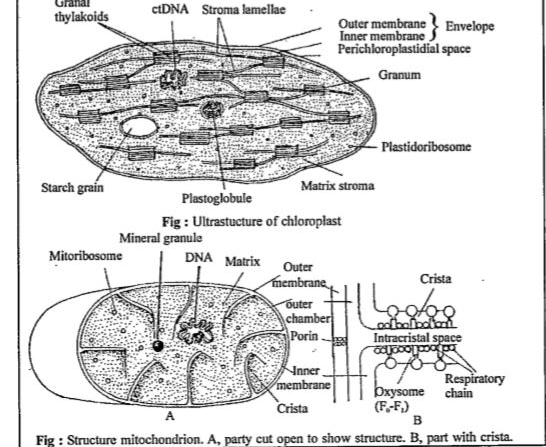
Q7. Name two cell organelles that are double membrane bound. What are the characteristics of these two organelles? State their functions and draw labelled diagrams of both.
Answer: The two double membrane-bound organelles are mitochondria and chloroplasts. Mitochondria have an outer and inner membrane; the inner one forms folds called cristae that increase surface area. The inner region, called the matrix, contains circular DNA and 70S ribosomes. They are known as the powerhouses of the cell because they carry out aerobic respiration and produce ATP.
Whereas chloroplasts have an outer and inner membrane enclosing a fluid-filled stroma that contains thylakoids arranged into stacks called grana. They also contain circular DNA and 70S ribosomes. Their main function is photosynthesis, where light energy is converted into chemical energy.
ChatGPT said:
Q9. Multicellular organisms have division of labour. Explain.
Answer: Division of labour means that different parts of an organism perform specific functions for efficient survival. In multicellular organisms, cells specialize for different functions (cellular level), similar cells form tissues (tissue level), tissues form organs (organ level), and organs work together as systems (organ system level). This coordination ensures smooth and efficient functioning of the whole body.
Q10. Cell is the basic unit of life. Discuss in brief.
Answer: The cell is the structural and functional unit of life. As per cell theory, all living organisms are made up of cells. Unicellular organisms show that a single cell can perform all vital functions, while in multicellular organisms, specialized cells form tissues and organs to carry out life processes. Anything smaller than a complete cell cannot lead an independent life.
Q11. What are nuclear pores? State their function.
Answer: Nuclear pores are small openings in the nuclear envelope formed by fusion of the inner and outer membranes. They allow bidirectional movement of materials like RNA and proteins between the nucleus and cytoplasm, enabling coordination between nuclear and cytoplasmic activities.
Q12. Both lysosomes and vacuoles are endomembrane structures, yet they differ in terms of their functions. Comment.
Answer: Lysosomes and vacuoles are both endomembrane structures but differ in function. Lysosomes carry hydrolytic enzymes that digest cellular waste and foreign substances. Vacuoles mainly store water, sap, and excretory products, helping maintain cell turgor. In plants, vacuoles can occupy most of the cell volume, while in protists, contractile and food vacuoles assist in osmoregulation and feeding.
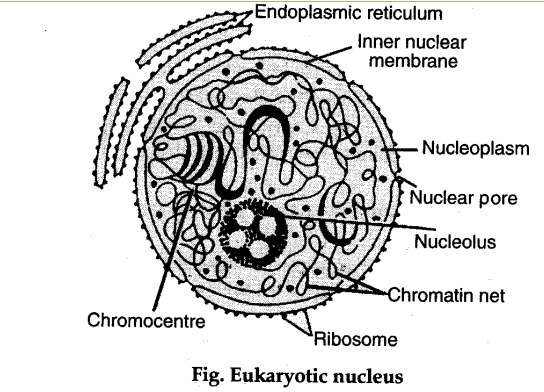
Q13. Describe the structure of the following with the help of labelled diagrams.
(i) Nucleus (ii) Centrosome
Answer:
(i) Nucleus: The nucleus is a dense, membrane-bound structure containing DNA. It has a double membrane envelope with nuclear pores, nucleoplasm, a nucleolus for rRNA synthesis, and chromatin that condenses into chromosomes during division. The outer membrane is continuous with the ER.
(ii) Centrosome: The centrosome has two perpendicular centrioles made of microtubules arranged in triplets forming a cartwheel pattern. It helps in spindle formation during cell division and in forming cilia or flagella basal bodies.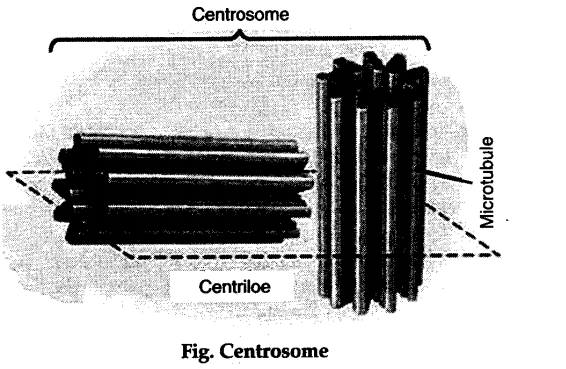
Q14. What is a centromere? How does the position of centromere form the basis of classification of chromosomes. Support your answer with a diagram showing the position of centromere on different types of chromosomes.
Answer: A centromere is the primary constriction that joins two chromatids in a chromosome and holds kinetochores for spindle attachment. Based on centromere position, chromosomes are of four types: metacentric (centromere in the middle), sub-metacentric (slightly off-center), acrocentric (near one end), and telocentric (at the terminal end).