
EXERCISE
Q1. Give a brief introduction to India.
Answer: India is a vast and diverse country situated in the southern part of Asia. It is the seventh-largest country in the world and the second most populous. Known for its democratic system of governance, India boasts a rich and varied physical environment, including the high Himalayas, extensive plains, plateaus, and coastal regions. This physical diversity is accompanied by social and cultural variety, with people of different religions, languages, and traditions living together. Despite these differences, India maintains a strong sense of unity and integration.
Q2. Discuss the characteristics relating to India’s location and size.
Answer: India is situated in the northern hemisphere, extending from 8°4′28″ N to 37°17′53″ N latitude and 68°7′33″ E to 97°24′47″ E longitude. The Tropic of Cancer (23°30′ N) passes almost through the middle, dividing the country into two nearly equal halves. India lies in the southern part of Asia, with the Himalayas to the north, the Indian Ocean to the south, the Arabian Sea to the west, and the Bay of Bengal to the east.
In terms of size, India ranks seventh in the world, covering a total area of 3,287,263 km². Its north-south length is approximately 3,214 km, while its east-west width is around 2,933 km. The country has a coastline of about 6,100 km and a land boundary stretching roughly 15,200 km, making it geographically significant both in area and strategic location.
Q3. Into how many physiographic divisions India can be divided? Discuss with diagrams.
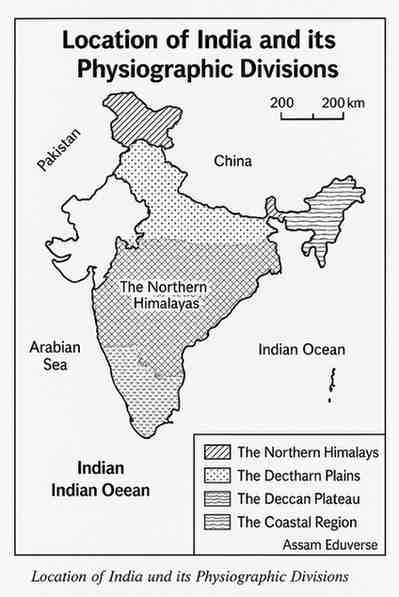
Answer: Based on its physiographic characteristics, India can be divided into four major physiographic divisions:
- The Northern Himalayas: The high mountain ranges in the northern part of the country.
- The Northern Plains: The vast fertile plains located south of the Himalayas.
- The Deccan Plateau: The extensive plateau region in the southern part of the country.
- The Coastal Region: The narrow plains located along the eastern and western coasts.
Additionally, the Indian islands in the Bay of Bengal and the Arabian Sea can be considered as a separate physiographic unit.
Q4. Describe the physiographic divisions of India.
Answer: India’s physiography is highly diverse and can be divided into four major divisions:
- The Northern Himalayas: A series of high, parallel mountain ranges in the north, formed from the sediments of the Tethys Sea. These young folded mountains have many high peaks and glaciers, which are sources of major rivers. They can be further divided into the Higher Himalayas, Lesser Himalayas, and Outer Himalayas (Siwaliks).
- The Northern Plains: A vast alluvial plain created by the Indus, Ganges, and Brahmaputra rivers. Stretching from the Indo-Pakistan border to Assam and covering about 700,000 km², it is extremely fertile and one of the most densely populated regions in the world.
- The Deccan Plateau: Located south of the northern plains, this large plateau is composed of old, hard rocks. It is bordered by the Western Ghats in the west and Eastern Ghats in the east, sloping eastward. Major rivers include the Godavari, Krishna, and Kaveri (flowing east) and the Narmada and Tapti (flowing west).
- The Coastal Region: Narrow plains along the eastern and western coasts. The eastern coastal plain along the Bay of Bengal is wider and more fertile, with major river deltas like the Mahanadi and Godavari. The western coastal plain along the Arabian Sea is narrower.
The Indian Islands, including the Andaman and Nicobar in the Bay of Bengal and Lakshadweep in the Arabian Sea, form a separate physiographic division with unique maritime features.
Q5. Describe briefly the climatic characteristies of India.
Answer: The climate of India is mainly a monsoon type, but it shows great regional variations such as :
- Temperature: Tropical in the south and temperate in the north.
- Monsoons: The south-west monsoon (June–Sept) gives most rainfall; the north-east monsoon brings rain to the east coast in winter.
- Rainfall: Very uneven—Western Ghats and Northeast get over 300 cm, while the Thar desert gets less than 50 cm.
- Seasons: India has four seasons – pre-monsoon (summer), monsoon (rainy), post-monsoon (autumn), and winter.
Q6. Explain how the monsoons affect the climate of India.
Answer: The monsoons have a major impact on India’s climate. The South-West Monsoon, blowing from the Arabian Sea and Bay of Bengal during summer, brings heavy rainfall to the western coast, North-Eastern India, and the Himalayan foothills. This rainfall is vital for agriculture and water resources.
The North-East Monsoon consists of dry winds from Central Asia that blow during winter. They generally cause little rain, except along the Coromandel Coast where they pick up moisture from the Bay of Bengal. Monsoons also create seasonal changes, dividing the year into a rainy monsoon season and a dry winter season. In addition, they help moderate summer temperatures, as the rains bring relief from intense heat.
Q7. What are the major soil types found in India? Give short description of each type of soil.
Answer: The major soil types found in India are:
- Mountain Soils: Found in the Himalayan region. These soils are formed from the deposition of sediments carried by glaciers and rivers. They are often acidic due to the decomposition of leaves from coniferous forests and are not very fertile.
- Alluvial Soils: Found in the vast Indo-Ganga-Brahmaputra plain. These are the most fertile soils, created by the deposition of sediments by rivers. They can be divided into new alluvial soils (soft and very fertile) and old alluvial soils (harder and less fertile).
- Desert Soils: Found in the Thar desert and surrounding regions. They are sandy and not very fertile due to low organic and nitrogen content. However, they can be made cultivable with irrigation.
- Lava Soils (Black Soils): Formed from the weathering of lava deposits in the Deccan plateau. They are black, clayey, and can retain moisture, making them very suitable for cotton cultivation.
- Deccan Plateau Soils: Besides black soils, other types like red loamy soils are also found here. These soils are porous and do not retain water well. Lateritic soils, rich in iron and aluminium, are found in some parts.
- Coastal Soils: Found along the eastern and western coasts. They are generally sandy, but the delta regions have fertile riverine soils.
Q8. What are the different vegetation types found in India? Mention them in a map.
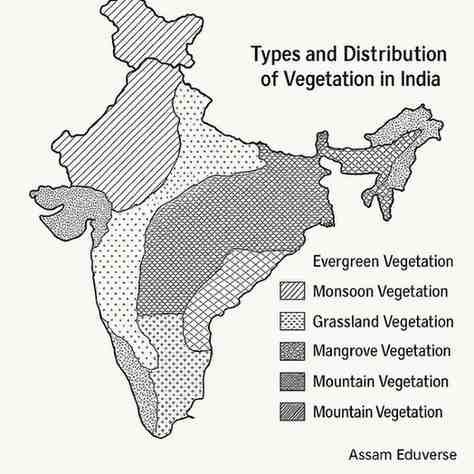
Answer: The six major vegetation types in India are:
- Evergreen Vegetations
- Monsoonal Vegetations
- Dry Thorny Vegetations
- Grassland Vegetations
- Mangrove Vegetations
- Mountain Vegetations
Q9. Describe the types of vegetation of India.
Answer: The various types of vegetation of India are :
Evergreen Vegetation: Found in regions with more than 200 cm of annual rainfall. These are dense forests with tall trees (up to 45m) that do not shed their leaves throughout the year. Examples of trees are shisham and rubber. They are found in the Western Ghats and North-Eastern India.
- Monsoonal Vegetation: Found in regions with 100-200 cm of annual rainfall. These are deciduous forests, meaning the trees shed their leaves in winter to conserve moisture. Examples include sal, teak, and sissoo. They are found in most of the plains and the eastern parts of the Deccan plateau.
- Dry Thorny Vegetation: Found in arid regions with less than 50 cm of annual rainfall. The trees have thorny leaves to reduce water loss. Examples include acacia and cactus. They are found in the Thar desert and its neighboring areas.
- Grassland Vegetation: Found in areas with 50-100 cm of annual rainfall. They consist of short grasses and thorny bushes. Extensive grasslands are not common in India, but patches are found in Punjab, Rajasthan, and the Deccan plateau.
- Mangrove Vegetation: Found in coastal delta regions with salty water. The trees are adapted to survive in brackish water. Examples include sundari and date palm. They are found in the Ganga-Brahmaputra delta (Sundarbans).
- Mountain Vegetation: The types of vegetation change with altitude in the mountain regions. The lower hills have monsoonal forests. As altitude increases, they change to evergreen forests, then to coniferous forests (deodar), and finally to Alpine vegetation (short grasses and shrubs) and snow.
Q10. Write a short note on the growth of population in India?
Answer: India is the second most populous country in the world, with a population of over a billion people. Its population has grown rapidly, particularly since the early 20th century. The main reasons for this growth are a high birth rate and a significant decline in the death rate due to advancements in medical facilities and public health. This rapid population increase has led to various problems, such as food shortages, unemployment, and housing issues. Controlling population growth is crucial for the country’s economic development.
Q11. “Population distribution is not uniform in all places of India”— Explain.
Answer: Population distribution in India is not uniform. Some regions are crowded while others are sparsely populated due to the following factors:
- Physical factors: Fertile northern plains with rivers and flat land are densely populated, while the Himalayas, Thar Desert, and Western Ghats have very low density due to harsh terrain and climate.
- Economic factors: Industrially and commercially developed areas attract a large population, while backward regions remain sparsely settled.
- Urbanization: Cities and towns with better jobs, education, and facilities draw people, leading to high population concentration in urban areas.
Q12. Discuss how population density varies in India.
Answer: Population density in India is not the same everywhere. As per the 2001 Census, the average population density was 324 persons per km², but some parts of the country are heavily crowded while others remain sparsely populated.
The high-density regions include the fertile Indo-Ganga-Brahmaputra plains, where alluvial soil and good transport facilities support large populations. Similarly, urban and industrial areas such as Delhi, Mumbai, and Kolkata also record very high densities because of abundant job opportunities and better living conditions.
On the other hand, the low-density regions include the Himalayan mountains, where the harsh climate and rugged terrain discourage settlement. The Thar Desert in Rajasthan also has a sparse population due to scarce water. Likewise, the Western Ghats and parts of the Deccan plateau, with thick forests and difficult terrain, remain thinly populated.
Q13. Give a description of urban population of India and also present data on urban population growth in some major cities of the country.
Answer: The urban population in India has been rising rapidly over the decades. In 1991, about 25.7% of India’s population lived in urban areas. This steady growth is mainly the result of industrialization and urbanization, which draw people from rural areas in search of better employment, education, and healthcare.
The number of towns and cities has also increased significantly, reflecting the expansion of economic activities, infrastructure, and services. Major metropolitan cities have emerged as the main centers of trade, commerce, and industry, leading to a sharp rise in their population.
Below is the 1991 Census data on the urban population growth in some of India’s largest cities:
| City | Population (in lakhs) |
|---|---|
| Mumbai | 125.71 |
| Kolkata | 109.16 |
| Delhi | 83.75 |
| Chennai | 53.61 |
| Hyderabad | 42.80 |
| Bangalore | 40.86 |
| Ahmedabad | 32.97 |
| Pune | 24.85 |
| Kanpur | 21.11 |
| Nagpur | 16.61 |
Q14. Describe the characteristics of the major agricultural regions of India.
Answer: Based on dominant crops and cultivation methods, India can be divided into several agricultural regions. They are :
- Fruits and Vegetables Region: This region includes the Himalayas, where temperate fruits like apples and cherries are grown in the west, and oranges, potatoes, and chilies in the east.
- Rice-Jute-Tea Region: This region includes the eastern parts of India, where fertile alluvial soils and high rainfall (180-250 cm) are suitable for the cultivation of rice, jute, and tea.
- Wheat and Sugarcane Region: This region in northern India has fertile alluvial soils and is a major producer of wheat and sugarcane.
- Millets and Oilseeds Region: Located in the Deccan plateau, this region has less fertile soil and scanty rainfall. It is suitable for growing millets like bajra and jowar, as well as oilseeds.
- Maize and Coarse Crop Region: This region includes western Rajasthan and Gujarat. Rainfall is low, and agriculture is often dependent on irrigation. Maize and other coarse crops are grown here.
- Cotton Region: The northwestern Deccan plateau, with its black soil and 75-100 cm of rainfall, is famous for cotton cultivation.
- Spices and Plantation Crop Region: This region includes the coastal plains and islands, which receive heavy rainfall. It is suitable for plantation crops like coffee, rubber, pepper, and cardamom.
Q15. Locate the major industrial regions of India on a map and describe each of them briefly.
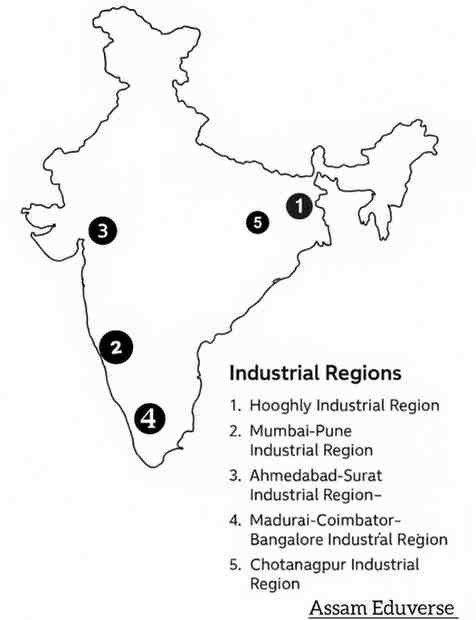
Answer: The five major industrial regions of India are:
- Hooghly Industrial Region
- Mumbai-Pune Industrial Region
- Ahmedabad-Surat Industrial Region
- Madurai-Coimbatore-Bangalore Industrial Region
- Chotanagpur Industrial Region
Brief Description of Each Region:
- Hooghly Industrial Region: Located along the Hooghly river, this is one of India’s oldest industrial regions, famous for jute and engineering industries.
- Mumbai-Pune Industrial Region: This region is a major center for the cotton textile industry and has diversified into petrochemicals and other industries due to the availability of petroleum.
- Ahmedabad-Surat Industrial Region: This is a fast-growing region known for its petrochemical, fertilizer, and textile industries, based on the availability of natural oil and gas.
- Madurai-Coimbatore-Bangalore Industrial Region: Famous for its cotton textile industries and has seen the growth of government-controlled industries like machine tools and aeronautics.
- Chotanagpur Industrial Region: The industries in this region have grown based on the rich mineral resources of the Chotanagpur plateau, with major industries including mining, metallurgy, and engineering.
Q16. Write short notes on the following–
(a) The north Indian plain region.
Answer: The North Indian Plain is a vast, flat alluvial plain that lies between the Himalayas and the Deccan Plateau. It was formed by the deposition of sediments by the Indus, Ganges, and Brahmaputra rivers. It has a total area of about 700,000 km2. This plain is very fertile, making it the most important agricultural region in the country. It is also one of the most densely populated regions in the world due to the favorable climate, fertile soil, and easy transport.
(b) Importance of agriculture on Indian economy.
Answer: Agriculture is the backbone of the Indian economy, providing livelihood to about two-thirds of the population. It contributes significantly to the country’s national income and ensures food security by supplying essential crops to feed the growing population. Agriculture also provides raw materials to agro-based industries such as textiles and sugar, supporting industrial development. Furthermore, agricultural products are an important source of foreign exchange through exports. Overall, agriculture sustains rural communities, supports related industries, and plays a crucial role in India’s economic growth and stability.
(c) Monsoon Vegetations.
Answer: Monsoon vegetations are a type of deciduous forest found in regions with 100-200 cm of annual rainfall. These trees shed their leaves in the dry winter season to conserve moisture. Sal, teak, and sissoo are common examples. They are widely distributed in India, including in Assam, West Bengal, Uttar Pradesh, and the eastern parts of the Deccan plateau.
(d) Monsoons and rainfall in India.
Answer: Monsoons are seasonal winds that are the primary source of rainfall in India. The south-west monsoon, blowing from June to September, brings heavy rainfall to most of the country and is crucial for agriculture. The north-east monsoon, which blows during the winter, is a dry wind, but it brings some rainfall to the Coromandel Coast after collecting moisture from the Bay of Bengal. The distribution of rainfall from the monsoons is very uneven across the country.
(e) Causes of population growth in India.
Answer: The main causes of population growth in India are:
- High Birth Rate: Despite a gradual decline, the birth rate is still high, especially in rural areas.
- Declining Death Rate: Due to improvements in healthcare, sanitation, and food security, the death rate has fallen significantly.
- Migration: Influx of people from neighboring countries also contributes to population growth.
(f) Causes responsible for uneven distribution of population in India.
Answer: The uneven distribution of population in India is caused by both physical and economic factors.
- Physical Factors: Favorable climates, fertile plains, and availability of water in regions like the Indo-Gangetic plain attract a high population. Conversely, mountainous, desert, and forested areas with difficult terrain and harsh climates are sparsely populated.
- Economic Factors: Industrialization, urbanization, and the availability of employment opportunities in cities and towns lead to a high concentration of population.
(g) Lava soils.
Answer: Lava soils, also known as black soils, are formed from the weathering of solidified lava deposits. They are found in the Deccan plateau region, particularly in Maharashtra and Gujarat. These soils are black, clayey, and have a high capacity to retain moisture, which makes them highly suitable for the cultivation of cotton. For this reason, they are also known as cotton soils.
(h) Hooghly industrial region.
Answer: The Hooghly industrial region is a major industrial belt located along the banks of the Hooghly river in West Bengal. It is one of India’s oldest industrial regions, having its origin during the British period. The main industries here are jute and engineering. Despite facing challenges like labor unrest and power supply issues, it remains an important industrial center in eastern India.
Q15. Characteristics of the North Indian Rivers
Answer: The North Indian rivers have the following characteristics :
- It flows throughout the year due to snow-fed sources.
- It travels long distances across the plains.
- It forms wide and fertile valleys.
- It moves slowly in deep channels, making navigation possible.
- It carries large amounts of sediments, creating fertile plains and deltas.
Q16. Characteristics of the South Indian Rivers
Answer:The South Indian rivers have the following characteristics :
- It flows mainly during the rainy season and may dry up in winter.
- It travels shorter distances over narrow valleys and rocky terrain.
- It forms steep gradients with swift currents.
- It is not suitable for navigation.
- It is ideal for hydropower generation due to its rapid flow.
(k) Indian islands.
Answer: The Indian islands are considered a separate physiographic division. There are two main groups:
- Andaman and Nicobar Islands: Located in the Bay of Bengal.
- Lakshadweep Islands: Located in the Arabian Sea.
These islands are union territories and have a maritime location and environment, which makes their physiography, climate, and lifestyle of the people distinct from the mainland.
(l) The Himalayan mountain region.
Answer: The Himalayan mountain region is the highest and most extensive mountain system in the world. It is a series of young folded mountains that extend from west to east along the northern border of India. The region is characterized by high peaks, deep gorges, and glaciers, which are the source of India’s major perennial rivers. It plays a crucial role in influencing India’s climate by acting as a barrier to the cold winds from Central Asia.