
EXERCISE
Give very short answer
Q1. What is atmosphere? Write in brief with data about its structure.
Answer: Atmosphere is the gaseous envelope of air that surrounds the Earth from its surface up to some height. It is held in place by the Earth’s gravitational force. The atmosphere is composed of various gases, water vapour, and dust particles. The two most abundant gases are Nitrogen (78.08%) and Oxygen (20.94%). Other gases like Argon (0.93%), Carbon dioxide (0.036%), and trace amounts of neon, helium, methane, etc., make up the rest.
Q2. What are the main layers of the atmosphere based on chemical composition of the gases? Write briefly about the characteristics of these layers.
Answer: Based on chemical composition, the atmosphere is divided into two main layers:
- Homosphere: This is the lower layer of the atmosphere, extending up to an altitude of about 80 km. The chemical composition of gases remains almost the same throughout this layer. It contains about 99% of the total atmospheric mass.
- Heterosphere: This is the upper layer, extending beyond 80 km up to 10,000 km. The chemical composition changes considerably in this layer. It is further divided into four sub-layers based on the dominance of gases with different atomic weights: the Nitrogen layer, Oxygen layer, Helium layer, and Hydrogen layer. The air density is extremely low in this layer.
Q3. Write with diagram about the layers of the atmosphere based on the variations in altitude and temperature and write the characteristics of each layer in brief.
Answer:
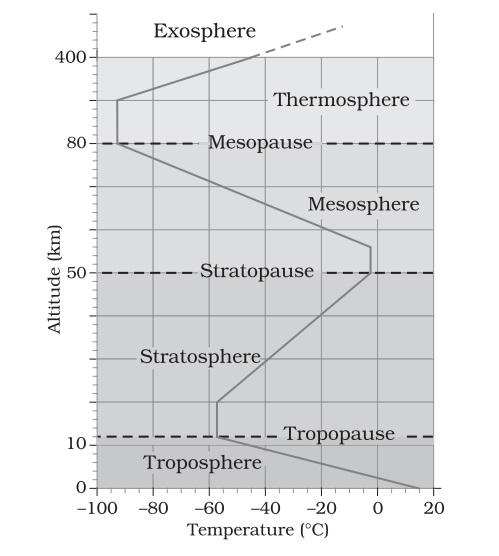
Based on variations in altitude and temperature, the atmosphere is divided into the following layers:
- Troposphere: This is the lowermost layer, with an average height of 12 km (16 km at the equator, 8 km at the poles). It contains about three-fourths of the total atmospheric gases and almost all water vapour and dust particles. All weather phenomena, such as clouds, rain, and storms, occur here. The temperature decreases with increasing height at a rate of 6.5∘C per km.
- Stratosphere: Located above the tropopause, this layer extends up to about 50 km. It is free from weather phenomena. The temperature increases with height, from about −60∘C at the bottom to 0∘C at the top. The ozone layer, which absorbs harmful ultraviolet radiation from the sun, is located in this layer.
- Mesosphere: This layer is above the stratopause and extends up to 80 km. The temperature decreases with altitude, reaching a minimum of about −100∘C at the mesopause.
- Thermosphere: Located above the mesopause, this layer extends up to 400 km. The temperature increases again in this layer, rising up to 1650∘C. It contains electrically charged ions, and therefore, it is also known as the Ionosphere.
- Exosphere: This is the topmost layer, extending from 400 km up to 10,000 km. The air is extremely thin, consisting mainly of hydrogen and helium.
Q4. Discuss with examples the factors responsible for variation in atmospheric pressure.
Answer: The two main factors responsible for the variation in atmospheric pressure are:
- Air Temperature: There is an inverse relationship between air temperature and atmospheric pressure. When air is heated, it expands and becomes lighter, causing a low-pressure area. For example, the equatorial region, which receives direct sunlight, has a consistently low-pressure belt. Conversely, cold air is dense and heavy, leading to high pressure, as seen in the polar regions.
- Altitude from the Earth’s Surface: Atmospheric pressure decreases as altitude increases. This is because the weight of the air column above a point decreases as you go higher. As a result, places at lower altitudes (like sea level) have higher atmospheric pressure than places at higher altitudes (like mountain tops). For every 900 feet of ascent, the air pressure decreases by 1 inch or 34 millibars.
Q5. With the help of diagram discuss the characteristics of the major pressure belts of the world.
Answer: The Earth has four major pressure belts:
- Equatorial Low Pressure Belt: Located between 10∘ N and 10∘ S latitudes, this belt is characterized by low pressure due to high temperatures and the resulting upward movement of air. The air is calm with no horizontal wind, which is why it’s also called the Equatorial Doldrum.
- Sub-Tropical High Pressure Belts: Located between 25∘ and 35∘ in both hemispheres, these belts have high pressure. This is because the warm, moist air rising from the equatorial belt cools and descends here. The air is calm, and this region is also known as the Horse Latitudes.
- Sub-Polar Low Pressure Belts: Found between 60∘ and 70∘ in both hemispheres, these belts have low pressure due to the Earth’s rotation, which causes air to be deflected away from these regions.
- Polar High Pressure Belts: Located near the poles (around 80∘ to 90∘ in both hemispheres), these belts have permanently high pressure because of the extremely cold temperatures.
Diagram:

Q6. Write the importance of atmosphere towards creation of a favourable physical environment on the earth.
Answer: The atmosphere is crucial for creating a favourable physical environment on Earth. Its importance includes:
- Sustaining Life: It provides essential gases like oxygen for humans and animals and carbon dioxide for plants.
- Temperature Regulation: It helps in the distribution and circulation of heat and moisture, maintaining a balanced temperature (average 15∘C) that is suitable for life.
- Protection from Radiation: The ozone layer in the stratosphere absorbs harmful ultraviolet radiation from the sun, protecting all living organisms.
- Weather and Climate: The atmosphere is the medium where all weather and climate phenomena, such as clouds and rain, occur, which are vital for life on Earth.
Q7. What is wind? Discuss the factors of origin of wind.
Answer: Wind is air in motion. It is the horizontal movement of air from one place to another.
The most important factor for the origin of wind is the difference in atmospheric pressure. This pressure difference is caused by the non-uniform heating of the Earth’s surface. When air in a region heats up, it becomes lighter and rises, creating a low-pressure area. The cooler, heavier air from a high-pressure area then moves in to fill the void, creating a horizontal movement of air which we call wind.
Q8. What is the most important reason for the origin of wind? Briefly discuss the factors determining velocity and direction of wind.
Answer: The most important reason for the origin of wind is the pressure gradient force, which is the force generated by the difference in atmospheric pressure between two places.
The velocity and direction of wind are determined by four main interactive forces:
- Pressure Gradient Force: This is the primary force that starts air movement. The steeper the pressure gradient (the greater the pressure difference over a short distance), the higher the wind velocity. The wind always moves from high pressure to low pressure.
- Coriolis Force: Due to the Earth’s rotation, a force known as the Coriolis force deflects the wind’s path. In the Northern Hemisphere, it deflects wind to the right, and in the Southern Hemisphere, it deflects it to the left. The effect is zero at the equator and increases towards the poles.
- Frictional Force: This force acts against the direction of wind movement and slows it down. The amount of friction depends on the surface over which the wind blows; it is greater over rugged land with mountains and buildings and less over smooth surfaces like water.
- Gravitational Force: This force pulls the air towards the Earth, influencing vertical air movement and contributing to the pressure differences that drive horizontal wind.
Q9. What do you mean by ‘Coriolis Force’? With the help of diagram briefly describe its contribution in determining the direction of wind.
Answer: Coriolis force is a force that arises due to the Earth’s rotation on its axis. It causes all moving objects, including wind, to be deflected from their original path. This force was first described by the French mathematician Gasperd de Coriolis.
According to Ferrell’s Law, the Coriolis force deflects wind to the right in the Northern Hemisphere and to the left in the Southern Hemisphere. This is why planetary winds do not blow in a straight line but take a curved path. The magnitude of this force is zero at the equator and maximum at the poles.
Diagram:

Q10. What is meant by ‘Pressure Gradient Force’? What is its contribution in air movement.
Answer: The Pressure Gradient Force is the force generated by the difference in atmospheric pressure between two places. The rate of this pressure difference is called the pressure gradient.
This force is the fundamental cause of air movement. It always drives air from a region of high pressure (where air is denser) to a region of low pressure (where air is less dense). The steeper the pressure gradient, the stronger the force and the higher the velocity of the resulting wind.
Q11. Briefly discuss the contribution of the earth’s gravitational force in air movement.
Answer: The Earth’s gravitational force plays a fundamental role in air movement, although not as a direct cause of horizontal wind. Its main contributions are:
- Creating Pressure: Gravity holds the atmosphere to the Earth, giving it weight and creating atmospheric pressure.
- Vertical Movement: Gravity is a driving force in the vertical movement of air. Heavier, cold air sinks due to gravity, creating a high-pressure zone, while lighter, warm air rises, creating a low-pressure zone. This vertical movement is a key part of the larger atmospheric circulation.
- Pressure Differences: The variation in gravitational force with altitude leads to a decrease in atmospheric pressure at higher altitudes, which in turn causes air to move upwards.
Q12. What do you mean by naming of wind? How the wind blowing over a place is named?
Answer: Winds are named based on the direction from which they blow. For example, a wind blowing from the west is called a westerly wind. A wind blowing from the north-east is called a north-easterly wind. The side from which the wind blows is called the windward side, and the side towards which it blows is called the leeward side.
Q13. How the velocity of wind is determined? What are the units of wind velocity?
Answer: The velocity of wind is determined using an instrument called an Anemometer. More modern versions, like an Anemograph, automatically record both the direction and velocity of the wind.
The common unit of wind velocity is Knot. One knot is equal to one nautical mile per hour, which is approximately 1.854 kilometres per hour.
Q14. How the classification of wind is done? Briefly discuss with examples.
Answer: Winds are broadly classified into three main groups based on their spatial extent and duration:
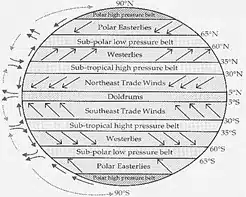
- Primary Circulation (Planetary Winds): These are large-scale, permanent winds that blow throughout the year over a vast area, determined by the global pressure belts. Examples include trade winds, westerlies, and polar easterlies.
- Secondary Circulation (Periodic Winds): These are winds that change their direction periodically, often due to regional or seasonal changes in temperature and pressure. Examples include monsoon winds, cyclones, and anticyclones.
- Tertiary Circulation (Local Winds): These are temporary winds that blow over a very limited area, influenced by purely local factors like topography and daily temperature changes. Examples include sea breeze, land breeze, mountain wind, and valley wind.
Q15. What do you mean by primary circulation of wind? Show distribution of primary circulations in a diagram. Mention its important characteristics.
Answer: Primary circulation refers to the planetary wind systems that blow permanently throughout the year, driven by the global distribution of permanent high and low-pressure belts. These are the largest-scale wind patterns on Earth.
The important characteristics are:
- Persistence: They are permanent and blow consistently from high-pressure to low-pressure belts.
- Planetary Scale: They cover vast areas of the Earth.
- Coriolis Effect: Their direction is significantly influenced by the Coriolis force.
- Types: The three main types are the Trade Winds, the Westerlies, and the Polar Easterlies.
Diagram:
Q16. What is secondary circulation of wind? Discuss its contribution in determining the climate of a place with examples.
Answer: Secondary circulation refers to wind systems that blow over a large region but change their direction periodically.
Q17. What is local wind? Briefly discuss with examples how local wind determines the weather condition of a place.
Answer: Local winds are temporary wind circulations that are limited to a small, localized area. They are caused by local factors such as changes in temperature and pressure due to topography.
Local winds have a strong effect on the daily weather of a region.
- Sea Breeze and Land Breeze: During the day, land heats up faster than the sea, forming a low-pressure area over land. Wind blows from the cooler sea (high pressure) to land, creating a cooling sea breeze. At night, land cools faster, and wind blows from land (high pressure) to the warmer sea (low pressure), forming a land breeze. This helps moderate coastal temperatures.
- Mountain and Valley Wind: In the day, air in the valley heats up and rises along the mountain slopes, creating a valley wind. At night, air on mountain tops cools, becomes heavy, and flows down into the valley, creating a mountain wind. This movement prevents fog accumulation in valleys during winter.
Q18. What is a cyclone? What are its types? Mention briefly how it influences the climate of a place?
Answer: A cyclone is an atmospheric condition where high-velocity winds blow in a circular path around a central low-pressure area.
There are two main types of cyclones: Tropical Cyclones and Extra-Tropical Cyclones. Tropical cyclones form over warm tropical oceans and are violent, with very high winds and heavy rainfall, often causing severe damage to coastal areas. Extra-tropical cyclones occur in mid-latitudes when warm and cold air masses meet; they are less violent but still bring clouds, rainfall, and strong winds. Cyclones affect the climate by causing rapid weather changes, especially heavy rainfall, which impacts the areas they hit.
Cyclones influence the climate of a place by bringing significant and often rapid weather changes, especially heavy rainfall, which is a major component of the climate in the areas they affect.
Q19. What is an air mass? How it is classified? What is its contribution in determining the climate of a place?
Answer: An air mass is a large body of air that has a uniform temperature and humidity throughout. It is formed when a large volume of air remains stationary over a source region for a long time and takes on the characteristics of that surface.
Air masses are classified based on their source region and associated characteristics. The four main types are:
- Tropical Continental Air mass (CT)
- Tropical Maritime Air mass (mT)
- Polar Continental Air mass (cP)
- Polar Maritime Air mass (mP)
Air masses play a crucial role in determining the climate of a place. As they move from their source region, they carry their temperature and moisture characteristics, influencing the weather of the areas they travel over. For example, a polar continental air mass from a cold, dry region will bring cold, dry weather to the areas it passes through.
Q20. What do you mean by ‘Front’? How it is formed? Briefly discuss the relationship between climate and front.
Answer: A front is a line of discontinuity that forms on the surface when two air masses with different characteristics (like temperature, humidity, and density) meet. They do not mix readily, creating a boundary between them.
A front is formed when a cold, heavy air mass and a warm, light air mass move towards each other (convergence). The lighter, warm air rises over the heavier, cold air, leading to instability and the formation of the front.
Fronts have a significant relationship with climate. The movement of fronts often leads to rapid weather changes. For example, a cold front can bring sudden and heavy rainfall, while a warm front might bring a period of steady, gentle rain. These frequent changes in weather, driven by fronts, are a defining characteristic of the climate in the mid-latitude regions.
Q21. What do you mean by ‘Monsoon Wind’? How it is formed? In which areas of the earth its impact is quite distinct?
Answer: Monsoon wind is a periodic wind that changes its direction with the change of season. The word ‘Monsoon’ is derived from the Arabic word “Mausim,” meaning season.
Monsoon winds are formed due to the differential heating of land and water surfaces. During summer, the land heats up much faster than the sea, creating a low-pressure area over land and a high-pressure area over the sea. This causes a moist wind to blow from the sea to the land, bringing heavy rainfall. During winter, the land cools faster than the sea, creating high pressure over land and low pressure over the sea. The wind then reverses direction, blowing from the land to the sea, which is generally dry.
The impact of monsoon winds is most distinct and powerful in Asia, particularly in its southern and southeastern parts.
Q22. Write with reasons:
(a) Why do all weather phenomena occur mainly in troposphere?
Answer: Weather phenomena occur mainly in the troposphere because this layer contains almost all of the atmosphere’s water vapour and dust particles. Water vapour is essential for the formation of clouds and precipitation (rain, snow, etc.). The presence of dust particles also acts as a condensation nuclei for water vapour. Additionally, the temperature in the troposphere decreases with altitude, creating an unstable environment that allows for the vertical movement of air, which is necessary for weather phenomena like storms and cyclones.
(b) What would be the consequence of the increase in the amount of carbon dioxide?
Answer: The increase in the amount of carbon dioxide would lead to a rise in global atmospheric temperature, a phenomenon known as Global Warming. Carbon dioxide is a greenhouse gas that absorbs the solar radiation reflected from the Earth’s surface, trapping heat in the atmosphere. An increased concentration of this gas would lead to more heat being trapped, causing the Earth’s temperature to rise.
(c) What is the reason behind the prevalence of high pressure of dry air than moist air?
Answer: Dry air has a higher pressure than moist air because water molecules (a component of moist air) are lighter than the molecules of nitrogen and oxygen that make up dry air. Therefore, a given volume of moist air weighs less than the same volume of dry air, resulting in lower pressure.
(d) How does the ozone layer help the living-beings?
Answer: The ozone layer helps living beings by absorbing harmful ultraviolet (UV) radiation from the sun. This radiation is dangerous and can cause skin cancer, eye damage, and harm to plant life. By filtering out most of the UV rays, the ozone layer acts as a protective shield, allowing life to thrive on Earth.
(e) Why is the air pressure highest at the sea level?
Answer: The air pressure is highest at sea level because it is at the bottom of the atmosphere. The entire column of air above it, from sea level all the way to the top of the atmosphere, is pushing down on it due to gravity. As you go higher, the amount of air above you decreases, so the weight and pressure also decrease.
(f) What is the reason behind variation in vertical extent of the troposphere in the polar region and equatorial region?
Answer: The vertical extent of the troposphere is greater at the equatorial region (16 km) and lower at the polar region (8 km) due to temperature. At the equator, the air is hot and rises to a greater height, pushing the tropopause higher. At the poles, the air is cold and dense, so it contracts and does not rise as high, keeping the tropopause at a lower altitude.
(g) Why is horizontal movement of wind parallel to the earth’s surface not felt in the equatorial low pressure belt?
Answer: The horizontal movement of wind is not felt in the equatorial low-pressure belt because this region is dominated by vertical air movement. The high temperatures cause the air to heat up, expand, and rise vertically, creating a calm condition with very little to no horizontal wind. This is why this zone is known as the Doldrums.
Q23. Give short answer to the following questions:
(a) What is the vertical extent of the atmosphere?
Answer: The atmosphere extends vertically up to an altitude of around 10,000 km from the Earth’s surface.
(b) Up to what altitude from the earth’s surface does chemical composition of gases remain almost same?
Answer: The chemical composition of gases remains almost the same up to an altitude of about 80 km from the Earth’s surface, in the layer known as the Homosphere.
(c) What is the name of the boundary line between homosphere and heterosphere?
Answer: The boundary between the homosphere and heterosphere is called the Homopause or Turbopause.
(d) What is Ferrell’s Law?
Answer: Ferrell’s Law states that due to the Coriolis force, wind and other moving objects are deflected to the right in the Northern Hemisphere and to the left in the Southern Hemisphere.
(e) What is Beaufort Scale? Write briefly about the utility of this scale with example.
Answer: The Beaufort Scale is a numbered scale (from 0 to 12) developed by Sir Francis Beaufort in 1805 to measure and describe wind velocity based on its observable effects on the environment. Its utility lies in providing a simple and universally understandable way to estimate wind speed without a specific instrument. For example, a Beaufort number of 3, described as a “gentle breeze,” means that leaves and small twigs are in motion and a light flag is extended by the wind.
(f) Write in brief about Lapse Rate.
Answer: Lapse rate refers to the rate at which air temperature decreases with an increase in altitude in the troposphere. The standard lapse rate is approximately 6.5∘C per kilometre of ascent.
Q24. Write short note:
(a) Homosphere
Answer: Homosphere is the lower layer of the atmosphere, extending up to an altitude of about 80 km. The chemical composition of gases in this layer remains almost uniform, with nitrogen and oxygen being the most abundant. This layer contains the troposphere, stratosphere, and mesosphere and holds about 99% of the total atmospheric mass.
(b) Heterosphere
Answer: Heterosphere is the upper layer of the atmosphere, located above the homosphere (from 80 km to 10,000 km). In this layer, the chemical composition of gases changes significantly with altitude, with lighter gases like helium and hydrogen dominating at higher levels. This layer includes the thermosphere and exosphere and has an extremely low air density.
(c) Air temperature, earth’s surface height and air pressure relationship
Answer: Air temperature and air pressure have an inverse relationship: as temperature increases, pressure decreases, and vice-versa. This is because warm air is less dense and exerts less pressure. The Earth’s surface height also has an inverse relationship with air pressure: as height increases, pressure decreases. This is because there is less weight from the air column above.
(d) Polar High Pressure Belt
Answer: The Polar High Pressure Belts are located around the poles, approximately between 80∘ and 90∘ latitude in both hemispheres. These belts are characterized by permanently high pressure due to the extremely cold temperatures. The cold, dense air sinks, creating a high-pressure zone. This high pressure drives the polar winds towards the sub-polar low-pressure belts.
(e) Wind system
Answer: A wind system refers to the large-scale atmospheric circulation patterns that move air, heat, and moisture across the globe. It is a complex process influenced by a combination of forces, including the pressure gradient force, Coriolis force, gravitational force, and frictional force. Wind systems are crucial for distributing energy and maintaining the Earth’s climate balance.
(f) Pressure Gradient
Answer: Pressure gradient is the rate of change of atmospheric pressure over a given horizontal distance. It is the primary force that initiates wind movement. A steep pressure gradient (a large pressure difference over a short distance) results in strong winds, while a gentle pressure gradient leads to light winds or calm conditions.
(g) Trade wind
Answer: Trade winds are a type of primary or planetary wind that blows from the subtropical high-pressure belts towards the equatorial low-pressure belt. Due to the Coriolis effect, they blow from the north-east in the Northern Hemisphere and from the south-east in the Southern Hemisphere. Historically, these winds were crucial for sailing ships, which is how they got their name.
(h) Horse latitude
Answer: The Horse Latitudes are the calm regions located within the subtropical high-pressure belts (between 25∘ and 35∘ latitude) in both the Northern and Southern Hemispheres. This region is characterized by descending air, leading to very little horizontal wind movement. The name originated in the Middle Ages when sailors would throw horses overboard to lighten the ships and escape the stagnant winds.
(i) Roaring Forties
Answer: The “Roaring Forties” is a term used by sailors to describe the strong westerly winds found in the Southern Hemisphere, roughly between the latitudes of 40∘ and 50∘. These winds are particularly strong due to the absence of large landmasses to slow them down. They are part of the larger westerlies wind system.
(j) Anticyclone
Answer: An anticyclone is a high-pressure system where winds circulate outward from a central high-pressure area. The wind movement is clockwise in the Northern Hemisphere and anti-clockwise in the Southern Hemisphere. Anticyclones are generally associated with fair weather, clear skies, and calm conditions because the air in the center is sinking.
(k) Jet Stream
Answer: A Jet Stream is a high-altitude, fast-flowing, narrow air current found in the upper troposphere. These winds blow from west to east and can reach very high speeds (up to 640 km/h). They play a significant role in influencing the weather and climate of the regions below them.
(1) Isobar
Answer: An isobar is a line on a weather map that connects all places having the same atmospheric pressure at a given time. Isobars are essential for weather forecasting, as their spacing indicates the pressure gradient: closely spaced isobars mean a steep pressure gradient and strong winds, while widely spaced isobars indicate a gentle gradient and light winds.
(m) Tropical Cyclone
Answer: A tropical cyclone is a low-pressure system that forms over warm tropical oceans. It is characterized by violent, rotating winds and heavy rainfall. They are highly destructive and are known by different names in various parts of the world, such as hurricanes (in the West Indies), typhoons (in the Pacific), and cyclones (in the Indian Ocean).
Q25. Write the differences:
(a) Horizontal wind and Vertical wind
Answer: Horizontal wind is the movement of air parallel to the Earth’s surface. It is the wind we commonly feel and is responsible for daily weather patterns like breezes, gales, and storms. It mainly redistributes air horizontally across regions.
On the other hand, vertical wind (or vertical current) is the movement of air upwards or downwards. It plays a crucial role in carrying heat, moisture, and energy to different layers of the atmosphere, affecting cloud formation, rainfall, and temperature distribution.
(b) Wind and Air mass
Answer: Wind is the movement of air and represents a dynamic process. It involves the continuous flow of air from one place to another, influenced by pressure differences and temperature variations.
On the other hand, an air mass is a large body of air that has uniform characteristics of temperature and humidity. It is relatively static and maintains specific properties acquired from its source region.
(c) Tropical cyclone and Extra-tropical cyclone
Answer: Tropical cyclones form over warm tropical oceans and are fueled by the release of latent heat from condensing water vapor. They have a small, clear eye at the center and are highly destructive with very strong winds.
On the other hand, extra-tropical cyclones form in the mid-latitudes due to the meeting of different air masses. They are generally larger in size, less destructive than tropical cyclones, and are associated with weather fronts.
(d) Sea breeze and Land breeze
Answer: Sea breeze is a wind that blows from the sea to the land during the day. It occurs because the land heats up faster than the sea, creating low pressure over the land.
On the other hand, land breeze is a wind that blows from the land to the sea at night. It occurs because the land cools faster than the sea, creating high pressure over the land.
(e) Mountain wind and Valley wind
Answer: Mountain wind is a cold, dense wind that flows down the mountain slopes into the valley at night.
On the other hand, valley wind is a warm, light wind that flows up the mountain slopes from the valley during the day.
(f) Cyclone and Anticyclone
Answer: A cyclone is a low-pressure system where winds spiral inward towards the center. In the Northern Hemisphere, winds move in an anti-clockwise direction, and in the Southern Hemisphere, they move in a clockwise direction. Cyclones are associated with unstable, often stormy, weather.
On the other hand, an anticyclone is a high-pressure system where winds spiral outward from the center. In the Northern Hemisphere, winds move in a clockwise direction, and in the Southern Hemisphere, they move in an anti-clockwise direction. Anticyclones are associated with calm, fair weather.
(g) Cold Front and Warm Front
Answer: A cold front is the leading edge of a colder air mass that is displacing a warmer air mass. It is usually associated with a rapid weather change and can bring thunderstorms and heavy rain.
On the other hand, a warm front is the leading edge of a warmer air mass that is moving over and displacing a colder air mass. It typically brings a gradual increase in clouds and a period of steady, gentle rain.
(h) Cold wave and Hot Wave
Answer: A cold wave is a spell of extremely cold weather caused by the movement of a cold-core anticyclone from a polar or high-latitude region.
On the other hand, a hot wave is a period of unusually hot and dry weather caused by a warm-core anticyclone that brings stable, hot air from a tropical or subtropical region.
(i) Troposphere and Stratosphere
Answer: Troposphere is the lowest atmospheric layer where temperature decreases with altitude. It is the layer where all weather phenomena occur.
On the other hand, stratosphere is the layer above the troposphere where temperature increases with altitude. It is free from weather disturbances and contains the ozone layer.
Q26.Find out the correct answer:
(a) Where is Ozone layer located?
(1) Troposphere (2) Stratosphere (3) Mesosphere (4) Thermosphere
Answer: (2) Stratosphere
(b) What is amount of oxygen in the atmosphere in terms of volume?
(1) 20.94% (2) 29.01% (3) 32.47% (4) 78.08%
Answer: (1) 20.94%
(c) The most important reason for air movement is
(1) Humidity difference (2) Pressure difference (3) Gravitational Force (4) Centrifugal Force
Answer: (2) Pressure difference
(d) The instrument used for determination of wind velocity is
(1) Wind vane (2) Anemometer (3) Beaufort scale (4) Hydrometer
Answer: (2) Anemometer
(e) The unit of wind velocity is
(1) Knot (2) Milibar (3) Percentage (4) Degree
Answer: (1) Knot
(f) Monsoon wind belongs to which of the following class?
(1) Local winds (2) Primary circulation (3) Secondary circulation (4) Permanent wind
Answer: (3) Secondary circulation
(g) The name of the cyclone formed in the coastal region of the Pacific Ocean in the east is
(1) Cyclone (2) Hurricane (3) Willy-Willy (4) Typhoon
Answer: (4) Typhoon