
Thinking about the Text
Activity
Q1. On the following map mark out the route, which the author thought of but did not take, to Delhi.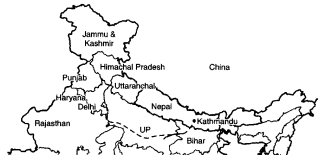
Answer:
Route ¡s shown by dotted line
- Kathmandu to Patna by bus & train
- Patna to Allaha bad by boat/Ganges
- Allahabad to Delhi by boat/Yamuna
Q2. Find out the possible routes (by rail, road or air) from Kathmandu to New Delhi/ Mumbai/Kolkata/Chennai.
Answer:
For self-attempt. Students may take the Atlas of the country and see or find themselves the air, road routes from Kathmandu to New Delhi/Mumbai/ Kolkata/ Chennai.
Some possible routes are:
By Road
- Kathmandu—>Viratnagar—>Patna
- Kathmandu—>Nepalganj—>Gorakhpur
By Rail
Patna—>Delhi
Gorakhpur—>Delhi
Patna—>Kolkata
Gorakhpur—Varanasi—>Kolkata
Patna—>Mumbai
Gorakhpur—>Allahabad—>Mumbai
Patna—>Khadarpur—>Chennai
Gorakhpur—>Allahabad—>Nagpur—>Chennai
I. Answer these questions in one or two words or in short phrases.
Q1. Name the two temples the author visited in Kathmandu.
Answer: Pashupatinath and Baudhnath stupa.
Q2. The writer says, “All this I wash down with Coca Cola.” What does ‘all this’ refer to?
Answer: ‘All this’ refers to a bar of marzipan, a corn-on-the-cob, love story comics, and a Reader’s Digest that he bought.
Q3. What does Vikram Seth compare to the quills of a porcupine?
Answer: The fifty or sixty bansuris (flutes) protruding from a pole in all directions.
Q4. Name five kinds of flutes.
Answer: The reed neh, the recorder, the Japanese shakuhachi, the deep bansuri of Hindustani classical music, and the high-pitched Chinese flutes.
II. Answer each question in a short paragraph.
Q1. What difference does the author note between the flute seller and the other hawkers?
Answer: The author notes that the flute seller is distinct from the other hawkers because he is not loud or pushy. He plays his flute in a meditative manner and sells his wares in an offhanded, casual way, as if the selling is incidental to his main enterprise of playing the music. The other hawkers are noisy and shout to attract customers.
Q2. What is the belief at Pashupatinath about the end of Kaliyug?
Answer: At Pashupatinath, there is a small shrine on the bank of the Bagmati river that half protrudes from a stone platform. It is believed that when this shrine emerges fully, the goddess inside will escape, and the evil period of Kaliyug will end on earth.
Q3. The author has drawn powerful images and pictures. Pick out three examples each of
(i) the atmosphere of ‘febrile confusion’ outside the temple of Pashupatinath
(ii) the things he sees
(iii) the sounds he hears
Answer:
(i) Three examples of ‘febrile confusion’:
- A fight breaks out between two monkeys, one chasing the other.
- The rush of worshippers trying to get the priest’s attention and elbowing each other.
- A party of saffron-clad Westerners struggling for permission to enter.
(ii) Three examples of things he sees: - A corpse being cremated on the banks of the river.
- Washerwomen at work and children bathing in the river.
- Small shrines to flower-adorned deities along the narrow streets.
(iii) Three examples of sounds he hears: - Film songs blaring from radios.
- Car horns sounding and bicycle bells ringing.
- The lowing of stray cows and vendors shouting out their wares.
III. Answer the following questions in not more than 100-150 words each.
Q1. Compare and contrast the atmosphere in and around the Baudhnath shrine with the Pashupatinath temple.
Answer: The atmosphere at the Pashupatinath temple and the Baudhnath stupa are in stark contrast. The Pashupatinath temple is a place of “febrile confusion.” The air is filled with the chaos of priests, hawkers, devotees, tourists, and animals like cows, monkeys, and pigeons. Worshippers push each other to get closer to the priest. The holy Bagmati river flows below, where a corpse is being cremated, while washerwomen work and children bathe, creating a bustling and somewhat disordered scene.
In contrast, the Baudhnath stupa is a “haven of quietness.” The immense white dome is surrounded by a road, with small shops run by Tibetan immigrants selling various items. However, there are no crowds or loud noises. The atmosphere is one of stillness and tranquility, offering a calm and peaceful experience compared to the hectic environment of Pashupatinath. This contrast highlights the different energies of the two sacred places.
Q2. How does the author describe Kathmandu’s busiest streets?
Answer: The author describes Kathmandu’s busiest streets as vivid, mercenary, and religious. The streets are a chaotic blend of different sights and sounds. They are filled with small shrines adorned with flowers, alongside vendors selling fruit, flutes, postcards, cosmetics, and antiques. The air is a cacophony of sound, with film songs blaring from radios, car horns blaring, bicycle bells ringing, and vendors shouting. Even stray cows contribute to the noise by lowing questioningly at motorcycles. Despite the overwhelming chaos, the author finds himself indulging in the experiences of the street, enjoying a corn-on-the-cob and a marzipan bar, which shows the lively and engaging nature of the city.
Q3. “To hear any flute is to be drawn into the commonality of all mankind.” Why does the author say this?
Answer: The author says this because flute music is a universal sound. He points out that almost every culture has its own version of the flute, whether it is the reed neh, the Japanese shakuhachi, the deep bansuri, or the high-pitched Chinese flutes. Each has its specific fingering and range, but the sound of any flute connects humanity. He believes that flute music is the most universal and particular of all sounds, with its phrases and sentences being closest to the human voice. The flute’s “motive force” is also living breath, just like the human voice, which needs to pause and breathe. This commonality in its very nature makes the author feel a sense of shared humanity when he hears the flute seller’s music.
Thinking about Language
I. Read the following sentences carefully to understand the meaning of the italicised phrases. Then match the phrasal verbs in column A with their meanings in column B.
- A communal war broke out when the princess was abducted by the neighbouring prince.
- The cockpit broke off from the plane during the plane crash.
- The car broke down on the way and we were left stranded in the jungle.
- The dacoit broke away from the police as they took him to court.
- The brothers broke up after the death of the father.
- The thief broke into our house when we were away.
| A | B |
| (i) break out | (a) to come apart due to force |
| (ii) break off | (b) end a relationship |
| (iii) break down | (c) break and enter illegally; unlawful trespassing |
| (iv) break away (from someone) | (d) to start suddenly, (usually a fight, a war or a disease) |
| (v) break up | (e) to escape from someone’s grip |
| (vi) break into | (f) stop working |
Answers:
| A | B |
| (i) break out | (d) to start suddenly, (usually a fight, a war or a disease) |
| (ii) break off | (a) to come apart due to force |
| (iii) break down | (f) stop working |
| (iv) break away (from someone) | (b) end a relationship |
| (v) break up | (e) to escape from someone’s grip |
| (vi) break into | (c) break and enter illegally; unlawful trespassing |
Q1.Use the suffixes -ion or -tion to form nouns from the following verbs. Make the necessary changes in the spellings of the words.
Example: proclaim-proclamation
Answer:
- cremate – cremation
- invent – invention
- direct – direction
- dislocate – dislocation
- act – action
- tempt – temptation
- meditate – meditation
- associate – association
- exhaust – exhaustion
- immigrate – immigration
- imagine – imagination
- dedicate – dedication
Q2. Now fill in the blanks with suitable words from the ones that you have formed.
- Mass literacy was possible only after the of the ……….. printing machine.
- Ramesh is unable to tackle the situation as he lacks ………..
- I could not resist the ……….. to open the letter.
- Hardwork and ……….. are the main keys to success.
- The children were almost fainting with ……….. after being made to stand in the sun.
Answer:
- Mass literacy was possible only after the of the invention printing machine.
- Ramesh is unable to tackle the situation as he lacks imagination
- I could not resist the temptation to open the letter.
- Hardwork and dedication are the main keys to success.
- The children were almost fainting with exhaustion after being made to stand in the sun.
III. Punctuation
Q1. Use capital letters, full stops, question marks, commas and inverted commas wherever necessary in the following para-graph.
an arrogant lion was wandering through the jungle one day he asked the tiger who is stronger than you you O lion replied the tiger who is more fierce than a leopard asked the lion you sir replied the leopard he marched upto an elephant and asked the same question the elephant picked him up in his trunk swung him in the air and threw him down look said the lion there is no need to get mad just because you don’t know the answer
Answer: An arrogant lion was wandering through the jungle one day. He asked the tiger, “Who is stronger than you?” “You, O lion,” replied the tiger. “Who is more fierce than a leopard?” asked the lion. “You, sir,” replied the leopard. He marched up to an elephant and asked the same question. The elephant picked him up in his trunk, swung him in the air, and threw him down. “Look,” said the lion, “there is no need to get mad just because you don’t know the answer.”
IV. Simple Present Tense
Q1. Fill in the blanks with the correct form of the verb in brackets.
(i) The heart is a pump that …………. (send) the blood circulating through our body. The pumping action …………. (take place) when the left ventricle of the heart …………. (contract). This …………. (force) the blood out into the arteries, which …………. (expand) to receive the on coming blood.
Answer: The heart is a pump that sends the blood circulating through our body. The pumping action takes place when the left ventricle of the heart contracts. This forces the blood out into the arteries, which expands to receive the on coming blood.
(ii) The African lungfish can live without water for up to four years. During a drought it digs a pit and ………… (enclose) itself in a capsule of slime and earth, leaving a tiny opening for air. The capsule ………… (dry) and ………… (harden), but when rain ………… (come), the mud ………… (dissolve) and the lungfish (swim) ………… away.
Answer:The African lungfish can live without water for up to four years. During a drought it digs a pit and encloses itself in a capsule of slime and earth, leaving a tiny opening for air. The capsule dries and hardens, but when rain comes, the mud dissolves and the lungfish swims away.
(iii) Mahesh : We have to organise a class party for our teacher. ………… (Do) anyone play an instrument?
Vipul : Rohit ………… (play) the flute.
Mahesh : ………… (Do) he also act ?
Vipul : No, he ………… (compose) music.
Mahesh : That’s wonderful!
Answer: Mahesh : We have to organise a class party for our teacher. ………… (Do) anyone play an instrument?
Vipul : Rohit ………… (play) the flute.
Mahesh : ………… (Do) he also act ?
Vipul : No, he ………… (compose) music.
Mahesh : That’s wonderful!
Mahesh : We have to organise a class party for our teacher. ………… (Do) anyone play an instrument?
Vipul : Rohit ………… (play) the flute.
Mahesh : ………… (Do) he also act ?
Vipul : No, he ………… (compose) music.
Mahesh : That’s wonderful!
Answer: Mahesh : We have to organise a class party for our teacher. Does anyone play an instrument?
Vipul : Rohit plays the flute.
Mahesh : Does he also act?
Vipul : No, he composes music.
Mahesh : That’s wonderful!
Speaking
Q1.Discuss in class the shrines you have visited or know about. Speak about one of them.
Answer:
Do it yourself.
Q2. Imagine you are giving an eyewitness account or a running commentary of one of the following:
- a game of football, cricket or hockey, or some sports event
- a parade (e.g. Republic Day) or some other national event
Speak a few sentences narrating what you see and hear. Use the simple present and the present continuous tenses. For example:
- He passes the ball but Ben gets in the way…
- These brave soldiers guard our frontiers. They display their skills here
Answer:
For self-attempt
Writing
Diary entry for a travelogue
Q1. The text you read is a travelogue where the author, Vikram Seth, talks about his visit to two sacred places in Kathmandu.
Imagine that you were with Vikram Seth on his visit to Pashupatinath temple, and you were noting down all that you saw and did there, so that you could write a travelogue later.
Record in point form
- what you see when you reach the Pashupatinath temple
- what you see happening inside the temple
- what you do when inside the temple
- what you see outside the temple
- what your impressions are about the place.
Answer:
28th August, 20XX
Dear Diary,
Today I feel pleasure to note down my experience to the visit to Pashupatinath Temple in Kathmandu with Vikram Seth. The visit was indeed exciting for me, though there was too much tumult at Pashupatinath Temple. I saw crowds of priests, hawkers, devotees, tourists at the temple. We offered a few flowers to God. Inside the temple I saw a large number of worshippers trying to get the priest’s attention and some of them were elbowed aside by others who were pushing their way to the front.
Outside the temple, I saw a party of saffron- clad westeners struggle for permission to enter the temple. The policeman did not allow them to enter the temple because they were not Hindus.
There is no doubt that the place is worth visiting. We feel aesthetic satisfaction by visiting such religious place.
Mayank
Q2. Here is your diary entry when you visited Agra. Read the points and try to write a travelogue describing your visit to Agra and the Taj Mahal. You may add more details. January 2003—rise before dawn—take the Shatabdi Express at 6.15 am from Delhi— meet a newly-married couple on train— talk about Himachal Pradesh—get off the train—enter the once-grand city, Agra— twisted alleys—traffic dense—rickshaws, cars, people—vendors selling religious artifacts, plastic toys, spices and sweets—go to the Taj Mahal—constructed entirely of white marble—magical quality—colour changes with varying of light and shadow— marble with gemstones inside—reflection of the Taj Mahal in the pond—school-children, tourists—tourist guides following people.
Answer:
A Visit to Agra
It was January 2003.1 woke up before dawn and took the Shatabdi Express at 6.15 a.m. from Delhi bound for Agra. I met a newly married couple who belonged to Himachal Pradesh. We talked with one another and got off the train. I entered the once grand city, Agra. I saw the dense traffic, numerous rickshaw pullers, cars, people and vendors selling religious artifacts, plastic toys, spices and sweets. I went to the Taj Mahal which is one of the seven wonders of the world. It was entirely of white marble and had a magical quality of colour changing with varying of light and shadow. The white marble of Taj Mahal has gemstones of multi coloured engraved in it. The reflection of the Taj Mahal could be seen in the pond. There were many tourists, school children and tourist guides.