
Thinking about the Text
I. Given in the box are some headings. Find the relevant paragraphs in the text to match the headings.
An Orphaned Cub; Bruno’s Food-chart; An Accidental Case of Poisoning; Playful Baba; Pain of Separation; Joy of Reunion; A Request to the Zoo; An Island in the Courtyard.
Answer:
- An Orphaned Cub: Paragraphs 1-3
- Bruno’s Food-chart: Paragraph 6
- An Accidental Case of Poisoning: Paragraphs 8-10
- Playful Baba: Paragraph 12
- Pain of Separation: Paragraphs 13-15
- Joy of Reunion: Paragraphs 16-17
- A Request to the Zoo: Paragraphs 18-19
- An Island in the Courtyard: Paragraphs 20-22
II. Answer the following questions.
Q1. “I got him for her by accident.”
(i) Who says this?
Answer: The author, Kenneth Anderson, says this.
(ii) Who do ‘him’ and ‘her’ refer to?
Answer: ‘Him’ refers to the orphaned sloth bear cub (Bruno), and ‘her’ refers to the author’s wife.
(iii) What is the incident referred to here?
Answer: The incident refers to the author accidentally coming across the bear cub after his companion shot and killed the mother bear. The author rescued the cub and brought it home for his wife.
Q2. “He stood on his head in delight.”
(i) Who does ‘he’ refer to?
Answer:‘He’ refers to Baba, the sloth bear.
(ii) Why was he delighted?
Answer: Baba was delighted because he saw the author’s wife after three months of separation. He recognized her from a distance and was overjoyed to see her again.
Q3. “We all missed him greatly: but in a sense we were relieved.”
(i) Who does ‘we all’ stand for?
Answer: ‘We all’ stands for the author, his wife, his son, and the tenants’ children.
(ii) Who did they miss?
Answer: They missed Bruno, the sloth bear.
(iii) Why did they nevertheless feel relieved?
Answer: They felt relieved because the bear was getting too big to be kept at home and had to be chained most of the time to keep the tenants’ children safe. Giving him to the zoo was a practical solution.
III. Answer the following questions in 30 to 40 words each.
Q1. On two occasions Bruno ate/drank something that should not be eaten/drunk. What happened to him on these occasions?
Answer: On the first occasion, Bruno ate barium carbonate, a poison meant for rats. He suffered from paralysis and could not stand, but the vet’s antidote saved his life. On the second occasion, he drank nearly a gallon of old engine oil, but it had no ill effects on him at all.
Q2. Was Bruno a loving and playful pet? Why, then, did he have to be sent away?
Answer: Yes, Bruno was a loving and playful pet. He was very attached to the author’s wife and their dogs. However, as he grew in size, he had to be kept chained most of the time to ensure the safety of the tenants’ children. He was getting too big to keep at home, so they decided to send him to the zoo.
Q3. How was the problem of what to do with Bruno finally solved?
Answer: The problem was solved by building a special island for Bruno in the author’s courtyard. The island was twenty feet long and fifteen feet wide, surrounded by a seven-foot-deep dry moat. A wooden box was placed on the island for him to sleep in. This way, the bear could live at home safely and happily.
Thinking about Language
I.
1. Find these words in the lesson. They all have ie or ei in them. Answer:
- field
- ingredients
- height
- mischievous
- friends
- eighty-seven
- relieved
- piece
2.Now here are some more words. Complete them with ei or ie. Consult a dictionary if necessary.
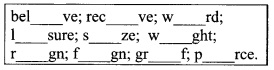
Answer:
- believe
- receive
- weird
- leisure
- seize
- weight
- reign
- feign
- grief
- pierce
(The rule ‘i’ before ‘e’ except after ‘c’ works for most words, but there are exceptions like ‘weird’ and ‘seize’.)
II. Here are some words with silent letters. Learn their spelling. Your teacher will dictate these words to you. Write them down and underline the silent letters.
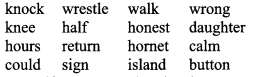
Answer:
- knock
- knee
- hours
- could
- wrestle
- walk
- wrong
- half
- honest
- daughter
- return
- hornet
- calm
- sign
- island
- button
III. How to look at an Index
An index is a list of names or topics that are to be found in a book. It is a list arranged in alphabetical order at the end of a book. The following paragraph shows that the doctor is consulting the index of a medical book to find out which injection is appropriate for Bruno.
“Out came his medical books, and a feverish reference to index began: What poison did you say, sir ?” “Barium carbonate”, “Ah yes—B—Ba— Barium Salts—Ah ! Barium carbonate! Symptoms—paralysis—treatment— injections of… Just a minute, sir. I’ll bring my syringe and the medicine.”
Q1.You have read about the French Revolution and you want to know more about the Third Estate in the context of the French Revolution. You can refer to the index of the book Living World History by T. Walter Wallbank and Arnold Schrier:
French-Algerian War, 696
French and Indian War, 370, 401
French Revolution, 393, 404-405, 408, 427, 489
Freud (froid), Sigmund [1856-1939], 479, illus. 477
Frobisher (frŌ’bish cr), Martin [1535-1594], 321,338
Third Coalition, 415
Third Communist International See Comintern
Third Estate (France), 404, 405
Third Reform Bill, 454
Third Reich (rîH), 641, 643, 652, 653
On which pages in this book will you find information about the French Revolution and the Third Estate?
Answer:
French Revolution, 393, 404-405, 408, 427,489
Third Estate (France), 404-405
Q2. To know what ‘Food Security’ and ‘Minimum Support Price’ mean in the context of the economic growth of a country you can go to the subject index given below from Poverty and Famines— An Essay on Entitlement and Deprivation by Amartya Sen. Under which heading in the index are you likely to find these topics?
Famine relief, 43, 57, 87-8, 96-8, 116-17, 131-2
Fishermen, 51, 67-9, 71, 72-3, 78, 119
Finland, 213
Floods, 52-3, 58, 131-2, 147-8
Food availability decline (FAD thesis),
6-7, 7-8,41-2,43-4, 53, 57-63, 80-1,82-3, 88-93, 111, 117-20,125 137,141,153, 154-6, 157-8, 162
Food countermovement, 94, 138, 160-2
Food habits, 12-3, 25-6,45, 50, 164
Answer:
Famine relief, 43,57,87-8,96-8,116-17, 131-2.
Q3. Given below is a portion of an Index page from the book French’s Index of Differential Diagnosis, edited by F. Dudley Hart M.D., F.R.C.P.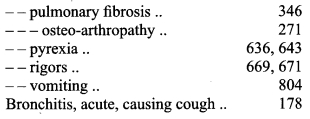
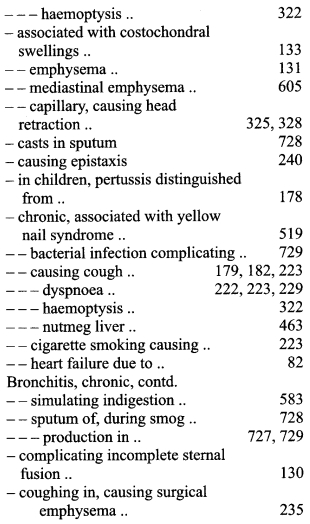
Study the entries and find out whether the following topics are discussed in the book.
- bronchitis due to cigarette smoking
- heart failure due to bronchitis
- bronchitis in children
Answer:
- Yes, page 223 under Bronchitis, acute, causing.
- Heart failure due to … page 82.
- Yes, page 178.
IV.
1. The Narrative Present
Q1. Can you rewrite the paragraph in complete sentences?
Answer: The vet and I made a dash back to the car. Bruno was still floundering about on his stumps but was clearly weakening rapidly. He was vomiting, breathing heavily with heaving flanks and a gaping mouth. We held him and the doctor gave him a hypodermic injection. 10 c.c. of the antidote entered his system without a drop being wasted. Ten minutes later, his condition was unchanged. Another 10 c.c was injected. Ten minutes later, his breathing was less stertorous. Bruno could move his arms and legs a little, although he could not stand yet. Thirty minutes later, Bruno got up and had a great feed. He looked at us disdainfully, as if to say, ‘What’s barium carbonate to a big black bear like me?’. Bruno was still eating.
Q2. Adverbs
Find the adverbs in the passage below.
(You ve read about adverbs in unit 1)
We thought that everything was over when suddenly a black sloth-bear came out panting in the hot sun. Now I will not shoot a sloth-bear wantonly but, unfortunately for the poor beast, one of my companions did not feel that way about it, and promptly shot the bear on the spot.
Answer: The adverbs in the passage are: suddenly, wantonly, unfortunately, promptly.
(i) Complete the following sentences, using a suitable adverb ending in -ly.
(a) Rana does her homework …………..
(b) It rains ………….. in Mumbai in June.
(c) He does his work …………..
(d) The dog serves his master …………..
Answer:
(a) Rana does her homework carefully.
(b) It rains heavily in Mumbai in June.
(c) He does his work efficiently.
(d) The dog serves his master loyally.
(ii) Choose the most suitable adverbs or adverbial phrases and complete the following sentences.
(a) We should get down from a moving train, (never, sometimes, often)
(b) I was in need of support after my poor performance, (badly, occasionally, sometimes)
(c) Rita met with an accident. The doctor examined her (suddenly, seriously, immediately)
Answer:
(a) We should never get down from a moving train.
(b) I was badly in need of support after my poor performance.
(c) Rita met with an accident. The doctor examined her immediately.
Q3. Take down the following scrambled version of a story… Then, read the scrambled story carefully and try to rewrite it rearranging the incidents.
A grasshopper, who was very hungry, saw her and said, “When did you get the corn?
I am dying of hunger.” She wanted to dry them. It was a cold winter’s day, and an ant was bringing out some grains of com from her home, She had gathered the com in summer.
“I was singing all day,” answered the grasshopper.
“If you sang all summer,” said the ant, “you can dance all winter.”
“What were you doing?” asked the ant again.
The grasshopper replied, “I was too busy.”
“I collected it in summer,” said the ant. “What were you doing in summer?
Why did you not store some com?”
Answer: It was a cold winter’s day, and an ant was bringing out some grains of corn from her home. She had gathered the corn in summer and wanted to dry them. A grasshopper, who was very hungry, saw her and said, “When did you get the corn? I am dying of hunger.” “I collected it in summer,” said the ant. “What were you doing in summer? Why did you not store some corn?” The grasshopper replied, “I was too busy.” “What were you doing?” asked the ant again. “I was singing all day,” answered the grasshopper. “If you sang all summer,” said the ant, “you can dance all winter.”
Speaking
‘Animals also feel the pleasure of love and the pain of separation’.
Make a presentation by giving examples from your own experience
Answer: This is a speaking activity and does not have a single written solution..
Writing
Q1. Pets have unique care and handling requirements and should only be kept by those with the commitment to understand and meet their needs. Give your argument in support of or against this statement.
Answer:
In favour of the Motion, Pets play a significant role in the life of its owner. They become the members of the family. Animals do have emotions and sentiments. They play the role of a father, a mother and a brother/sister. They need to be tackled properly and utmost care. I am of the opinion that pets give us happiness and assist us in regaining confidence in the trying circumstances. These pets need proper care and love. Those who fulfil their requirements become the most fortunate people because they get true friends. It’s very difficult to get a worthy and honest friend in this commercial world. But animals reciprocate love and take care of the entire family. I strongly say that animals should be treated amiably and amicably.
Q2. There is an on-going debate whether snake charmers should continue in their profession. You can get some idea about the debate from the newspaper clipping (The Hindu, 16 June 2004) given below. Read it, discuss in pairs or groups, and write either for or against the profession of snake charmers.
Report comes in support of snake charmers
Answer:
For self-attempt.
Report comes in support of snake charmers
By Our Staff Reporter
New Delhi, June 15. Over 30 years after the introduction of the Wildlife Protection Act (WPA) that banned the catching of snakes in India, a small community of snake charmers continues to practise the trade catching over 400,000 snakes every year — which ultimately die — in defiance of the law.
A report based on new research by the Wildlife Trust of India (WTI), however, has strongly recommended that the traditional knowledge of the snake charmers and skills be now utilised for education and medicine by setting up sapera centres. This is mainly because the community has virtually no access to land, education or employment opportunities. They are dependent on snake charming to earn a livelihood. They trade around as vendors of traditional medicine, snake catchers and musicians. Ignorance about the law is quite common.
The report entitled ‘Biodiversity, Livelihoods and the Law: The Case of the Jogi-Nath Snake Charmers of India’ based on path-breaking research was formally released by the Inspector General of Forests, V.K. Bahuguna, along with a presentation by members of the sapera community in the Capital on Monday.
“Despite thirty years of the law being in existence, over 70 per cent of the Jogi-Naths are still dependent on snake charming to earn a livelihood. Ignorance about the law was quite common. None of them own land, even though they would like to,” said Bahar Dutt, who led this research. Notably, most of those practising the trade in the current generation are all under 35 years of age.
Trapping occurs throughout the year and during their travels, though this activity increases during the monsoons. According to the data, each family on an average collects at least seven snakes.
Most snakes were force-fed and snake husbandry methods and health were found to be poor. “The snake charmers community council imposes a heavy fine on a person if the snake dies in his custody as it is considered an extremely bad omen. As a result, the snakes are released when the charmers realise that their condition is deteriorating,” said Dutt. Their ambition to showcase the reptiles and earn money was not fulfilled, as they flouted four WPA provisions, for illegally possessing the animals, not feeding them properly, causing injuries by extracting teeth unscientifically and killing snakes for the valuable snake parts and bones. Their offence generally invites imprisonment for three to seven years and a fine up to Rs 25,000 in each case.
“On the positive side researchers found that the snake charmers possess a unique ability to handle venomous snakes with a tremendous knowledge of the different species and their behaviour. They are also called by local farmers to retrieve snakes, who would otherwise just kill them, from agricultural fields or human inhabited areas,” she said.