
SEBA Class 10 Social Science Economics Chapter 1 Financial Literacy Question Answer
By Jamal Ali (M.Sc Physics, 5+ years teaching experience) · Reviewed by Editorial Board
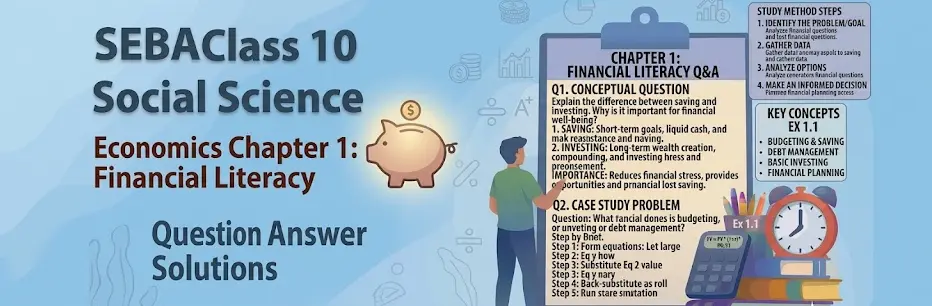
SEBA Class 10 Social Science Economics Chapter 1 Financial Literacy Question Answer is prepared according to the latest ASSEB Division-I syllabus and the updated textbook released in March 2026. These solutions are written in simple and student-friendly language to help HSLC students understand important concepts clearly.
This chapter covers important topics related to banking, digital payments, financial markets, cyber frauds, and financial institutions. Students preparing for the examination can also practice SEBA Class 10 Social Science Chapterwise MCQs for better revision and exam preparation.
The solutions provided here will help students improve conceptual understanding, practice important questions, and prepare effectively for the HSLC examination based on the latest ASSEB academic updates.
Class 10 Social Science Economics Chapter 1 Financial Literacy Solutions Assam Board
Very Short Answer Type Questions
Q1. What is bank?
Answer: A bank is a financial institution that accepts money from people as savings and provides loans to those who need financial support. It also offers different banking services to customers.
Q2. What is debit card?
Answer: A debit card is a card provided by a bank that allows account holders to withdraw money, make online payments, and pay digitally using the money available in their bank account.
Q3. In which year was the Reserve Bank of India set up?
Answer: The Reserve Bank of India was established in the year 1935.
Q4. Give an example of UPI App.
Answer: Some popular examples of UPI apps are Paytm, PhonePe, Google Pay, and BHIM.
Q5. What is current deposit?
Answer: A current deposit is a type of bank account from which money can be deposited or withdrawn at any time according to the needs of the account holder.
Q6. Mention one type of financial instrument.
Answer: Stock is one type of financial instrument.
Q7. What is the other name of primary market?
Answer: The primary market is also called the New Issues Market (NIM).
Q8. SEBI was established in which year?
Answer: SEBI was established on 12th April, 1992.
Q9. What is Systematic Investment Plan (SIP)?
Answer: A Systematic Investment Plan (SIP) is a method of investing a fixed amount of money regularly in mutual funds over a certain period of time.
Q10. Mention one precaution to be taken against cyber fraud?
Answer: One important precaution against cyber fraud is to use strong passwords that are difficult for others to guess and avoid sharing personal banking details with unknown people.
Short Answer Type Questions
Q1. What are the functions of the Regional Rural Banks?
Answer: The functions of Regional Rural Banks are:
- It provides loans to villagers at low interest rates.
- To free rural people from private moneylenders.
- It encourages rural savings.
- It encourages invest savings in productive activities.
Q2. Amount transfer using internet banking can be done through which methods?
Answer: Amount transfer through internet banking can be done through NEFT, RTGS, and IMPS. These methods help people transfer money quickly and securely from one bank account to another.
Q3. State the different types of banking cards?
Answer: The two important types of banking cards are:
- Debit Card – It uses the money available in the user’s bank account.
- Credit Card – It allows the user to borrow money from the bank up to a certain limit.
Q4. How are Non-Banking Financial Institutions different from banks?
Answer: Non-Banking Financial Institutions are different from banks because money cannot be withdrawn through cheques from NBFIs. Also, deposits in banks are protected under deposit insurance schemes, while NBFIs generally do not provide such protection.
Q5. What is Unified Payments Interface and its features?
Answer: Unified Payments Interface (UPI) is a digital payment system that allows instant transfer of money between bank accounts using mobile phones.
Features of Unified Payments Interface are:
- It helps in Instant transfer of money.
- It gives facilities like payments through UPI ID or QR code.
- It is safe and secured transactions using UPI PIN.
- It is easy to make payment for shopping, bills, and online services.
Q6. What are the components of financial market?
Answer: The financial market has two main components:
- Money Market – It deals with short-term financial transactions.
- Capital Market – It deals with long-term investments and securities.
The Capital Market is further divided into the Primary Market and the Secondary Market.
Q7. What are the bonds?
Answer: Bonds are debt instruments issued by companies or governments to borrow money from investors. The borrower pays interest for a fixed period and returns the principal amount on maturity.
Q8. State the precautions in taking financial decisions.
Answer: The following precautions should be taken while making financial decisions. These are :
- We should not borrow money for risky investments.
- Avoiding schemes promising very high returns in a short time.
- To collect proper information before investing.
- To follow RBI and SEBI guidelines carefully.
Q9. What are the types of Cyber Frauds?
Answer: Some common types of cyber frauds are online banking fraud, credit card fraud, phishing, identity theft, investment scams, and ransomware attacks. These frauds are mainly done through the internet to steal money or personal information.
Q10. Write a Brief note on the origin of banks?
Answer: According to Geoffrey Crowther, the early forms of banks were businessmen, gold merchants, and money lenders. The first bank during the Middle Ages was the Bank of Venice in Italy. Over time, the word related to banking changed into “bank” in England. In India, the first bank was the Bank of Hindustan, established in 1770.
Long Answer Type Questions
Q1. Explain any four functions of the Central Bank.
Answer: The four important functions of the Central Bank are:
- The Central Bank has the sole authority to issue currency notes in the country.
- It controls the flow of credit in the economy by regulating the lending activities of commercial banks.
- The Central Bank acts as a bank for commercial banks and helps them during financial difficulties.
- It advises the government on financial matters and manages government accounts and budgetary requirements.
Q2. Explain the precautions to be taken for using Banking cards.
Answer: The following precautions should be taken while using banking cards:
- We should always keep our ATM PIN secret and make sure nobody sees it while entering it.
- We should keep banking cards in a safe place to avoid loss or misuse.
- If a card is lost or stolen, we should immediately inform the bank so the card can be blocked.
- We should never share PIN, CVV number, OTP, or other card details with anyone.
- We should use strong PINs that are difficult to guess.
- Credit cards should be used carefully, and dues should be paid on time to avoid extra charges.
Q3. What are the functions of the commercial banks?
Answer: The main functions of commercial banks are:
- Commercial banks collect deposits from people in the form of savings accounts, current accounts, and fixed deposits.
- They provide loans to farmers, businessmen, industrialists, and other sections of society.
- Banks create credit by lending a major part of deposited money while keeping only a small amount as reserve.
- Commercial banks also provide locker facilities and help customers keep valuable items and documents safely.
Q4. What is financial market/ State the role of financial market.
Answer: A financial market is a place where financial securities like shares and bonds are bought and sold. It helps companies and institutions raise money for business activities.
The roles of financial market are:
- It converts people’s savings into productive investments.
- It directs money towards industries and sectors that require financial support.
- Investors can easily buy or sell securities and convert them into cash.
- It provides financial support for the growth and modernization of industries.
Q5. What is mutual fund? State the reasons why investors prefer mutual funds?
Answer: A mutual fund pools money from different investors and invests it in various securities through a professional fund manager.
Investors prefer mutual funds because they are professionally managed and reduce investment risk through diversification. They also save investors from the difficulty of analyzing individual shares and allow people to start investing with a small amount of money.
Q6. Explain the following:
a) PAN card:
Answer: The Permanent Account Number (PAN) is a ten-digit alphanumeric number issued by the Income Tax Department. It is mainly used for tax-related and financial transactions. PAN card also acts as an important identity proof and is necessary for many banking activities.
b) Aadhaar card:
Answer: Aadhaar card is a 12-digit unique identification number issued by UIDAI. It contains biometric and demographic details of individuals and serves as proof of identity and address. Aadhaar is also useful for banking services and government schemes.
Q7. Briefly explain any two functions of each of the following:
a) IDBI:
Answer: The two functions of IDBI are –
- IDBI offers financial assistance to industries.
- It develops institutions related to the industrial development of the country.
b) RRBs:
Answer: The two functions of RRBs are –
- RRBs provide loans at low interest rates to villagers.
- They mobilise rural savings and invest them in productive activities.
c) NABARD:
Answer: The two functions of NABARD are –
- NABARD acts as the apex financial institution for rural investment and production.
- It coordinates rural development schemes started by the government and RBI.
d) SIDBI:
Answer: The two functions of SIDBI are –
- SIDBI promotes modernization and improved technology in small industries.
- It creates markets for products of small industries.
Q8. What are the precautions an individual needs to take for using Digital Payments?
Answer: The following precautions should be taken while using digital payments:
- We should avoid making digital payments using public Wi-Fi networks because they are less secure.
- We should download banking and payment apps only from trusted and verified sources.
- We should regularly update apps to maintain proper security.
- We should never share OTPs, passwords, UPI PINs, or banking details with anyone.
- Before sending money, we should carefully check the recipient’s details.
- We should remember that a UPI PIN is required only for sending money, not for receiving it.
- We should never scan QR codes to receive money.
Quick Revision Mind Map of Financial Literacy
The following mind map provides a quick revision of important concepts from the Financial Literacy chapter including banking cards, digital payments, financial markets, cyber frauds, and financial institutions.
Banking Cards
- Debit Card
- Credit Card
- Use Strong PIN
- Keep Cards Safe
Digital Payments
- UPI
- NEFT, RTGS, IMPS
- Avoid Public Wi-Fi
- Use Verified Apps
Financial Literacy
Understanding banking, digital payments, financial markets, and safe financial practices.
Financial Market
- Money Market
- Capital Market
- SEBI Regulation
Banks & Institutions
- RRBs
- NABARD
- SIDBI
- Commercial Banks
Financial Documents
- PAN Card
- Aadhaar Card
Cyber Frauds
- Phishing
- Identity Theft
- Online Fraud
Financial Literacy Chapter 1 Solutions for HSLC Examination | Assam Eduverse
Financial Literacy is one of the most practical and useful chapters included in the updated Economics syllabus for Class 10 students. The chapter explains important topics such as banking systems, ATM cards, digital payments, cyber security, financial markets, and financial institutions in a simple and easy-to-understand manner. Since many of these concepts are connected with everyday life, students can easily relate them to real situations like online transactions, UPI payments, and safe banking practices.
The updated textbook released by ASSEB Division-I in March 2026 focuses more on conceptual understanding and practical learning. Instead of only memorising answers, students should try to understand how different financial systems work and why financial awareness is important in modern life. Regular practice of Class 10 Social Science Economics Question Answer Assam Board can help students improve both conceptual clarity and answer-writing skills during examination preparation.
Students should carefully revise important topics like banking precautions, cyber fraud prevention, digital payment systems, and financial market concepts. Many of these topics are not only important for the HSLC examination but are also useful for developing awareness about safe financial behaviour in today’s digital environment.
For better preparation, students should practice writing answers in a clear and organised manner instead of simply learning them by heart. Understanding definitions, writing important points properly, and revising questions regularly can improve confidence as well as presentation skills in examinations.
Students preparing for board examinations can also check the latest SEBA Class 10 Syllabus to understand chapter-wise topic distribution and the updated examination pattern followed by ASSEB Division-I. Studying according to the syllabus helps students prepare important topics more effectively.
The chapter also creates awareness about responsible use of digital services and modern financial tools. Topics related to online payment safety, fraud prevention, and banking systems are becoming increasingly important because digital financial transactions are now a regular part of daily life.
Students searching for HSLC Economics Chapter 1 Financial Literacy Solutions should focus on regular revision, proper understanding of concepts, and consistent answer-writing practice. Solving chapter-wise questions multiple times can help students become more confident before the examination.
In conclusion, this chapter provides students with both academic knowledge and practical understanding of modern financial systems. With proper revision, regular practice, and a clear understanding of important concepts, students can strengthen their preparation for the HSLC examination while also developing useful financial awareness for everyday life.
FAQs – Financial Literacy Chapter (Class 10 Economics)
1. Why is Financial Literacy important for Class 10 students?
Financial Literacy helps students understand banking systems, digital payments, cyber safety, and modern financial practices. It also creates awareness about safe online transactions and financial decision-making in daily life.
2. Which topics are included in the Financial Literacy chapter?
This chapter mainly includes banking, ATM and credit cards, UPI payments, cyber frauds, financial markets, financial institutions, and precautions related to digital transactions.
3. Is the revised Economics chapter based on the new ASSEB textbook?
Yes, the chapter follows the revised textbook introduced by ASSEB Division-I in March 2026 for HSLC students studying under the updated curriculum.
4. How should students prepare Economics chapters for the HSLC examination?
Students should focus on understanding concepts clearly, revising important definitions, practicing chapter-wise questions regularly, and improving answer-writing skills through consistent revision.
5. How can students improve preparation for Social Science examinations?
Students can improve preparation by following the latest syllabus, revising important questions regularly, practicing MCQs, and understanding important concepts from the updated textbook.
🎓 About Assam Eduverse
Assam Eduverse is an educational platform dedicated to providing study resources for students under SEBA, AHSEC, ASSEB, SCERT, and CBSE.
The platform provides chapter-wise notes, solutions, MCQs, important questions, and previous year papers for students of Class 9–12 according to the latest exam pattern and updated Assam Board syllabus.
Both Assamese and English medium resources are available to help students improve conceptual understanding, revision, and examination preparation.
Students can explore MCQs, study materials, solutions, and exam preparation guides for better learning and revision.