
SEBA Class 10 Maths Chapter 2 Exercise 2.1 Solutions – Polynomials
By Jamal Ali (M.Sc Physics, 5+ years teaching experience) · Reviewed by Editorial Board
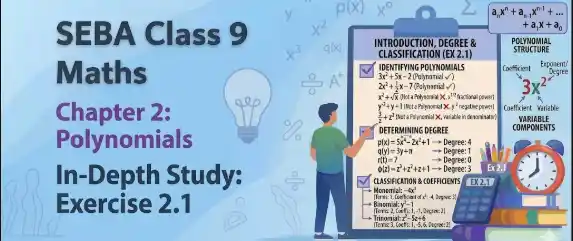
SEBA Class 10 Maths Chapter 2 Exercise 2.1 Solutions provides a focused approach to understanding one of the most important concepts in algebra—the number of zeroes of a polynomial using graphs. As per the latest ASSEB Division 1 syllabus (March 2026), this exercise is highly scoring and forms a key part of the Polynomials chapter, contributing significantly to the overall 8–10 marks weightage.
In this exercise, students learn how to determine the number of zeroes by observing graphical representations of polynomials. To build a strong foundation, you can also refer to complete polynomials chapter solutions and strengthen concepts through SEBA Class 10 Maths chapterwise solutions. These resources help in better understanding and structured preparation.
Practicing SEBA Class 10 Maths chapter 2 important questions exercise 2.1 along with SEBA HSLC Maths polynomials ex 2.1 solved questions improves accuracy in interpreting graphs and answering MCQs effectively. Students can also use SEBA Class 10 Maths polynomials exercise 2.1 solutions pdf for quick revision. All solutions are prepared by subject experts of Assam Eduverse and reviewed for accuracy as per the latest board guidelines.
SEBA Class 10 Maths Chapter 2 Exercise 2.1 Solutions with Step-by-Step Answers & Important Questions
Q1. The graphs of y = p(x) are given below for some polynomials p(x). Find the number of zeroes of p(x), in each case.
Answer:
To find the number of zeroes of a polynomial, we count how many times its graph intersects the x-axis.
(i) The graph does not intersect the x-axis.
Number of zeroes = 0
(ii) The graph intersects the x-axis at one point.
Number of zeroes = 1
(iii) The graph intersects the x-axis at three points.
Number of zeroes = 3
(iv) The graph intersects the x-axis at two points.
Number of zeroes = 2
(v) The graph intersects the x-axis at four points.
Number of zeroes = 4
(vi) The graph intersects the x-axis at three points.
Number of zeroes = 3
Extra Practice Questions – Number of Zeroes of Polynomials
These questions will help you understand how to identify the number of zeroes of a polynomial using graphs and equations.
Q1. How many zeroes does the polynomial \(p(x) = x^2 - 4\) have?
Answer:
\(x^2 - 4 = (x-2)(x+2)\)
So, zeroes = 2
Q2. How many zeroes does the polynomial \(p(x) = x^3 - x\) have?
Answer:
\(x(x^2 -1) = x(x-1)(x+1)\)
Zeroes = 3
Q3. How many zeroes does \(p(x) = x^2 + 1\) have?
Answer:
No real solution
Zeroes = 0
Q4. If a graph cuts the x-axis at 3 distinct points, how many zeroes does the polynomial have?
Answer:
Number of zeroes = 3
Q5. If a graph touches the x-axis at one point and does not cross it, how many zeroes does it have?
Answer:
Touching also counts as zero
Zeroes = 1
Q6. If a polynomial graph cuts the x-axis at 5 points, what is the number of zeroes?
Answer:
Zeroes = 5
Q7. How many zeroes does \(p(x) = 2x + 3\) have?
Answer:
Linear polynomial
Zeroes = 1
Q8. If a graph does not intersect the x-axis, what can you say about zeroes?
Answer:
No intersection means no real zero
Zeroes = 0
Q9. The number of zeroes of a polynomial is equal to
(a) Degree of polynomial
(b) Number of times graph cuts x-axis
(c) Number of variables
(d) Value of polynomial
Answer: (b) Number of times graph cuts x-axis
Zeroes are points where graph intersects x-axis.
Q10. If a graph touches the x-axis twice, number of zeroes is
(a) 0
(b) 1
(c) 2
(d) 3
Answer: (c) 2
Each touching point counts as a zero.
Q11. A quadratic polynomial can have maximum how many zeroes?
(a) 1
(b) 2
(c) 3
(d) 4
Answer: (b) 2
Degree 2 → maximum 2 zeroes.
Q12. A cubic polynomial can have maximum how many zeroes?
(a) 2
(b) 3
(c) 4
(d) 1
Answer: (b) 3
Degree 3 → maximum 3 zeroes.
Q13. If a graph intersects x-axis 4 times, what is minimum degree?
Answer:
Minimum degree = 4
Q14. How many zeroes does constant polynomial \(p(x) = 5\) have?
Answer:
It never becomes zero
Zeroes = 0
Q15. If graph cuts x-axis at negative and positive values both, what can you say?
Answer:
Polynomial has both positive and negative zeroes
Q16. If graph intersects x-axis only once, polynomial is
(a) Linear
(b) Quadratic
(c) Constant
(d) None
Answer: (a) Linear
Linear graphs intersect x-axis once.
Q17. If a polynomial has 0 zeroes, what does its graph look like?
Answer:
Graph does not touch or cut x-axis
Q18. If graph crosses x-axis 2 times and touches once, total zeroes?
Answer:
2 crossings + 1 touching = 3 zeroes
Q19. If degree of polynomial is 5, maximum zeroes?
Answer:
Maximum zeroes = 5
Q20. Can a polynomial have infinite zeroes?
Answer:
No, a polynomial has finite number of zeroes.
📚 Explore More SEBA Class 10 Learning Resources
• Improve your preparation with SEBA Class 10 Assamese Medium chapterwise question answers for better understanding in your preferred language.
• Get subject-wise clarity through Class 10 Science chapter-wise solutions (SEBA) to strengthen core concepts and numerical problem-solving.
• Prepare theory subjects effectively with SEBA Class 10 Social Science chapter-wise solutions covering history, geography, and civics in detail.
• For elective subject preparation, explore Class 10 Elective Geography chapter-wise solutions aligned with the latest Assam Board syllabus.
• Access complete Assamese medium resources from Assam Board Assamese medium solutions hub for all subjects as per the updated 2026 curriculum.
SEBA Class 10 Maths Chapter 2 Exercise 2.1 Solutions – Smart Strategy for HSLC Success | Assam Eduverse
Building a clear understanding of SEBA Class 10 Maths Chapter 2 Exercise 2.1 Solutions is essential for mastering the basics of polynomials. This exercise focuses on identifying the number of zeroes of a polynomial through graphical representation, which is a fundamental concept in algebra. Since this chapter carries around 8–10 marks in the HSLC examination, Exercise 2.1 plays a crucial role in scoring well.
As per the latest exam guidelines, students should be prepared for both MCQs and descriptive problem-solving questions from this exercise. Graph-based questions are commonly asked in objective format, while conceptual explanations and step-based answers appear in descriptive sections. This makes it important to develop both speed and clarity while solving problems.
By practicing SEBA HSLC Maths polynomials ex 2.1 solved questions, students can clearly understand how graphs intersect the x-axis and how that determines the number of zeroes. This concept is highly scoring if practiced properly. To strengthen your basics further, you can also refer to complete polynomials chapter solutions, which provide a broader understanding of the entire chapter.
Students should regularly solve SEBA Class 10 Maths chapter 2 important questions exercise 2.1 to improve accuracy and confidence. These questions are often based on exam trends and help in understanding how concepts are applied in different ways. For structured preparation, referring to chapterwise maths solutions ensures that no concept is left uncovered.
For revision purposes, using SEBA Class 10 Maths polynomials exercise 2.1 solutions pdf can be very helpful. It allows students to quickly go through all important questions before exams. However, it is important to combine revision with regular writing practice. You can also explore Class 9 and 10 study materials to strengthen your overall Mathematics preparation.
Students must also ensure they are following the latest Mathematics textbook updated in March 2026. Studying from outdated materials may lead to confusion or incorrect preparation. Assam Eduverse provides updated and expert-reviewed solutions that strictly follow the current ASSEB guidelines.
To gain more confidence, students can practice additional problems from chapterwise question answers and also move ahead to Exercise 2.2 solutions for deeper understanding of polynomial concepts.
Consistent practice, conceptual clarity, and proper revision are the keys to mastering this exercise. By thoroughly practicing SEBA Class 10 Maths Chapter 2 Exercise 2.1 Solutions, students can confidently solve graph-based questions and improve their performance in both objective and descriptive sections.
In conclusion, focusing on understanding graphs, practicing important questions, and revising regularly will help students maximize their scores. With high-quality and updated resources from Assam Eduverse, students can stay ahead in their preparation and achieve excellent results in the HSLC Mathematics examination.
FAQs – Exercise 2.1 Polynomials (Class 10 Maths)
1. How do you find the number of zeroes of a polynomial from a graph?
The number of zeroes is equal to the number of times the graph of the polynomial intersects or touches the x-axis. Each intersection point represents one zero of the polynomial.
2. Why is Exercise 2.1 important for HSLC Maths preparation?
This exercise builds the basic understanding of graphs and zeroes, which is frequently tested in both objective and descriptive questions. It also forms the foundation for advanced concepts in the chapter.
3. What type of questions are usually asked from this exercise in exams?
Students are generally asked to identify the number of zeroes from given graphs or match graphs with polynomials. These questions often appear in MCQ format as well as short-answer questions.
4. What is the best way to practice graph-based polynomial questions?
The best approach is to observe different graph patterns, practice regularly, and understand how curves behave near the x-axis. Consistent practice improves accuracy and confidence in exams.
🎓 About Assam Eduverse
Assam Eduverse is an educational platform focused on providing study resources for students under SEBA, AHSEC (ASSEB), SCERT, and CBSE.
The platform offers chapter-wise notes, solutions, MCQs, important questions, and previous year papers for Class 9–12. All materials are prepared according to the latest Assam Board syllabus and follow current exam patterns.
Content is designed to help students understand concepts clearly, practice regularly, and improve performance in board examinations. Both Assamese and English medium resources are available to support different learning needs.
Explore MCQs, study materials, solutions, and exam preparation guides to strengthen preparation and revision. 📘 Visit Assam Eduverse for free Assam Board Solutions, notes, and Study Materials prepared by experts.