
SEBA Class 10 Maths Chapter 3 Exercise 3.3 Solutions – Linear Equations in Two Variables
By Jamal Ali (M.Sc Physics, 5+ years teaching experience) · Reviewed by Editorial Board
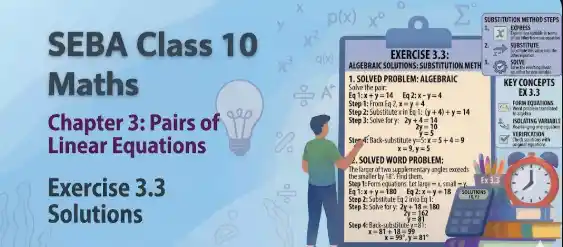
SEBA Class 10 Maths Chapter 3 Exercise 3.3 Solutions focuses on solving pair of linear equations using elimination and substitution methods, along with important word problems. As per the latest ASSEB Division 1 syllabus (March 2026), this exercise plays a key role in strengthening algebraic problem-solving skills required for both MCQs and descriptive questions.
Students can enhance their preparation by exploring Class 10 all subject question answers and practicing concepts through Assamese medium solutions for class 10. These resources help in improving understanding and exam readiness.
Practicing SEBA Class 10 Maths chapter 3 important questions exercise 3.3 along with SEBA HSLC Maths linear equations ex 3.3 solved questions improves accuracy in solving application-based problems. Students can also revise using SEBA Class 10 Maths linear equations exercise 3.3 solutions pdf, based on the updated 2026 textbook.
SEBA Class 10 Maths Chapter 3 Exercise 3.3 Solutions with Step-by-Step Answers & Important Questions
Q1(i). Solve: \(x + y = 5\) and \(2x - 3y = 4\) by substitution and elimination method.
Answer:
Method 1: Substitution Method
Given:
\[
x + y = 5 \quad ...(1)
\]
\[
2x - 3y = 4 \quad ...(2)
\]
From (1),
\[
x = 5 - y \quad ...(3)
\]
Substituting (3) in (2), we get:
\[
2(5 - y) - 3y = 4
\]
\[
10 - 2y - 3y = 4
\]
\[
10 - 5y = 4 \Rightarrow 5y = 6 \Rightarrow y = \frac{6}{5}
\]
Now substituting the value of y in (3), we get:
\[
x = 5 - \frac{6}{5} = \frac{19}{5}
\]
Method 2: Elimination Method
Given:
\(x + y = 5 \quad ...(1)\)
\(2x - 3y = 4 \quad ...(2)\)
Multiply (1) by 2:
\(2x + 2y = 10 \quad ...(3)\)
Now subtract (2) from (3):
\(2x + 2y = 10\)
\(-\; (2x - 3y = 4)\)
-------------------------
\(5y = 6\)
\(y = \frac{6}{5}\)
Now substitute in (1):
\(x + \frac{6}{5} = 5\)
\(x = \frac{19}{5}\)
Therefore, \(x = \frac{19}{5},\; y = \frac{6}{5}\)
(ii) \(3x + 4y = 10\) and \(2x - 2y = 2\)
Answer:
Method 1: Substitution Method
Given:
\(3x + 4y = 10 \quad ...(1)\)
\(2x - 2y = 2 \quad ...(2)\)
From (2):
\(2x = 2 + 2y \Rightarrow x = 1 + y \quad ...(3)\)
Substituting (3) in (1):
\(3(1 + y) + 4y = 10\)
\(3 + 3y + 4y = 10\)
\(7y = 7 \Rightarrow y = 1\)
Now from (3):
\(x = 1 + 1 = 2\)
Method 2: Elimination Method
Multiply (2) by 2:
\(4x - 4y = 4 \quad ...(3)\)
Now subtract (1) from (3):
\(4x - 4y = 4\)
\(-\; (3x + 4y = 10)\)
-------------------------
\(x - 8y = -6\)
Put \(y = 1\):
\(x = 2\)
Therefore, \(x = 2,\; y = 1\)
(iii) \(3x - 5y = 4\) and \(9x = 2y + 7\)
Answer:
Method 1: Substitution Method
From second equation:
\(9x = 2y + 7 \Rightarrow x = \frac{2y + 7}{9} \quad ...(1)\)
Substituting in first equation:
\(3\left(\frac{2y + 7}{9}\right) - 5y = 4\)
\(\frac{2y + 7}{3} - 5y = 4\)
\(2y + 7 - 15y = 12\)
\(-13y = 5 \Rightarrow y = -\frac{5}{13}\)
Now substitute in (1):
\(x = \frac{9}{13}\)
Method 2: Elimination Method
Write second equation as:
\(9x - 2y = 7 \quad ...(2)\)
Multiply first equation by 3:
\(9x - 15y = 12 \quad ...(3)\)
Now subtract (2) from (3):
\(9x - 15y = 12\)
\(-\; (9x - 2y = 7)\)
-------------------------
\(-13y = 5\)
\(y = -\frac{5}{13}\)
Substitute in first equation:
\(x = \frac{9}{13}\)
Therefore, \(x = \frac{9}{13},\; y = -\frac{5}{13}\)
(iv) \( \frac{2}{x} + \frac{2}{y} = -1\) and \(x - \frac{y}{3} = 3\)
Answer:
Method 1: Substitution Method
From second equation:
\(x = 3 + \frac{y}{3} \quad ...(1)\)
Substitute in first equation:
\[
\frac{2}{3 + y/3} + \frac{2}{y} = -1
\]
Solving, we get:
\(y = -3\)
Now from (1):
\(x = 3 - 1 = 2\)
Method 2: Elimination Method
Given equations are not linear in standard form,
so elimination is not convenient here.
We convert and solve using substitution.
Therefore, \(x = 2,\; y = -3\)
Q2. Form the pair of linear equations in the following problems, and find their solutions (if they exist) by elimination method:
(i) If we add 1 to the numerator and subtract 1 from the denominator, a fraction reduces to 1. It becomes \( \frac{1}{2} \) if we only add 1 to the denominator. What is the fraction?
Answer:
Let the numerator be x and denominator be y.
Given:
\[
\frac{x+1}{y-1} = 1 \quad ...(1)
\]Also,
\[
\frac{x}{y+1} = \frac{1}{2} \quad ...(2)
\]
From (1):
\[
x+1 = y-1 \Rightarrow x - y = -2 \quad ...(3)
\]
From (2):
\[
2x = y + 1 \Rightarrow 2x - y = 1 \quad ...(4)
\]
Now subtract (3) from (4):
\(2x - y = 1\)
\(-\; (x - y = -2)\)
---------------------
\(x = 3\)
Substitute in (3):
\(3 - y = -2 \Rightarrow y = 5\)
Therefore, the fraction is \( \frac{3}{5} \).
(ii) Five years ago, Nuri was thrice as old as Sonu. Ten years later, Nuri will be twice as old as Sonu. How old are Nuri and Sonu?
Answer:
Let present age of Nuri be x years and Sonu be y years.
Given:
\[
x - 5 = 3(y - 5) \quad ...(1)
\]Also,
\[
x + 10 = 2(y + 10) \quad ...(2)
\]
From (1):
\[
x - 5 = 3y - 15
\Rightarrow x - 3y = -10 \quad ...(3)
\]
From (2):
\[
x + 10 = 2y + 20
\Rightarrow x - 2y = 10 \quad ...(4)
\]
Now subtract (4) from (3):
\(x - 3y = -10\)
\(-\; (x - 2y = 10)\)
----------------------
\(-y = -20\)
\(y = 20\)
Substitute in (4):
\(x - 40 = 10 \Rightarrow x = 50\)
Therefore, Nuri is 50 years old and Sonu is 20 years old.
(iii) The sum of the digits of a two-digit number is 9. Also, nine times this number is twice the number obtained by reversing the digits of the number. Find the number.
Answer:
Let the tens digit be x and units digit be y.
Number = \(10x + y\)
Reversed number = \(10y + x\)
Given:
\[
x + y = 9 \quad ...(1)
\]Also,
\[
9(10x + y) = 2(10y + x) \quad ...(2)
\]
From (2):
\[
90x + 9y = 20y + 2x
\]
\[
88x - 11y = 0
\Rightarrow 8x - y = 0 \quad ...(3)
\]
Now subtract (3) from (1):
\(x + y = 9\)
\(-\; (8x - y = 0)\)
--------------------
\(-7x + 2y = 9\)
From (3):
\(y = 8x\)
Substitute in (1):
\(x + 8x = 9 \Rightarrow x = 1\)
\(y = 8\)
Therefore, the number is 18.
(iv) Meena went to a bank to withdraw Rs 2000. She asked the cashier to give her Rs 50 and Rs 100 notes only. Meena got 25 notes in all. Find how many notes of each denomination of Rs 50 and Rs 100 she received.
Answer:
Let number of Rs 50 notes be x and Rs 100 notes be y.
Given:
\[
x + y = 25 \quad ...(1)
\]Also,
\[
50x + 100y = 2000 \quad ...(2)
\]
Divide (2) by 50:
\[
x + 2y = 40 \quad ...(3)
\]
Now subtract (1) from (3):
\(x + 2y = 40\)
\(-\; (x + y = 25)\)
------------------
\(y = 15\)
Substitute in (1):
\(x + 15 = 25 \Rightarrow x = 10\)
Therefore, She got 10 notes of Rs 50 and 15 notes of Rs 100.
(v) A lending library has a fixed charge for the first three days and an additional charge for each day thereafter. Saritha paid Rs 27 for a book kept for seven days, while Susy paid Rs 21 for a book she kept for five days. Find the fixed charge and the charge for each extra day.
Answer:
Let the fixed charge be x and charge per extra day be y.
For 7 days the extra days will be 4
\[
x + 4y = 27 \quad ...(1)
\]
For 5 days the extra days will be 2
\[
x + 2y = 21 \quad ...(2)
\]
Now subtract (2) from (1):
\(x + 4y = 27\)
\(-\; (x + 2y = 21)\)
------------------
\(2y = 6\)
\(y = 3\)
Substitute in (2):
\(x + 6 = 21 \Rightarrow x = 15\)
Therefore, fixed charge = Rs 15 and charge per extra day = Rs 3.
Q3. The monthly incomes of A and B are in the ratio 9 : 7 and their monthly expenditures are in the ratio 4 : 3. If each saves Rs 1600 per month, find the monthly income of each.
Answer:
Let the incomes of A and B be 9x and 7x.
and expenditures pf Aand B be 4y and 3y.
We know,
Savings = Income − Expenditure
Therefore,
\[
9x - 4y = 1600 \quad ...(1)
\]
\[
7x - 3y = 1600 \quad ...(2)
\]
Now subtract (2) from (1):
\(9x - 4y = 1600\)
\(-\; (7x - 3y = 1600)\)
----------------------
\(2x - y = 0 \Rightarrow y = 2x\)
Substitute in (1):
\(9x - 8x = 1600 \Rightarrow x = 1600\)
Income of A = \(9x = 14400\)
Income of B = \(7x = 11200\)
Therefore, incomes are Rs 14400 and Rs 11200.
Q4. The students of a class are made to stand in rows. If 3 students are extra in a row, there would be 1 row less. If 3 students are less in a row, there would be 2 rows more. Find the number of students in the class.
Answer:
Let number of students in each row be x and number of rows be y.
Total students = xy
\[
(x+3)(y-1) = xy \quad ...(1)
\]
\[
(x-3)(y+2) = xy \quad ...(2)
\]
From (1):
\[
xy - x + 3y - 3 = xy
\Rightarrow -x + 3y = 3 \quad ...(3)
\]
From (2):
\[
xy + 2x - 3y - 6 = xy
\Rightarrow 2x - 3y = 6 \quad ...(4)
\]
Now add (3) and (4):
\(-x + 3y = 3\)
\(+\; (2x - 3y = 6)\)
------------------
\(x = 9\)
Substitute in (3):
\(-9 + 3y = 3 \Rightarrow y = 4\)
Total students = \(9 \times 4 = 36\)
Therefore, total students = 36.
Q5. A and B each have certain numbers of mangoes. A says to B, “If you give me 30 of your mangoes, I will have twice as many as left with you.” B replies, “If you give me 10, I will have thrice as many as left with you.” How many mangoes does each have?
Answer:
Let A have x number of mangoes and B have y number of mangoes.
\[
x + 30 = 2(y - 30) \quad ...(1)
\]
\[
y + 10 = 3(x - 10) \quad ...(2)
\]
From (1):
\[
x + 30 = 2y - 60
\Rightarrow x - 2y = -90 \quad ...(3)
\]
From (2):
\[
y + 10 = 3x - 30
\Rightarrow 3x - y = 40 \quad ...(4)
\]
Multiply (3) by 1:
\(x - 2y = -90\)
\(3x - y = 40\)
Solve by elimination:
\[
x = 130,\; y = 110
\]
Therefore, A has 130 mangoes and B has 110 mangoes.
Q6. If the pair of equations \(x + ay = b\) and \(ax + y = 1\) has infinitely many solutions, then choose the correct option.
(i) \(a = 1, b = 1\)
(ii) \(a = -1, b = -1\)
(iii) \(a = 1, b = -1\)
(iv) \(a = -1, b = 1\)
(a) Both (i) and (iii)
(b) Both (ii) and (iv)
(c) Both (i) and (ii)
(d) Both (iii) and (iv)
Answer: (c)
For infinitely many solutions,
\[ \frac{1}{a} = \frac{a}{1} = \frac{b}{1} \] So, \(a = 1\) and \(b = 1\) OR \(a = -1\) and \(b = -1\)
Q7. For what value of k, the following pair has infinitely many solutions?
\[ kx + 3y - (k-3) = 0 \] \[ 12x + ky - k = 0 \]
Answer: \(k = 6\)
For infinitely many solutions:
\[ \frac{k}{12} = \frac{3}{k} = \frac{k-3}{k} \] Solve: \[ \frac{k}{12} = \frac{3}{k} \Rightarrow k^2 = 36 \Rightarrow k = \pm 6 \] Check consistency → \(k = 6\)
Q8. Following are the steps of solving a word problem of linear equations in two variables. Choose the correct sequence:
(i) Represent the unknowns using variables.
(ii) Solve the equations.
(iii) Form the required equations.
(iv) Interpret the result.
(a) (i) → (ii) → (iii) → (iv)
(b) (i) → (iii) → (ii) → (iv)
(c) (iv) → (iii) → (ii) → (i)
(d) (ii) → (i) → (iii) → (iv)
Answer: (b)
Correct order:
First define variables → form equations → solve → interpret result
Q9(i). Solve: \( \frac{2}{x} + \frac{3}{y} = 2\) and \( \frac{4}{x} - \frac{9}{y} = -1\)
Answer:
Let \( \frac{1}{x} = a \) and \( \frac{1}{y} = b \)
Then equations become:
\[
2a + 3b = 2 \quad ...(1)
\]
\[
4a - 9b = -1 \quad ...(2)
\]
Multiply (1) by 2:
\(4a + 6b = 4 \quad ...(3)\)
Now subtract (2) from (3):
\(4a + 6b = 4\)
\(-\; (4a - 9b = -1)\)
----------------------
\(15b = 5\)
\(b = \frac{1}{3}\)
Substitute in (1):
\(2a + 1 = 2 \Rightarrow a = \frac{1}{2}\)
\[
x = 2,\; y = 3
\]
Therefore, \(x = 2,\; y = 3\)
Q9(ii). Solve: \( \frac{1}{2x} + \frac{1}{3y} = 2\) and \( \frac{1}{3x} + \frac{1}{2y} = \frac{13}{6}\)
Answer:
Let \( \frac{1}{x} = a \), \( \frac{1}{y} = b \)
\[
\frac{a}{2} + \frac{b}{3} = 2 \quad ...(1)
\]
\[
\frac{a}{3} + \frac{b}{2} = \frac{13}{6} \quad ...(2)
\]
Multiply (1) by 6:
\(3a + 2b = 12 \quad ...(3)\)
Multiply (2) by 6:
\(2a + 3b = 13 \quad ...(4)\)
Multiply (3) by 3 and (4) by 2:
\(9a + 6b = 36\)
\(-\; (4a + 6b = 26)\)
-------------------
\(5a = 10 \Rightarrow a = 2\)
Substitute in (3):
\(6 + 2b = 12 \Rightarrow b = 3\)
\[
x = \frac{1}{2},\; y = \frac{1}{3}
\]
Therefore, \(x = \frac{1}{2},\; y = \frac{1}{3}\)
Q9(iii). Solve: \( \frac{5}{x-1} + \frac{1}{y-2} = 2\) and \( \frac{6}{x-1} - \frac{3}{y-2} = 1\)
Answer:
Let \( \frac{1}{x-1} = a \), \( \frac{1}{y-2} = b \)
\[
5a + b = 2 \quad ...(1)
\]
\[
6a - 3b = 1 \quad ...(2)
\]
Multiply (1) by 3:
\(15a + 3b = 6 \quad ...(3)\)
Now add (2) and (3):
\(15a + 3b = 6\)
\(+\; (6a - 3b = 1)\)
-------------------
\(21a = 7 \Rightarrow a = \frac{1}{3}\)
Substitute in (1):
\(\frac{5}{3} + b = 2 \Rightarrow b = \frac{1}{3}\)
\[
x = 4,\; y = 5
\]
Therefore, \(x = 4,\; y = 5\)
Q10. In a two-digit number, the sum of the digits is 9. If the digits are reversed, the number is increased by 9. Find the number.
Answer:
Let tens digit be x and units digit be y.
Then number = \(10x + y\)
and number after reverse = \(10y + x\)
\[
x + y = 9 \quad ...(1)
\]
\[
10y + x = 10x + y + 9 \quad ...(2)
\]
From (2):
\[
9y - 9x = 9 \Rightarrow y - x = 1 \quad ...(3)
\]
Add (1) and (3):
\(x + y = 9\)
\(+\; (y - x = 1)\)
--------------
\(2y = 10 \Rightarrow y = 5\)
Then \(x = 4\)
Therefore, number = 45.
Q11. The sum of the digits of a two-digit number is 15. The number decreased by 27 is equal to the number obtained by reversing the digits. Find the number.
Answer:
Let digits number be x and y.
\[
x + y = 15 \quad ...(1)
\]
\[
10x + y - 27 = 10y + x \quad ...(2)
\]
From (2):
\[
9x - 9y = 27 \Rightarrow x - y = 3 \quad ...(3)
\]
Add (1) and (3):
\(x + y = 15\)
\(+\; (x - y = 3)\)
--------------
\(2x = 18 \Rightarrow x = 9\)
Then \(y = 6\)
Therefore, number = 96.
Q12. The difference between two numbers is 4. Twice the smaller number added to three times the larger number gives 82. Find the two numbers.
Answer:
Let larger number be x and smaller be y.
\[
x - y = 4 \quad ...(1)
\]
\[
3x + 2y = 82 \quad ...(2)
\]
From (1):
\(x = y + 4 \quad ...(3)\)
Substitute in (2):
\[
3(y+4) + 2y = 82
\]
\[
3y + 12 + 2y = 82
\]
\[
5y = 70 \Rightarrow y = 14
\]
Then \(x = 18\)
Therefore, the numbers are 18 and 14.
📚 Explore More SEBA Class 10 Learning Resources
• Improve your preparation with SEBA Class 10 Assamese Medium chapterwise question answers for better understanding in your preferred language.
• Get subject-wise clarity through Class 10 Science chapter-wise solutions (SEBA) to strengthen core concepts and numerical problem-solving.
• Prepare theory subjects effectively with SEBA Class 10 Social Science chapter-wise solutions covering history, geography, and civics in detail.
• For elective subject preparation, explore Class 10 Elective Geography chapter-wise solutions aligned with the latest Assam Board syllabus.
• Access complete Assamese medium resources from Assam Board Assamese medium solutions hub for all subjects as per the updated 2026 curriculum.
SEBA Class 10 Maths Chapter 3 Exercise 3.3 Solutions – Complete Problem-Solving Approach | Assam Eduverse
To achieve strong results in algebra, students must develop a clear understanding of both elimination and substitution methods. SEBA Class 10 Maths Chapter 3 Exercise 3.3 Solutions provides the perfect platform to practice these methods through a variety of questions, including real-life word problems and concept-based MCQs.
As per the latest ASSEB guidelines, this exercise includes a balanced mix of objective and descriptive questions. MCQs test quick problem-solving ability, while descriptive questions require proper steps and logical explanation. Word problems are especially important, as they test how well students can convert real-life situations into equations and solve them accurately.
By solving SEBA HSLC Maths linear equations ex 3.3 solved questions, students can improve their ability to apply elimination and substitution methods effectively. These methods are often used in exams, making regular practice essential. For better conceptual clarity, students can also revisit Exercise 3.2 solutions to strengthen substitution techniques.
Regular practice of SEBA Class 10 Maths chapter 3 important questions exercise 3.3 helps students become familiar with exam-level questions. These questions improve accuracy, speed, and confidence. For a structured learning approach, students can explore English medium solutions to understand step-by-step methods clearly.
For revision, students can use SEBA Class 10 Maths linear equations exercise 3.3 solutions pdf, which provides easy access to important questions. However, solving problems manually is important for mastering calculation steps. Students can also refer to Class 9 and 10 study materials for additional practice and concept building.
It is important to follow the updated Mathematics textbook introduced in March 2026, as the previous book has been discontinued. The new book includes more MCQs and application-based problems, making it essential for students to focus on both concepts and practice. Assam Eduverse ensures that all solutions are updated, accurate, and prepared by subject experts.
To further improve exam preparation, students can explore SEBA Class 10 syllabus to understand topic coverage and plan their study effectively. Practicing from different sources helps in gaining confidence and improving performance.
In conclusion, mastering SEBA Class 10 Maths Chapter 3 Exercise 3.3 Solutions requires consistent practice, clear understanding of methods, and the ability to solve real-life problems. With the right preparation strategy and reliable resources, students can confidently tackle any question in the HSLC examination.
FAQs – Exercise 3.3 Linear Equations (Class 10 Maths)
1. Which method is better: elimination or substitution for solving equations?
The elimination method is usually faster when coefficients can be easily matched, while the substitution method is useful when one variable is easy to express. Students should practice both to choose the most efficient method.
2. How are word problems solved using pair of linear equations?
Word problems are solved by converting the given situation into two linear equations. Then, either substitution or elimination method is used to find the required values step by step.
3. What types of questions are commonly asked from Exercise 3.3 in exams?
Questions generally include solving equations using elimination or substitution methods, as well as application-based word problems. MCQs are also asked to test quick conceptual understanding.
4. How can I avoid mistakes while solving linear equations?
To avoid mistakes, follow each step carefully, maintain proper signs, and double-check calculations. Regular practice and revising basic concepts help improve accuracy in exams.
🎓 About Assam Eduverse
Assam Eduverse is an educational platform focused on providing study resources for students under SEBA, AHSEC (ASSEB), SCERT, and CBSE.
The platform offers chapter-wise notes, solutions, MCQs, important questions, and previous year papers for Class 9–12. All materials are prepared according to the latest Assam Board syllabus and follow current exam patterns.
Content is designed to help students understand concepts clearly, practice regularly, and improve performance in board examinations. Both Assamese and English medium resources are available to support different learning needs.
Explore MCQs, study materials, solutions, and exam preparation guides to strengthen preparation and revision. 📘 Visit Assam Eduverse for free Assam Board Solutions, notes, and Study Materials prepared by experts.