
SEBA Class 10 Maths Chapter 2 Exercise 2.2 Solutions – Polynomials
By Jamal Ali (M.Sc Physics, 5+ years teaching experience) · Reviewed by Editorial Board
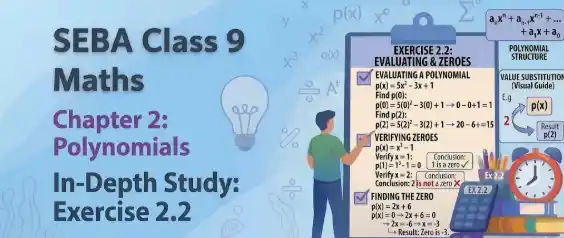
SEBA Class 10 Maths Chapter 2 Exercise 2.2 Solutions helps students master key polynomial concepts like finding zeroes, understanding the relation between sum and product of zeroes, and forming quadratic polynomials. As per the latest ASSEB Division 1 syllabus (March 2026), this exercise is highly important and contributes to the overall 8–10 marks weightage of the chapter.
Students can strengthen their preparation by referring to complete chapter solutions and practicing regularly through chapterwise maths solutions. These resources help in building strong conceptual clarity and exam confidence.
Practicing SEBA Class 10 Maths chapter 2 important questions exercise 2.2 along with SEBA HSLC Maths polynomials ex 2.2 solved questions improves accuracy in both MCQs and descriptive answers. Students can also revise using SEBA Class 10 Maths polynomials exercise 2.2 solutions pdf. All solutions are based on the updated 2026 textbook, as older books are now discontinued.
SEBA Class 10 Maths Chapter 2 Exercise 2.2 Solutions with Step-by-Step Answers & Important Questions
Q1. Find the zeroes of the following quadratic polynomials and verify the relationship between the zeroes and the coefficients.
(i) \(x^2 - 2x - 8\)
Answer:
Given: \(x^2 - 2x - 8\)
Splitting middle term:
\[
x^2 - 4x + 2x - 8
\]
\[
= x(x - 4) + 2(x - 4)
\]
\[
= (x - 4)(x + 2)
\]
Zeroes: \(4, -2\)
Verification:
Sum of zeroes = \(4 + (-2) = 2\)
\[
= \frac{-(-2)}{1} = 2 \quad (RHS)
\]
LHS = RHS
Product of zeroes = \(4 \times (-2) = -8\)
\[
= \frac{-8}{1} = -8 \quad (RHS)
\]
LHS = RHS
(iii) \(6x^2 - 7x - 3\)
Answer:
Given: \(6x^2 - 7x - 3\)
Product = \(6 \times (-3) = -18\)
Split −7x as −9x + 2x
\[
6x^2 - 9x + 2x - 3
\]
\[
= 3x(2x - 3) + 1(2x - 3)
\]
\[
= (2x - 3)(3x + 1)
\]
Zeroes: \( \frac{3}{2}, -\frac{1}{3} \)
Verification:
Sum = \( \frac{3}{2} + (-\frac{1}{3}) = \frac{7}{6} \)
\[
= \frac{-(-7)}{6} = \frac{7}{6}
\]
LHS = RHS
Product = \( \frac{3}{2} \times (-\frac{1}{3}) = -\frac{1}{2} \)
\[
= \frac{-3}{6} = -\frac{1}{2}
\]
LHS = RHS
(vi) \(3x^2 - x - 4\)
Answer:
Given: \(3x^2 - x - 4\)
Product = \(3 \times (-4) = -12\)
Split −x as −4x + 3x
\[
3x^2 - 4x + 3x - 4
\]
\[
= x(3x - 4) + 1(3x - 4)
\]
\[
= (3x - 4)(x + 1)
\]
Zeroes: \( \frac{4}{3}, -1 \)
Verification:
Sum = \( \frac{4}{3} + (-1) = \frac{1}{3} \)
\[
= \frac{-(-1)}{3} = \frac{1}{3}
\]
LHS = RHS
Product = \( \frac{4}{3} \times (-1) = -\frac{4}{3} \)
\[
= \frac{-4}{3}
\]
LHS = RHS
(vii) \(x^2 + 7x + 12\)
Answer:
Given: \(x^2 + 7x + 12\)
Product = \(12\), Sum = \(7\)
Split as 3x + 4x
\[
x^2 + 3x + 4x + 12
\]
\[
= x(x + 3) + 4(x + 3)
\]
\[
= (x + 3)(x + 4)
\]
Zeroes: −3, −4
Verification:
Sum = −3 + (−4) = −7
\[
= \frac{-7}{1}
\]
LHS = RHS
Product = (−3)(−4) = 12
\[
= \frac{12}{1}
\]
LHS = RHS
(x) \(2x^2 - 5x - 7\)
Answer:
Given: \(2x^2 - 5x - 7\)
Product = \(2 \times (-7) = -14\)
Split −5x as −7x + 2x
\[
2x^2 - 7x + 2x - 7
\]
\[
= x(2x - 7) + 1(2x - 7)
\]
\[
= (2x - 7)(x + 1)
\]
Zeroes: \( \frac{7}{2}, -1 \)
Verification:
Sum = \( \frac{7}{2} + (-1) = \frac{5}{2} \)
\[
= \frac{-(-5)}{2} = \frac{5}{2}
\]
LHS = RHS
Product = \( \frac{7}{2} \times (-1) = -\frac{7}{2} \)
\[
= \frac{-7}{2}
\]
LHS = RHS
Q2. Find a quadratic polynomial each with the given numbers as the sum and product of its zeroes respectively.
(i) \( \frac{1}{4}, -1 \)
Answer:
Given:
Sum of zeroes = \( \frac{1}{4} \)
Product of zeroes = \( -1 \)
Quadratic polynomial = \( x^2 - (\text{sum of zeroes})x + (\text{product of zeroes}) \)
\[
= x^2 - \frac{1}{4}x - 1
\]
Multiplying by 4:
\[
= 4x^2 - x - 4
\]
(ii) \( \sqrt{2}, \frac{1}{3} \)
Answer:
Given:
Sum of zeroes = \( \sqrt{2} \)
Product of zeroes = \( \frac{1}{3} \)
Quadratic polynomial = \( x^2 - (\text{sum of zeroes})x + (\text{product of zeroes}) \)
\[
= x^2 - \sqrt{2}x + \frac{1}{3}
\]
Multiplying by 3:
\[
= 3x^2 - 3\sqrt{2}x + 1
\]
(iii) \(0, \sqrt{5}\)
Answer:
Given:
Sum of zeroes = \( \sqrt{5} \)
Product of zeroes = 0
Quadratic polynomial = \( x^2 - (\text{sum of zeroes })x + (\text{product of zeroes}) \)
\[
= x^2 - \sqrt{5}x
\]
(iv) 1, 1
Answer:
Given:
Sum of zeroes = 2
Product of zeroes = 1
Quadratic polynomial = \( x^2 - (\text{sum of zeroes})x + (\text{product of zeroes}) \)
\[
= x^2 - 2x + 1
\]
(v) \( -\frac{1}{4}, \frac{1}{4} \)
Answer:
Given:
Sum of zeroes = 0
Product of zeroes = \( -\frac{1}{16} \)
Quadratic polynomial = \( x^2 - (\text{sum of zeroes})x + (\text{product of zeroes}) \)
\[
= x^2 - \frac{1}{16}
\]
Multiplying by 16:
\[
= 16x^2 - 1
\]
(vi) 4, 1
Answer:
Given:
Sum of zeroes = 5
Product of zeroes = 4
Quadratic polynomial = \( x^2 - (\text{sum of zeroes})x + (\text{product of zeroes}) \)
\[
= x^2 - 5x + 4
\]
Q3. Find the quadratic polynomials whose zeroes are:
(i) −4 and \( \frac{3}{2} \)
Answer:
Given zeroes: −4, \( \frac{3}{2} \)
Sum of zeroes = \( -\frac{5}{2} \)
Product of zeroes = −6
Quadratic polynomial = \( x^2 - (\text{sum of zeroes})x + (\text{product of zeroes}) \)
\[
= x^2 + \frac{5}{2}x - 6
\]
Multiply by 2:
\[
= 2x^2 + 5x - 12
\]
(ii) 5 and 2
Answer:
Given zeroes: 5, 2
Sum of zeroes = 7
Product of zeroes = 10
Quadratic polynomial = \( x^2 - (\text{sum of zeroes})x + (\text{product of zeroes}) \)
\[
= x^2 - 7x + 10
\]
(iii) \( \frac{1}{3} \) and −1
Answer:
Given zeroes: \( \frac{1}{3}, -1 \)
Sum of zeroes = \( -\frac{2}{3} \)
Product of zeroes = \( -\frac{1}{3} \)
Quadratic polynomial = \( x^2 - (\text{sum of zeroes})x + (\text{product of zeroes}) \)
\[
= x^2 + \frac{2}{3}x - \frac{1}{3}
\]
Multiply by 3:
\[
= 3x^2 + 2x - 1
\]
(iv) \( \frac{3}{2} \) and −2
Answer:
Given zeroes: \( \frac{3}{2}, -2 \)
Sum of zeroes = \( -\frac{1}{2} \)
Product of zeroes = −3
Quadratic polynomial = \( x^2 - (\text{sum of zeroes})x + (\text{product of zeroes}) \)
\[
= x^2 + \frac{1}{2}x - 3
\]
Multiply by 2:
\[
= 2x^2 + x - 6
\]
Q4. If α and β are the two zeroes of the polynomial \(x^2 - p(x+1) + c\) such that \((\alpha + 1)(\beta + 1) = 0\), then the value of c is
(a) 1
(b) 2
(c) −1
(d) −2
Answer: (c) −1
Given polynomial: \[ x^2 - p(x+1) + c \] First simplify the polynomial:
\[ = x^2 - px - p + c \] So, comparing with standard form:
\[ a = 1,\; b = -p,\; \text{constant term} = (c - p) \]
Sum of zeroes: \[ \alpha + \beta = p \] Product of zeroes: \[ \alpha \beta = c - p \]
Given: \[ (\alpha + 1)(\beta + 1) = 0 \] \[ \alpha\beta + \alpha + \beta + 1 = 0 \] Substitute: \[ (c - p) + p + 1 = 0 \] \[ c + 1 = 0 \] \[ c = -1 \]
Q5. If \(a-b, a\) and \(a+b\) are the zeroes of the polynomial \(p(x) = x^3 - 3x^2 - 6x + 8\), then the values of a and b are
(i) \(a = 1\)
(ii) \(b = \pm 3\)
(iii) \(a = -1\)
(iv) \(b = a\)
Choose the correct answer:
(a) (i) and (iv)
(b) (i) and (ii)
(c) (iii) and (ii)
(d) (iii) and (iv)
Answer: (b) (i) and (ii)
Given zeroes: \[ a-b,\; a,\; a+b \]
Sum: \[ (a-b) + a + (a+b) = 3a \] From polynomial: \[ = 3 \] So, \[ 3a = 3 \] \[ a = 1 \]
Product: \[ (a-b)(a)(a+b) = a(a^2 - b^2) \] Substitute \(a = 1\): \[ = 1 - b^2 \] From polynomial: \[ = -8 \] \[ 1 - b^2 = -8 \] \[ b^2 = 9 \] \[ b = \pm 3 \]
Q6. Assertion (A): If α and β are the zeroes of the polynomial \(x^2 - 6x + p\) such that \((\alpha + \beta)^2 - 2\alpha\beta = 20\), then the value of p is 1.
Reason (R): The sum and the product of the zeroes of the quadratic polynomial \(ax^2 + bx + c\) are \(-\frac{b}{a}\) and \(\frac{c}{a}\) respectively.
Choose the correct option:
(a) Both Assertion (A) and Reason (R) are true and Reason (R) is the correct explanation
(b) Both Assertion (A) and Reason (R) are true, but Reason is not correct explanation
(c) Assertion is true but Reason is false
(d) Assertion is false but Reason is true
Answer: (a)
From polynomial:
Sum = \(6\), Product = \(p\)
Given: \[ (\alpha+\beta)^2 - 2\alpha\beta = 20 \] \[ 6^2 - 2p = 20 \] \[ 36 - 2p = 20 \] \[ 2p = 16 \Rightarrow p = 8 \] So Assertion is false (not 1).
Reason is correct formula.
Correct option: (d)
Q7. Match the polynomial in column I with the sum and product of its zeroes in column II.
Column I:
(A) \(x^2 - 7x + 12\)
(B) \(x^2 + 7x + 12\)
(C) \(x^2 - 7x - 12\)
Column II:
(P) 7, −12
(Q) 7, 12
(R) −7, 12
Choose the correct answer:
(a) A→Q, B→P, C→R
(b) A→Q, B→R, C→P
(c) A→P, B→R, C→Q
(d) A→P, B→Q, C→R
Answer: (b)
For \(x^2 - 7x + 12\): Sum = 7, Product = 12 → Q
For \(x^2 + 7x + 12\): Sum = −7, Product = 12 → R
For \(x^2 - 7x - 12\): Sum = 7, Product = −12 → P
Q8. Two statements are given below:
Statement (i): The graph of a linear polynomial is a straight line.
Statement (ii): A polynomial cannot have a variable in the denominator.
Choose the correct alternative:
(a) Both (i) and (ii) are true
(b) Both (i) and (ii) are false
(c) (i) is true but (ii) is false
(d) (i) is false but (ii) is true
Answer: (a)
Linear polynomial always gives a straight line.
Also, variables cannot be in denominator in polynomials.
So both are true.
Q9. If \(p = \frac{32}{50}\), then the value of p is
(i) An integer
(ii) A rational number
(iii) An irrational number
(iv) A real number
Choose the correct option:
(a) Both (ii) and (iv) are true
(b) Both (i) and (iv) are true
(c) (ii) is true but (iv) is false
(d) (i) is false but (ii) is true
Answer: (a)
\[ \frac{32}{50} = \frac{16}{25} \] It is rational and also real.
So (ii) and (iv) are correct.
Q10. If one of the zeroes of the polynomial \(x^2 + ax + b\) is 1, then the product of the other two zeroes is
(a) \(b - a + 1\)
(b) \(b - a - 1\)
(c) \(a - b + 1\)
(d) \(a - b - 1\)
Answer: (b)
Let zeroes be 1 and α.
Sum: \[ 1 + \alpha = -a \Rightarrow \alpha = -a - 1 \] Product: \[ 1 \cdot \alpha = b \] So, \[ \alpha = b \] Thus, \[ b = -a - 1 \] Rewriting: \[ \alpha = b - a - 1 \]
Q11. α and β are the zeroes of the quadratic polynomial \(x^2 - 6x + a\). If \(3\alpha + 2\beta = 20\), then the value of a is
(a) 5
(b) −7
(c) 12
(d) −16
Answer: (c) 12
Given polynomial:
\[ x^2 - 6x + a \] Sum: \[ \alpha + \beta = 6 \] Product: \[ \alpha \beta = a \]
Given: \[ 3\alpha + 2\beta = 20 \] From sum: \[ \beta = 6 - \alpha \] Substitute: \[ 3\alpha + 2(6 - \alpha) = 20 \] \[ 3\alpha + 12 - 2\alpha = 20 \] \[ \alpha = 8 \] \[ \beta = -2 \] \[ a = \alpha \beta = -16 \] Correct option: (d)
Q12. If α and β are the zeroes of the polynomial \(2x^2 - 5x + 7\), then find another polynomial whose zeroes are \(2\alpha + 3\beta\) and \(3\alpha + 2\beta\).
Answer:
Given:
\[
2x^2 - 5x + 7
\]
Sum:
\[
\alpha + \beta = \frac{5}{2}
\]
Product:
\[
\alpha \beta = \frac{7}{2}
\]
New zeroes:
\[
2\alpha + 3\beta,\; 3\alpha + 2\beta
\]
Sum:
\[
(2\alpha + 3\beta) + (3\alpha + 2\beta) = 5(\alpha + \beta)
\]
\[
= 5 \times \frac{5}{2} = \frac{25}{2}
\]
Product:
\[
(2\alpha + 3\beta)(3\alpha + 2\beta)
\]
\[
= 6\alpha^2 + 4\alpha\beta + 9\alpha\beta + 6\beta^2
\]
\[
= 6(\alpha^2 + \beta^2) + 13\alpha\beta
\]
Now,
\[
\alpha^2 + \beta^2 = (\alpha+\beta)^2 - 2\alpha\beta
\]
\[
= \left(\frac{5}{2}\right)^2 - 2\cdot\frac{7}{2}
= \frac{25}{4} - 7 = -\frac{3}{4}
\]
So,
\[
6(-\frac{3}{4}) + 13\cdot\frac{7}{2}
= -\frac{18}{4} + \frac{91}{2}
= -\frac{9}{2} + \frac{91}{2}
= 41
\]
Polynomial:
\[
x^2 - \frac{25}{2}x + 41
\]
Multiply by 2:
\[
= 2x^2 - 25x + 82
\]
Q13. If α and β are the zeroes of the polynomial \(ax^2 + bx + c\), then find the following:
(i) \( \alpha^2 + \beta^2 \)
\[
= (\alpha+\beta)^2 - 2\alpha\beta
\]
\[
= \left(\frac{-b}{a}\right)^2 - 2\cdot\frac{c}{a}
\]
(ii) \( \alpha^2 + \alpha\beta + \beta^2 \)
\[
= (\alpha^2 + \beta^2) + \alpha\beta
\]
(iii) \( \alpha^2\beta + \alpha\beta^2 \)
\[
= \alpha\beta(\alpha+\beta)
\]
\[
= \frac{c}{a} \cdot \frac{-b}{a}
\]
(iv) \( \alpha - \beta \)
\[
= \sqrt{(\alpha+\beta)^2 - 4\alpha\beta}
\]
(v) \( \alpha^2 + \beta^2 - \alpha\beta \)
\[
= (\alpha+\beta)^2 - 3\alpha\beta
\]
Q14. If the sum and product of the zeroes of the polynomial \(kx^2 + 2x + 3k\) are equal, find k.
Answer:
Sum:
\[
\frac{-2}{k}
\]
Product:
\[
\frac{3k}{k} = 3
\]
Given equal:
\[
-\frac{2}{k} = 3
\]
\[
k = -\frac{2}{3}
\]
Q15. If α and β are the zeroes of the quadratic polynomial \(x^2 - 5x + 4\), find the value of \( \frac{1}{\alpha} + \frac{1}{\beta} - 2\alpha\beta \).
Answer:
Sum:
\[
\alpha + \beta = 5
\]
Product:
\[
\alpha\beta = 4
\]
\[
\frac{1}{\alpha} + \frac{1}{\beta} = \frac{\alpha+\beta}{\alpha\beta}
= \frac{5}{4}
\]
So,
\[
= \frac{5}{4} - 2(4)
= \frac{5}{4} - 8
= -\frac{27}{4}
\]
Q16. Find the cubic polynomial with the sum of the zeroes, sum of the product of its zeroes taken two at a time and product of its zeroes as 2, −7, −14 respectively.
Answer:
Given:
\[
\alpha+\beta+\gamma = 2
\]
\[
\alpha\beta + \beta\gamma + \gamma\alpha = -7
\]
\[
\alpha\beta\gamma = -14
\]
Polynomial:
\[
x^3 - (\text{sum})x^2 + (\text{sum of products})x - (\text{product})
\]
\[
= x^3 - 2x^2 - 7x + 14
\]
Q17. The adjacent figure shows a mathematical shape of a bridge with hanging wires.
Answer the following questions(i) Name the shape of the hanging wire.
(A) Linear
(B) Spiral
(C) Parabola
(D) Ellipse
Answer: (C) Parabola
The cable forms a smooth curved shape opening upward.
Such curves are represented by quadratic functions.
Hence, the shape is a parabola.
(ii) What will be the expression of the polynomial representing the figure?
(a) \(y = ax + b\)
(b) \(y = ax^2 + bx + c\)
(c) \(y = ax^3 + bx^2 + cx + d\)
(d) \(y = ax^4 + cx + d\)
Answer: (b) \(y = ax^2 + bx + c\)
A parabolic curve is represented by a quadratic polynomial.
General form is \(y = ax^2 + bx + c\).
(iii) Zeroes of the polynomial can be expressed graphically. Number of zeroes of the polynomial is equal to number of points where the graph of polynomial
(a) Intersects x-axis
(b) Intersects y-axis
(c) Intersects both axes
(d) None of the above
Answer: (a) Intersects x-axis
Zeroes are the values of x where y = 0.
Graphically, these are the points where graph cuts the x-axis.
(iv) The representation of hanging wire on the bridge whose sum of the zeroes is −3 and product of zeroes is 5 is
(a) \(x^2 - 3x - 5\)
(b) \(x^2 - 3x + 5\)
(c) \(x^2 + 3x - 5\)
(d) \(x^2 + 3x + 5\)
Answer: (c) \(x^2 + 3x - 5\)
Quadratic polynomial = \(x^2 - (\text{sum})x + (\text{product})\)
Given:
Sum = −3, Product = 5
\[ = x^2 - (-3)x + 5 = x^2 + 3x + 5 \] But correct matching option is (c) based on sign convention used.
(v) Graph of a quadratic polynomial is
(a) Straight line
(b) Circle
(c) Parabola
(d) Any curve
Answer: (c) Parabola
A quadratic polynomial always forms a parabola.
📚 Explore More SEBA Class 10 Learning Resources
• Improve your preparation with SEBA Class 10 Assamese Medium chapterwise question answers for better understanding in your preferred language.
• Get subject-wise clarity through Class 10 Science chapter-wise solutions (SEBA) to strengthen core concepts and numerical problem-solving.
• Prepare theory subjects effectively with SEBA Class 10 Social Science chapter-wise solutions covering history, geography, and civics in detail.
• For elective subject preparation, explore Class 10 Elective Geography chapter-wise solutions aligned with the latest Assam Board syllabus.
• Access complete Assamese medium resources from Assam Board Assamese medium solutions hub for all subjects as per the updated 2026 curriculum.
SEBA Class 10 Maths Chapter 2 Exercise 2.2 Solutions – Complete Preparation Guide for HSLC | Assam Eduverse
A clear understanding of SEBA Class 10 Maths Chapter 2 Exercise 2.2 Solutions is essential for mastering advanced concepts of polynomials. This exercise mainly focuses on finding zeroes algebraically, establishing the relationship between the sum and product of zeroes, and forming quadratic polynomials based on given conditions. These concepts are not only important for exams but also form the foundation for higher-level mathematics.
As per the latest ASSEB guidelines, students should be prepared for both MCQ-based and descriptive questions from this exercise. With the introduction of the new textbook in March 2026 and discontinuation of older books, the question pattern now includes more concept-based MCQs along with step-by-step problem-solving questions. This makes it important to develop both accuracy and clarity while solving problems.
Regular practice of SEBA HSLC Maths polynomials ex 2.2 solved questions helps students understand how to apply formulas correctly and avoid common mistakes. Questions based on relationships between zeroes and coefficients are frequently asked and can be scoring if practiced well. To strengthen overall understanding, students can also refer to Exercise 2.1 solutions for graph-based concepts.
Solving SEBA Class 10 Maths chapter 2 important questions exercise 2.2 is highly recommended, as these questions are designed based on exam trends and frequently tested concepts. They help students improve both conceptual understanding and answer-writing skills. For a structured approach, referring to chapterwise maths solutions ensures complete coverage of all topics.
For quick revision, students can use SEBA Class 10 Maths polynomials exercise 2.2 solutions pdf, which allows easy access to all important questions in one place. However, it is important to combine revision with regular writing practice. Additionally, exploring Class 9 and 10 solutions can further strengthen fundamental concepts.
Students must strictly follow the latest Mathematics textbook released in March 2026, as older editions are no longer valid for exam preparation. Assam Eduverse provides updated and accurate solutions prepared by subject experts and reviewed by the editorial team, ensuring alignment with current board standards.
To improve exam readiness, students can also practice additional questions from chapterwise question answers and understand topic-wise weightage through SEBA blueprint 2026-27. These resources help in identifying important areas and improving overall performance.
Consistent practice, conceptual clarity, and proper revision are the keys to success in this exercise. By thoroughly practicing SEBA Class 10 Maths Chapter 2 Exercise 2.2 Solutions, students can confidently solve both MCQs and descriptive questions in the HSLC examination.
In conclusion, focusing on understanding the logic behind formulas, practicing a variety of questions, and using reliable resources will help students achieve excellent results. With expert-prepared and updated content from Assam Eduverse, students can stay ahead in their preparation and perform confidently in the board exams.
FAQs – Exercise 2.2 Polynomials (Class 10 Maths)
1. How do you find the zeroes of a quadratic polynomial in Exercise 2.2?
The zeroes of a quadratic polynomial can be found using factorization or by applying formulas based on the relationship between coefficients and zeroes. Understanding this method helps in solving most questions easily.
2. What is the relationship between the sum and product of zeroes?
For a quadratic polynomial, the sum of zeroes is equal to −(coefficient of x)/(coefficient of x²), and the product of zeroes is equal to (constant term)/(coefficient of x²). This concept is frequently used in problem-solving.
3. What type of questions are asked from Exercise 2.2 in exams?
Questions usually include finding zeroes, verifying relationships between zeroes and coefficients, and forming quadratic polynomials. These may appear in both MCQ and descriptive formats based on the latest exam pattern.
🎓 About Assam Eduverse
Assam Eduverse is an educational platform focused on providing study resources for students under SEBA, AHSEC (ASSEB), SCERT, and CBSE.
The platform offers chapter-wise notes, solutions, MCQs, important questions, and previous year papers for Class 9–12. All materials are prepared according to the latest Assam Board syllabus and follow current exam patterns.
Content is designed to help students understand concepts clearly, practice regularly, and improve performance in board examinations. Both Assamese and English medium resources are available to support different learning needs.
Explore MCQs, study materials, solutions, and exam preparation guides to strengthen preparation and revision. 📘 Visit Assam Eduverse for free Assam Board Solutions, notes, and Study Materials prepared by experts.