
📝 Page 168
Q1: Define the principal focus of a concave mirror.
Answer:
The principal focus of a concave mirror is a point on its principal axis to which all the light rays which are parallel and close to the axis, converge after reflection from the concave mirror.
Q2: The radius of curvature of a spherical mirror is 20 cm. What is its focal length?
Answer:
Given, R = 20 cm
The focal length (f) of a spherical mirror is related to its radius of curvature (R) by the formula:
f = R / 2
So, f = 20 / 2 = 10 cm
Therefore, the focal length of the spherical mirror is 10 cm.
Q3: Name a mirror that can give an erect and enlarged image of an object.
Answer:
Concave mirror.
Q4: Why do we prefer a convex mirror as a rear-view mirror in vehicles ?
Answer:
We prefer a convex mirror as a rear-view mirror in vehicles because of two reasons :
- A convex mirror always produces an erect image of the objects.
- The image formed in a convex mirror is highly diminished or much smaller than the object, due to which a convex mirror gives a wide field of view of the traffic behind. A convex mirror enables the driver to view such larger area of the traffic behind him.
📝 Page 171
Q1: Find the focal length of a convex mirror whose radius of curvature is 32 cm.
Answer:
Given;
R = 32 cm
Focal length of a spherical mirror is given by the formula:
f = R / 2
So, f = 32 / 2 = 16 cm
Therefore, the focal length of the convex mirror is 16 cm.
Q2: A concave mirror produces three times magnified (enlarged), real image of an object. If the image is at a distance of 60 cm from the mirror, where is the object placed?
Answer:
A concave mirror produces three times magnified (enlarged) real image of an object placed at 10 cm in front of it. Where is the image located ?
Solution:
Because the image is real, so magnification m must be negative.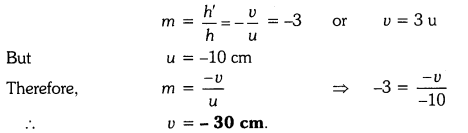
Thus the image is located at a distance of 30 cm from the mirror on the object side of the mirror.
📝 Page 176
Q1: A ray of light traveling in air enters obliquely into water. Does the light ray bend towards the normal or away from the normal? Why?
Answer:
The light ray bends towards the normal when it enters water from air. This is because water is optically denser than air, and when light enters a denser medium, its speed decreases and it bends towards the normal.
Q2: Light enters from air to glass having refractive index 1.50. What is the speed of light in the glass? (Speed of light in vacuum = 3 × 10⁸ m/s)
Answer:
Q3: Find out, from Table 10.3, the medium having highest optical density. Also, find the medium with lowest optical density.
Answer:
From Table 10.3:
Medium with highest optical density: Diamond (Refractive Index = 2.42)
Medium with lowest optical density: Air (Refractive Index ≈ 1.0003)
Q4: You are given kerosene, water, and turpentine. In which of these does the light travel fastest?
Answer:
Light travels fastest in the medium with lowest refractive index.
From the table:
Water: 1.33
Kerosene: 1.44
Turpentine: 1.47
Therefore, light travels fastest in water.
Q5: The refractive index of diamond is 2.42. What is the meaning of this statement?
Answer:
This means that the speed of light in vacuum is 2.42 times the speed of light in diamond.
📝 Page 184
Q1: Define 1 dioptre of power of a lens.
Answer:
1 dioptre is the power of a lens whose focal length is 1 metre.
Q2: A convex lens forms a real and inverted image of a needle at a distance of 50 cm from it. Where is the needle placed in front of the convex lens if the image is equal in size to the object? Also, find the power of the lens.
Answer: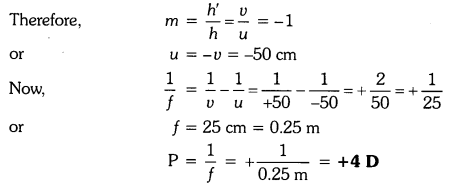
Q3: Find the power of a concave lens of focal length 2 m.
Answer:
Given
f = -2 m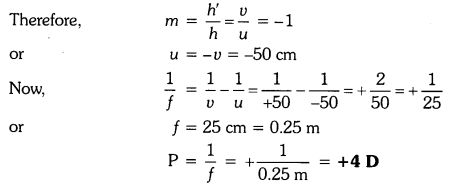
Q1: Which one of the following materials cannot be used to make a lens?
(a) Water
(b) Glass
(c) Plastic
(d) Clay
Answer: (d) Clay
Clay is opaque and does not allow light to pass through, so it cannot be used to make lenses.
Q2: The image formed by a concave mirror is observed to be virtual, erect and larger than the object. Where should be the position of the object?
(a) Between F and C
(b) At C
(c) Beyond C
(d) Between P and F
Answer: (d) Between the pole (P) and the principal focus (F).
Q3: Where should an object be placed in front of a convex lens to get a real image of the same size as the object?
(a) At the principal focus
(b) At 2F
(c) At infinity
(d) Between O and F
Answer: (b) At twice the focal length (2F)
Q4: A spherical mirror and a thin spherical lens have each a focal length of –15 cm. The mirror and the lens are likely to be
(a) Both concave
(b) Both convex
(c) Mirror is concave and lens is convex (d) Mirror is convex, lens is concave
Answer: (a) Both concave
Q5: No matter how far you stand from a mirror, your image appears erect. The mirror is likely to be
(a) Only plane
(b) Only concave
(c) Only convex
(d) Either plane or convex
Answer: (d) Either plane or convex
Q6: Which of the following lenses would you prefer to use while reading small letters found in a dictionary?
(a) Convex lens of focal length 50 cm
(b) Concave lens of focal length 50 cm
(c) Convex lens of focal length 5 cm
(d) Concave lens of focal length 5 cm
Answer: (c) A convex lens of focal length 5 cm (more magnifying power)
Q7: We wish to obtain an erect image using a concave mirror of focal length 15 cm. What should be the range of object distance?
Answer: The object should be placed between the pole and the focus (i.e., distance < 15 cm).
The image will be virtual, erect, and magnified. A ray diagram shows the image behind the mirror.
Q8: Name the type of mirror used in the following situations with reasons.
- (a) Headlights of a car – Concave mirror: To focus light into a beam.
- (b) Rear-view mirror – Convex mirror: Wider field of view.
- (c) Solar furnace – Concave mirror: To converge sunlight at a focal point.
Q9: If one half of a convex lens is blackened, will it form a complete image?
Answer: Yes, it will form the complete image, but with reduced brightness.
Q10: An object 5 cm high is placed 25 cm from a converging lens of focal length 10 cm. Find position, size, and nature of image.
Answer: Here : Object distance, u= -25 cm,
Object height, h = 5 cm,
Focal length, f = +10 cm
According to the lens formula,
According to the lens formula,
1⁄f = 1⁄v − 1⁄u
We have:
⇒ 1⁄v = 1⁄f − 1⁄u = 1⁄10 − 1⁄25 = 15⁄250
⇒ v = 250⁄15 = 16.66 cm
The positive value of v shows that the image is formed at the other side of the lens.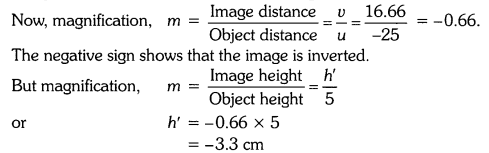
The negative value of image height indicates that the image formed is inverted.
The position, size, and nature of image are shown alongside in the ray diagram.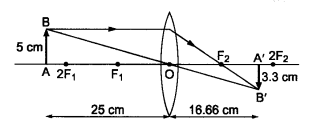
Image is at 16.67 cm, real, inverted, and smaller.
Q11: A concave lens forms an image 10 cm away from it. Focal length is –15 cm. Find object distance.
Answer:
Focal length, f = -15 cm, Image distance, ν = -10 cm (as concave lens forms the image on the same side of the lens)
From the lens formula 1/f=1/ν−1/u , we have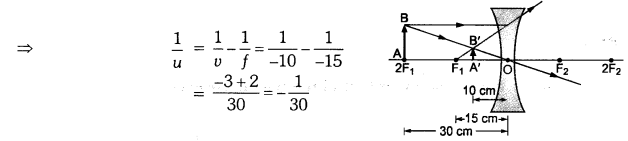
Object distance, u = -30 cm
The negative value of u indicates that the object is placed in front of the lens.
Q12: An object is placed 10 cm from a convex mirror of focal length 15 cm. Find image position and nature.
Answer: Object distance, u = -10 cm, Focal length, f = +15 cm, Image distance, ν = ?
Thus, image distance, ν = + 6 cm
Because ν is +ve, so a virtual image is formed at a distance of 6 cm behind the mirror.
Magnification, m=−υ/u=−6/−30=1/5 (i.e. < 1)
The positive value of m shows that image erect and its value, which is less than 1, shows that image is smaller than the object. Thus, image is virtual, erect and diminished.
Q13: What does magnification +1 by a plane mirror mean?
Answer: The image is same size as object, virtual and erect.
Q14: An object 5 cm long is 20 cm in front of a convex mirror (R = 30 cm). Find image position and size.
Answer: Since object size, h = +5 cm,
object distance, u = -20 cm
and radius of curvature, R = +30 cm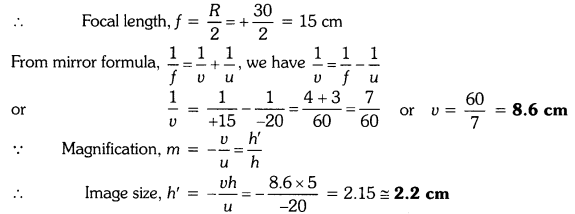
A virtual, erect image of height 2.2 cm is formed behind the mirror at a distance of 8.6 cm from the mirror
Q15: Object of size 7 cm is placed 27 cm in front of concave mirror of focal length 18 cm. Find image position and size.
Answer: Here, object size, h = +7.0 cm,
object distance, u = -27 cm
and focal length, f = -18 cm
Image distance, ν = ?
and image size, h’ = ?
From the mirror formula, 1/f=1/ν−1/u, we have
The screen should be placed at a distance of 54 cm on the object side of the mirror to obtain a sharp image.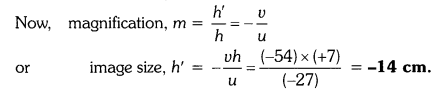
The image is real, inverted and enlarged in size.
Q16: Find the focal length of a lens with power –2 D. What type of lens is this?
Answer: Here, P = -2.0 D
The type of lens is concave because the focal length is negative.
Q17: A doctor prescribes a lens of +1.5 D. Find focal length and lens type.
Answer:
Here, P = +1.5 D
Because the focal length is positive, the prescribed lens is converging.