Exercise 7.1 Solutions
Expand each of the expressions in Exercises 1 to 5.
Q1. (1 – 2x)5
Solution: From binomial theorem expansion, we can write as
(1 – 2x)5 = 5Co (1)5 – 5C1 (1)4 (2x) + 5C2 (1)3 (2x)2 – 5C3 (1)2 (2x)3 + 5C4 (1)1 (2x)4 – 5C5 (2x)5
= 1 – 5 (2x) + 10 (4x)2 – 10 (8x3) + 5 ( 16 x4) – (32 x5)
= 1 – 10x + 40x2 – 80x3 + 80x4– 32x5
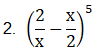
Solution: From the binomial theorem, the given equation can be expanded as

Q3. (2x – 3)6
Solution: From the binomial theorem, the given equation can be expanded as


Solution: From the binomial theorem, the given equation can be expanded as
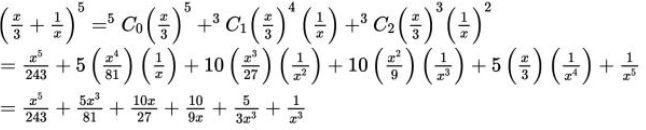
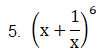
Solution: From the binomial theorem, the given equation can be expanded as
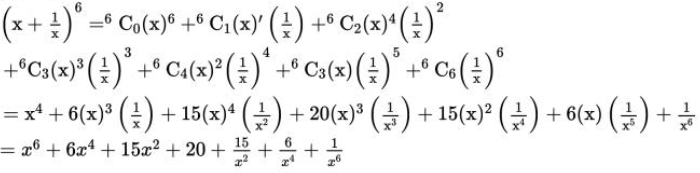
Q6. Using the binomial theorem, find (96)3.
Solution:
Given (96)3
96 can be expressed as the sum or difference of two numbers, and then the binomial theorem can be applied.
The given question can be written as 96 = 100 – 4
(96)3 = (100 – 4)3
= 3C0 (100)3 – 3C1 (100)2 (4) – 3C2 (100) (4)2– 3C3 (4)3
= (100)3 – 3 (100)2 (4) + 3 (100) (4)2 – (4)3
= 1000000 – 120000 + 4800 – 64
= 884736
Q7. Using the binomial theorem, find (102)5.
Solution:
Given (102)5
102 can be expressed as the sum or difference of two numbers, and then the binomial theorem can be applied.
The given question can be written as 102 = 100 + 2
(102)5 = (100 + 2)5
= 5C0 (100)5 + 5C1 (100)4 (2) + 5C2 (100)3 (2)2 + 5C3 (100)2 (2)3 + 5C4 (100) (2)4 + 5C5 (2)5
= (100)5 + 5 (100)4 (2) + 10 (100)3 (2)2 + 5 (100) (2)3 + 5 (100) (2)4 + (2)5
= 1000000000 + 1000000000 + 40000000 + 80000 + 8000 + 32
= 11040808032
Q8. Using the binomial theorem, find (101)4.
Solution:
Given (101)4
101 can be expressed as the sum or difference of two numbers, and then the binomial theorem can be applied.
The given question can be written as 101 = 100 + 1
(101)4 = (100 + 1)4
= 4C0 (100)4 + 4C1 (100)3 (1) + 4C2 (100)2 (1)2 + 4C3 (100) (1)3 + 4C4 (1)4
= (100)4 + 4 (100)3 + 6 (100)2 + 4 (100) + (1)4
= 100000000 + 4000000 + 60000 + 400 + 1
= 104060401
Q9. Using the binomial theorem, find (99)5m.
Solution:
Given (99)5
99 can be written as the sum or difference of two numbers then the binomial theorem can be applied.
The given question can be written as 99 = 100 -1
(99)5 = (100 – 1)5
= 5C0 (100)5 – 5C1 (100)4 (1) + 5C2 (100)3 (1)2 – 5C3 (100)2 (1)3 + 5C4 (100) (1)4 – 5C5 (1)5
= (100)5 – 5 (100)4 + 10 (100)3 – 10 (100)2 + 5 (100) – 1
= 1000000000 – 5000000000 + 10000000 – 100000 + 500 – 1
= 9509900499
10. Using Binomial Theorem, indicate which number is larger (1.1)10000 or 1000.
Solution: By splitting the given 1.1 and then applying the binomial theorem, the first few terms of (1.1)10000 can be obtained as
(1.1)10000 = (1 + 0.1)10000
= (1 + 0.1)10000 C1 (1.1) + other positive terms
= 1 + 10000 × 1.1 + other positive terms
= 1 + 11000 + other positive terms
> 1000
(1.1)10000 > 1000
Q11. Find (a + b)4 – (a – b)4. Hence, evaluate

Solution: Using the binomial theorem, the expression (a + b)4 and (a – b)4 can be expanded
(a + b)4 = 4C0 a4 + 4C1 a3 b + 4C2 a2 b2 + 4C3 a b3 + 4C4 b4
(a – b)4 = 4C0 a4 – 4C1 a3 b + 4C2 a2 b2 – 4C3 a b3 + 4C4 b4
Now (a + b)4 – (a – b)4 = 4C0 a4 + 4C1 a3 b + 4C2 a2 b2 + 4C3 a b3 + 4C4 b4 – [4C0 a4 – 4C1 a3 b + 4C2 a2 b2 – 4C3 a b3 + 4C4 b4]
= 2 (4C1 a3 b + 4C3 a b3)
= 2 (4a3 b + 4ab3)
= 8ab (a2 + b2)
Now by substituting a = √3 and b = √2, we get
(√3 + √2)4 – (√3 – √2)4 = 8 (√3) (√2) {(√3)2 + (√2)2}
= 8 (√6) (3 + 2)
= 40 √6
Q12. Find (x + 1)6 + (x – 1)6. Hence or otherwise evaluate
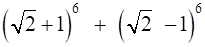
Solution: Using binomial theorem, the expressions (x + 1)6 and (x – 1)6 can be expressed as
(x + 1)6 = 6C0 x6 + 6C1 x5 + 6C2 x4 + 6C3 x3 + 6C4 x2 + 6C5 x + 6C6
(x – 1)6 = 6C0 x6 – 6C1 x5 + 6C2 x4 – 6C3 x3 + 6C4 x2 – 6C5 x + 6C6
Now, (x + 1)6 – (x – 1)6 = 6C0 x6 + 6C1 x5 + 6C2 x4 + 6C3 x3 + 6C4 x2 + 6C5 x + 6C6 – [6C0 x6 – 6C1 x5 + 6C2 x4 – 6C3 x3 + 6C4 x2 – 6C5 x + 6C6]
= 2 [6C0 x6 + 6C2 x4 + 6C4 x2 + 6C6]
= 2 [x6 + 15x4 + 15x2 + 1]
Now by substituting x = √2, we get
(√2 + 1)6 – (√2 – 1)6 = 2 [(√2)6 + 15(√2)4 + 15(√2)2 + 1]
= 2 (8 + 15 × 4 + 15 × 2 + 1)
= 2 (8 + 60 + 30 + 1)
= 2 (99)
= 198
Q13. Show that 9n+1 – 8n – 9 is divisible by 64 whenever n is a positive integer.
Solution: In order to show that 9n+1 – 8n – 9 is divisible by 64, it has to be shown that 9n+1 – 8n – 9 = 64 k, where k is some natural number.
Using the binomial theorem,
(1 + a)m = mC0 + mC1 a + mC2 a2 + …. + m C m am
For a = 8 and m = n + 1 we get
(1 + 8)n+1 = n+1C0 + n+1C1 (8) + n+1C2 (8)2 + …. + n+1 C n+1 (8)n+1
9n+1 = 1 + (n + 1) 8 + 82 [n+1C2 + n+1C3 (8) + …. + n+1 C n+1 (8)n-1]
9n+1 = 9 + 8n + 64 [n+1C2 + n+1C3 (8) + …. + n+1 C n+1 (8)n-1]
9n+1 – 8n – 9 = 64 k
Where k = [n+1C2 + n+1C3 (8) + …. + n+1 C n+1 (8)n-1] is a natural number
Thus, 9n+1 – 8n – 9 is divisible by 64 whenever n is a positive integer.
Hence proved.
Q14. Prove that
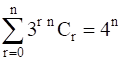
Solution: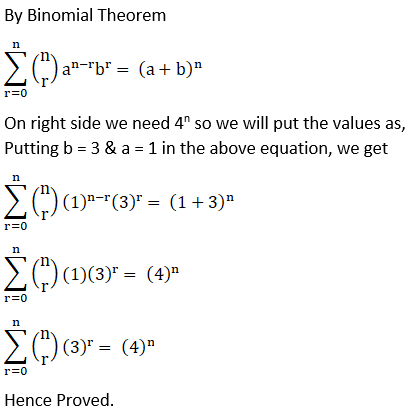
Miscellaneous Exercise Solutions
Q1. If a and b are distinct integers, prove that a – b is a factor of an – bn, whenever n is a positive integer. [Hint write an = (a – b + b)n and expand]
Solution: In order to prove that (a – b) is a factor of (an – bn), it has to be proved that
an – bn = k (a – b) where k is some natural number.
a can be written as a = a – b + b
an = (a – b + b)n = [(a – b) + b]n
= nC0 (a – b)n + nC1 (a – b)n-1 b + …… + n C n bn
an – bn = (a – b) [(a –b)n-1 + nC1 (a – b)n-1 b + …… + n C n bn]
an – bn = (a – b) k
Where k = [(a –b)n-1 + nC1 (a – b)n-1 b + …… + n C n bn] is a natural number
This shows that (a – b) is a factor of (an – bn), where n is a positive integer.
Q2. Evaluate

Solution: Using the binomial theorem, the expression (a + b)6 and (a – b)6 can be expanded
(a + b)6 = 6C0 a6 + 6C1 a5 b + 6C2 a4 b2 + 6C3 a3 b3 + 6C4 a2 b4 + 6C5 a b5 + 6C6 b6
(a – b)6 = 6C0 a6 – 6C1 a5 b + 6C2 a4 b2 – 6C3 a3 b3 + 6C4 a2 b4 – 6C5 a b5 + 6C6 b6
Now (a + b)6 – (a – b)6 =6C0 a6 + 6C1 a5 b + 6C2 a4 b2 + 6C3 a3 b3 + 6C4 a2 b4 + 6C5 a b5 + 6C6 b6 – [6C0 a6 – 6C1 a5 b + 6C2 a4 b2 – 6C3 a3 b3 + 6C4 a2 b4 – 6C5 a b5 + 6C6 b6]
Now by substituting a = √3 and b = √2, we get
(√3 + √2)6 – (√3 – √2)6 = 2 [6 (√3)5 (√2) + 20 (√3)3 (√2)3 + 6 (√3) (√2)5]
= 2 [54(√6) + 120 (√6) + 24 √6]
= 2 (√6) (198)
= 396 √6
Q3. Find the value of

Solution:
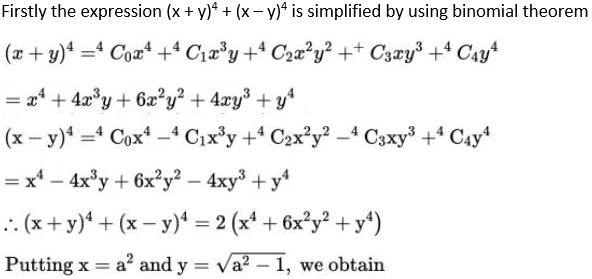
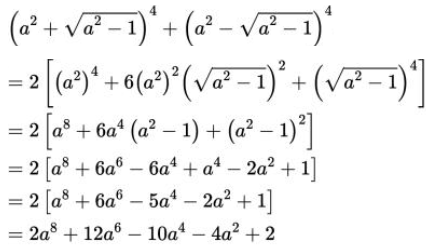
Q4. Find an approximation of (0.99)5 using the first three terms of its expansion.
Solution: 0.99 can be written as
0.99 = 1 – 0.01
Now by applying the binomial theorem, we get
(o. 99)5 = (1 – 0.01)5
= 5C0 (1)5 – 5C1 (1)4 (0.01) + 5C2 (1)3 (0.01)2
= 1 – 5 (0.01) + 10 (0.01)2
= 1 – 0.05 + 0.001
= 0.951
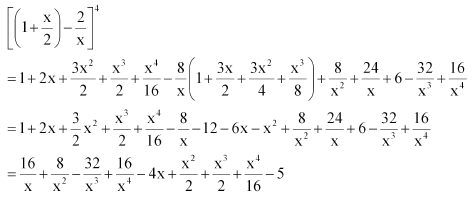
Q6. Expand using the Binomial Theorem
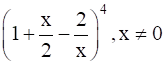
Solution: Using the binomial theorem, the given expression can be expanded as
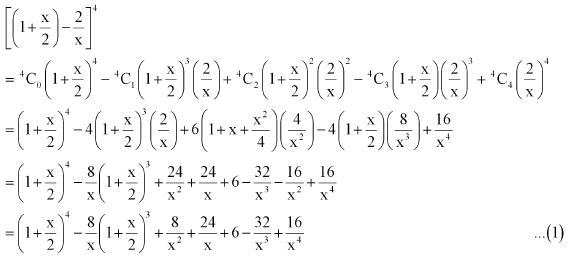
Again by using the binomial theorem to expand the above terms, we get
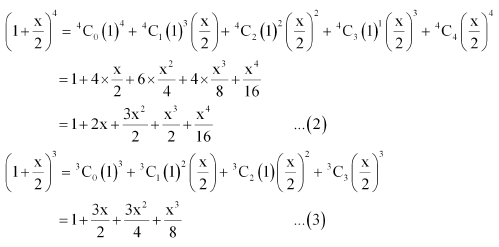
From equations 1, 2 and 3, we get